

CNC Horizontal Machining Center for Large Housings
A CNC Horizontal Machining Center for large housings is used when a part is too heavy, too bulky, or too complex for efficient single-side machining. Large housings, valve bodies, industrial enclosures, and powertrain components often need milling, drilling, tapping, boring, and face machining across several sides. If those operations require repeated re-clamping, the shop can lose time and risk accumulated positioning error.
That is why a horizontal machining center is often selected for heavy-duty precision manufacturing. It allows the workpiece to be machined from multiple sides in a more controlled setup, while supporting better chip evacuation and more stable processing of box-type or housing-type components.
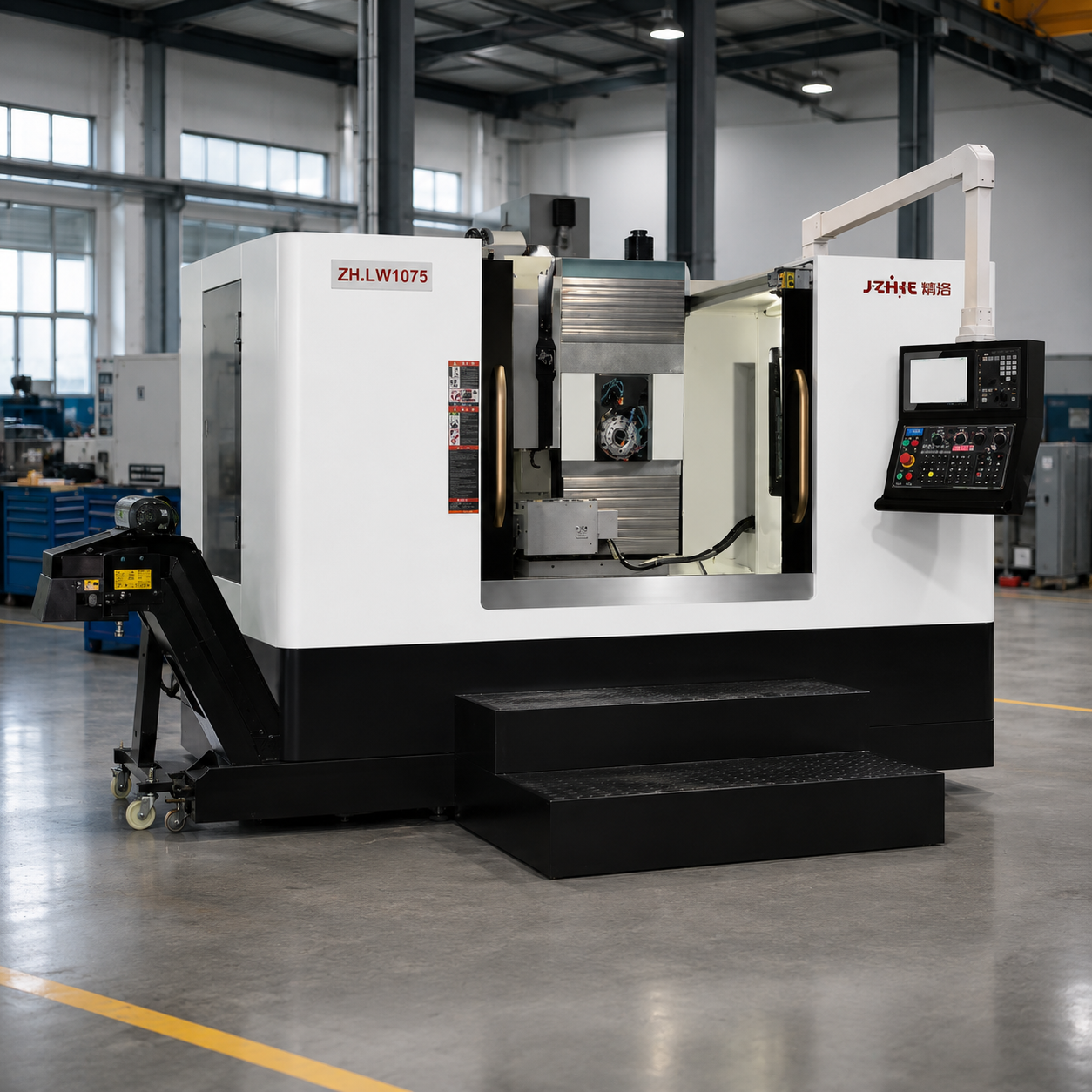
The linked Zhihe CNC product page describes this machine as a High-Rigidity Horizontal Machining Solution. It uses a fixed-column integral structure with a cross-slide table layout, an extra-large monolithic machine base, and a wide-span A-shaped column structure to improve vibration resistance, load-bearing capacity, rigidity, thermal stability, and dimensional consistency during long production cycles.
Product Overview
In industrial production, large housings often require machining across multiple faces while keeping hole position, flatness, and interface accuracy under control. A horizontal machine layout is useful because it can support multi-face processing more efficiently than a repeated single-side setup.
The product page highlights a precision CNC rotary table with arbitrary angle positioning. This is important for buyers because rotary-table capability can reduce the need for repeated manual repositioning. The same page also describes single-setup multi-face composite machining capability, which is a major reason buyers compare horizontal machining centers for housings, valve components, and automotive parts.
For a buyer, this means the machine should not be judged only by its outer enclosure or machine size. The real decision depends on structure, rotary-table performance, fixture strategy, chip control, thermal stability, and whether the supplier can match the machine to the actual workpiece.
Key Capabilities
Heavy-duty structural support
The machine adopts a fixed-column integral structure and cross-slide table design. This layout is intended to support stable precision movement and dynamic stability during machining. The product page also notes that the extra-large monolithic base enhances vibration resistance and load-bearing capacity, making the machine suitable for heavy-duty cutting and long-term high-precision machining.
For large housings, that matters. A weak structure may show up as poor surface finish, hole-position drift, unstable boring results, or extra inspection work after machining.
Multi-face machining in one setup
The integrated high-precision CNC rotary table supports multi-face and multi-process machining in a single setup. For housing parts, valve components, industrial enclosures, and disk or sleeve components, this can reduce repositioning work and help improve repeatability.
This is one of the biggest differences between a horizontal machining center and a simpler single-side machining process. The goal is not only to cut more surfaces. It is to keep related surfaces aligned through fewer manual operations.
Optional five-axis expansion
The product page also lists optional five-axis linkage expansion. This gives buyers room to discuss more complex part requirements if the work involves angled surfaces, compound geometry, or advanced multi-face machining needs.
Not every buyer needs this option. For many housing and valve applications, a strong horizontal platform with reliable rotary positioning may already be enough. The right choice should depend on part drawings, tolerance targets, and machining surfaces.
Fully enclosed safety protection
The machine includes a fully enclosed safety protection system. According to the product page, this helps contain chips and coolant while supporting operator safety and a cleaner production environment.
For heavy-duty machining, this is not cosmetic. Chip flow, coolant splash, and cleaning time can affect real production efficiency, especially during continuous shifts.
Product Data Buyers Should Notice
| Buyer Review Point | Product Page Information | Why It Matters |
|---|---|---|
| Machine structure | Fixed-column integral structure | Supports rigidity and stable machining |
| Table layout | Cross-slide table design | Helps maintain precision movement |
| Base design | Extra-large monolithic machine base | Improves vibration resistance and load-bearing capacity |
| Column structure | Wide-span A-shaped column | Enhances rigidity and thermal stability |
| Rotary table | Precision CNC rotary table | Supports multi-face machining |
| Angle control | Arbitrary angle positioning | Helps process multiple surfaces more flexibly |
| Expansion option | Optional five-axis linkage | Useful for more complex machining needs |
| Safety design | Fully enclosed protection system | Controls chips, coolant, and operator exposure |
| Operation design | Ergonomic control interface and maintenance access | Supports daily operation and service work |
The accessible product page mainly emphasizes structure, machine layout, rotary-table capability, application industries, and operator-friendly design. Buyers should still request the complete specification sheet before ordering, including axis travel, table size, table load, spindle power, spindle speed, controller, tool magazine, positioning accuracy, repeatability, coolant system, and optional configurations.
Manufacturing and Process Use
As a horizontal CNC machining platform, this machine is designed for automated and repeatable subtractive manufacturing. The usual process includes part loading, fixture positioning, program execution, milling, drilling, tapping, boring, chip removal, and inspection.
For large housings and box-type components, the horizontal layout can be useful because chips tend to fall away from the cutting zone more naturally than in some vertical setups. The rotary table also allows different faces of the part to be brought into position without moving the workpiece from one fixture to another.
This matters for parts such as:
- Medium and large-sized housings
- Valve components
- Industrial enclosures
- Disk and sleeve components
- Automotive powertrain parts
- Construction machinery components
- High-end molds
- Energy equipment parts
- General industrial machinery components
These application areas are specifically listed on the Zhihe CNC product page.
Application Scenarios
A CNC horizontal machining center for large housings is especially suitable when the buyer needs stable machining across several faces of a heavy or box-type part. Typical production needs include repeated hole patterns, machined flange surfaces, threaded ports, bearing bores, side faces, and mounting interfaces.
For valve components, the machine may be used to process ports, threaded holes, sealing surfaces, and multi-side features. For automotive powertrain parts, it may support housing surfaces, bore machining, and interface features that need consistent alignment. For energy equipment parts and construction machinery components, rigidity and long-term dimensional consistency become especially important.
The product page states that the machine is optimized for heavy cutting while maintaining surface finish quality and dimensional precision. Buyers should verify those claims through technical data, part-based review, and trial cutting where possible.
Quality Control and Buyer Decision Factors
When selecting a horizontal machining center, buyers should not stop at the machine category. The important questions are practical:
- What is the maximum workpiece size and weight?
- How many faces need machining?
- Are the features mainly milling, drilling, tapping, boring, or finishing?
- What tolerance must be held between faces?
- What rotary-table positioning accuracy is required?
- What fixture method will be used?
- Is optional five-axis expansion necessary?
- How will chips and coolant be managed?
- What inspection and trial-cutting process is available?
- What installation, training, and spare-parts support will the supplier provide?
Zhongshan Zhihe CNC Technology Co., Ltd. is described on the product page as a national high-tech CNC machine tool manufacturer specializing in R&D, production, sales, and customized machining solutions for industrial manufacturing applications. For buyers, that supplier capability matters because a horizontal machining center usually requires more than a simple equipment quote. It needs application matching.
Common Buying Mistakes
One common mistake is choosing a machine only by size. A large machine is not automatically the right machine. Buyers also need to consider rigidity, rotary-table function, fixture access, chip evacuation, and service support.
Another mistake is ignoring multi-face tolerance relationships. On large housings, the critical issue may not be one machined face. It may be the relationship between several faces, holes, and bores. This is where a rotary-table horizontal machining center can help, but only if the fixture and process are planned correctly.
A third mistake is overlooking maintenance access. The product page highlights ergonomic layout and accessible maintenance channels, which are useful because heavy-duty machining centers need regular cleaning, lubrication checks, coolant management, and service access.
Customization Guidance
If you are planning a project for large housings or similar components, provide:
- Workpiece drawings
- Material type
- Maximum dimensions
- Workpiece weight
- Machining faces
- Hole and bore requirements
- Tolerance targets
- Surface finish requirements
- Fixture concept
- Expected daily or monthly output
- Current machining problems
- Delivery destination
- Installation and service expectations
This information helps the supplier judge whether a horizontal machining center is the right machine type, whether optional five-axis linkage should be considered, and what fixture or process support may be needed.
For buyers comparing several machines, the main question should be this: can the machine finish the required faces in fewer setups while maintaining dimensional consistency and production rhythm?
Contact for Quotation
To request a quotation or machine recommendation, contact Zhongshan Zhihe CNC Technology Co., Ltd. with your workpiece drawing and process requirements. The product page lists the company phone / WhatsApp as +86 13620089178 and email as zhcnclathe@gmail.com.
A horizontal machining center should be selected around the part, not the catalogue title. For large housings, valve components, automotive powertrain parts, and heavy-duty industrial components, the linked Zhihe CNC machine is worth evaluating when the project requires fixed-column rigidity, rotary-table multi-face machining, enclosed protection, and long-term precision production.