

CNC Horizontal Machining Center for Large Housings
A CNC horizontal machining center for large housings is selected when a shop needs stable, repeatable machining for oversized shell-type parts that require milling, drilling, tapping, boring, and multi-face processing. For buyers handling large housings, valve bodies, industrial enclosures, disk and sleeve components, or automotive powertrain parts, the main challenge is not only cutting speed. Fixture stability, chip evacuation, rotary positioning, and dimensional consistency across batches often decide whether production runs smoothly.
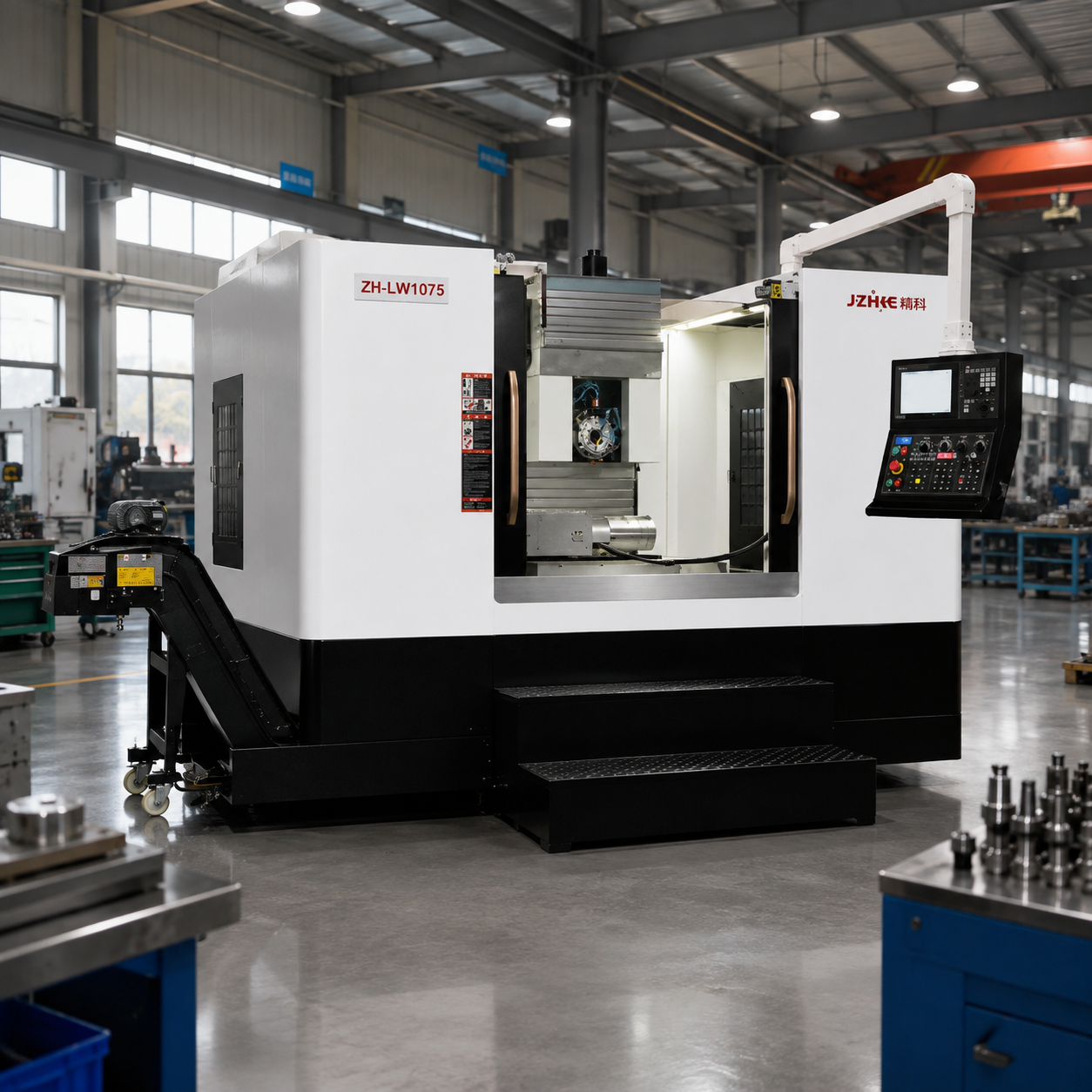
The linked Zhihe CNC product page presents this machine as a High-Rigidity Horizontal Machining Solution. It adopts a fixed-column integral structure combined with a cross-slide table layout, and uses an extra-large monolithic machine base to improve vibration resistance and load-bearing capacity during heavy-duty cutting and long-term precision machining.
 Product Overview
Large housing parts usually require machining on several faces. One side may need a milled mounting surface, another side may need threaded holes, and a third side may require boring or interface machining. If each face is processed through repeated manual re-clamping, the factory can lose time and introduce positioning errors between operations.
A horizontal machining center helps solve that issue by supporting more efficient multi-face processing. The product page highlights a precision CNC rotary table with arbitrary angle positioning, which enables single-setup multi-face composite machining and helps reduce repositioning errors.
For buyers, this means the machine should not be evaluated only by its machine size or appearance. The real question is whether the structure, rotary-table capability, fixture layout, chip control, and service support match the actual workpiece.
What the Machine Is Used For
This machine is designed for heavy-duty precision manufacturing where stable multi-side machining is required. It is suitable for plants processing medium and large-sized housings, valve components, industrial enclosures, disk and sleeve parts, automotive powertrain parts, construction machinery components, high-end molds, energy equipment parts, and general industrial machinery.
In many factories, this type of heavy duty HMC is used when a part cannot be completed efficiently on a single-side machine. The rotary table helps bring different machining faces into position, while the horizontal structure supports chip flow and process stability during long cutting cycles.
Key Product Features
High-rigidity fixed-column structure
The machine uses a fixed-column integral structure and cross-slide table design. This layout is intended to support motion precision and dynamic stability during machining. For large housings and valve parts, that matters because vibration or structural weakness can affect bore accuracy, sealing surfaces, hole position, and finish quality.
Extra-large monolithic base
The product page notes that the extra-large monolithic machine base improves vibration resistance and load-bearing capacity. For heavy workpieces, this is an important structural detail. A stronger base helps the machine maintain more stable cutting behavior during rough machining, interrupted cutting, and long-cycle production.
Wide-span A-shaped column
The machine is reinforced with a wide-span A-shaped column structure, which is designed to improve rigidity and thermal stability while reducing deformation during intensive machining. For buyers, this supports more reliable dimensional consistency during extended production cycles.
CNC rotary table for multi-face machining
The integrated high-precision CNC rotary table supports arbitrary angle positioning. This feature is useful when a housing, valve body, or enclosure requires machining on several faces while maintaining geometric relationships between surfaces, holes, ports, and mounting features.
Optional five-axis linkage expansion
The product page also lists optional five-axis linkage expansion. Not every buyer needs this option, but it is worth discussing when the part includes angled surfaces, compound geometry, or more complex machining requirements beyond standard indexed multi-face processing.
Fully enclosed protection system
The machine includes a fully enclosed safety protection system for chip and coolant containment. This helps improve operator safety and keeps the production environment cleaner, especially during heavy cutting or long unattended cycles.
Product Information Buyers Should Notice
| Review Point | Product Page Information | Buyer Meaning |
|---|---|---|
| Machine structure | Fixed-column integral structure | Supports rigidity and stable machining |
| Table layout | Cross-slide table design | Helps maintain precision movement |
| Base design | Extra-large monolithic machine base | Improves vibration resistance and load-bearing capacity |
| Column structure | Wide-span A-shaped column | Improves rigidity and thermal stability |
| Rotary table | Precision CNC rotary table | Supports multi-face machining |
| Positioning function | Arbitrary angle positioning | Reduces repeated manual repositioning |
| Machining capability | Single-setup multi-face composite machining | Helps reduce setup error and improve productivity |
| Expansion option | Optional five-axis linkage | Useful for more complex machining needs |
| Protection | Fully enclosed safety protection system | Controls chips, coolant, and operator exposure |
| Operation design | Ergonomic control interface and maintenance access | Supports daily operation and service work |
The public product page emphasizes structure, rotary-table capability, enclosed protection, application industries, and manufacturer capability. Buyers should still request the complete specification sheet before ordering, including axis travel, table size, table load, spindle power, spindle speed, controller, tool magazine, positioning accuracy, repeatability, coolant system, and optional configurations.
Materials and Surface Finish Considerations
A CNC horizontal machine in this category is usually evaluated for heavy metal parts such as cast housings, valve components, industrial enclosures, automotive powertrain parts, and energy equipment parts. The final surface quality depends on machine rigidity, tool selection, fixture stiffness, cutting parameters, coolant delivery, chip removal, and inspection control.
For valve components, threaded ports and sealing surfaces may be more important than simple drilling speed. For large housings, bore alignment, face relationship, and repeated hole position may become the main quality-control points. That is why buyers should review the machine around the part drawing, not only around the machine name.
Manufacturing Process and Machine Role
In production, a horizontal machining center is typically used after casting, forging, welding, or rough preparation. Operators load the workpiece into a fixture, confirm the program, and complete milling, drilling, tapping, boring, and finishing operations in a more controlled CNC process.
The product page states that the machine is optimized for heavy cutting while maintaining surface finish quality and dimensional precision. It also notes that the ergonomic layout and accessible maintenance channels help improve operational efficiency and reduce maintenance downtime.
Typical Application Scenarios
This machine is suitable for manufacturers that need stable multi-face machining rather than simple single-side hole-making.
Typical applications include:
- Large cast housings
- Valve bodies and valve components
- Gearbox housings
- Pump housings
- Industrial enclosures
- Disk and sleeve components
- Automotive powertrain parts
- Construction machinery parts
- Energy equipment components
- High-end mold components
- General industrial machinery parts
For a horizontal machining center for valve components, buyers should focus on rotary positioning, fixture access, port machining, threaded holes, sealing surfaces, and chip evacuation. For a CNC horizontal machining center for large housings, the main concerns are workpiece envelope, load capacity, multi-face accuracy, and long-cycle stability.
Quality Control and Buyer Decision Factors
Before choosing a machine in this class, buyers should confirm the details that affect real production, not only the catalogue description. Important questions include:
- What is the maximum workpiece size and weight?
- How many faces must be machined?
- Are the main operations milling, drilling, tapping, boring, or finishing?
- What tolerance must be held between faces?
- What rotary-table positioning accuracy is required?
- What fixture method will be used?
- Is optional five-axis linkage needed?
- How will chips and coolant be managed?
- What inspection process is available?
- What installation, training, and spare-parts support can the supplier provide?
Zhongshan Zhihe CNC Technology Co., Ltd. is described on the product page as a national high-tech CNC machine tool manufacturer specializing in R&D, production, sales, and customized machining solutions for industrial manufacturing applications. For buyers, this matters because a horizontal machining center project usually requires application matching, fixture discussion, and process review before final selection.
Customization and Procurement Guidance
Customization should start from the workpiece. Before requesting a quotation, buyers should prepare part drawings, material type, maximum dimensions, workpiece weight, machining faces, bore and hole requirements, tolerance targets, surface finish needs, fixture concept, and expected output.
The right question is not simply “Which HMC is larger?” A better question is: “Which horizontal machining center can complete the required faces in fewer setups while keeping dimensional consistency and stable cycle time?”
For many large housing projects, the answer depends on the machine structure, rotary table, fixturing method, chip evacuation, spindle configuration, and the supplier’s ability to support practical process planning.
Request a Recommendation
If you are comparing a CNC horizontal machining center for large housings or need a heavy duty HMC for valve components, industrial enclosures, automotive powertrain parts, construction machinery parts, or energy equipment parts, start with your workpiece drawing. Share the material, dimensions, weight, machining surfaces, tolerance requirements, and target output.
The product page lists Zhongshan Zhihe CNC’s phone / WhatsApp / WeChat as +86 13620089178 and email as zhcnclathe@gmail.com. A practical machine recommendation should explain how the fixed-column structure, rotary-table machining, enclosed protection, fixture plan, and service support fit the actual production task.