

-Axis Trunnion Machining Center for Shops That Need Fewer Setups
A 5-axis trunnion machining center is usually chosen for one practical reason: complex parts are becoming too difficult to machine efficiently through repeated clamping. When a workpiece needs multi-side milling, angled hole machining, contour finishing, deep pocket access, or continuous curved-surface cutting, every extra setup can add time, fixture cost, inspection pressure, and positioning risk.
That is where a trunnion-type five-axis platform becomes useful. Instead of moving the workpiece from fixture to fixture, the machine can tilt and rotate the part so the tool reaches more surfaces in one controlled process. For mold shops, aerospace suppliers, automotive part makers, optical component manufacturers, medical device suppliers, and precision metal manufacturers, this can be the difference between a stable process and a shop-floor bottleneck.
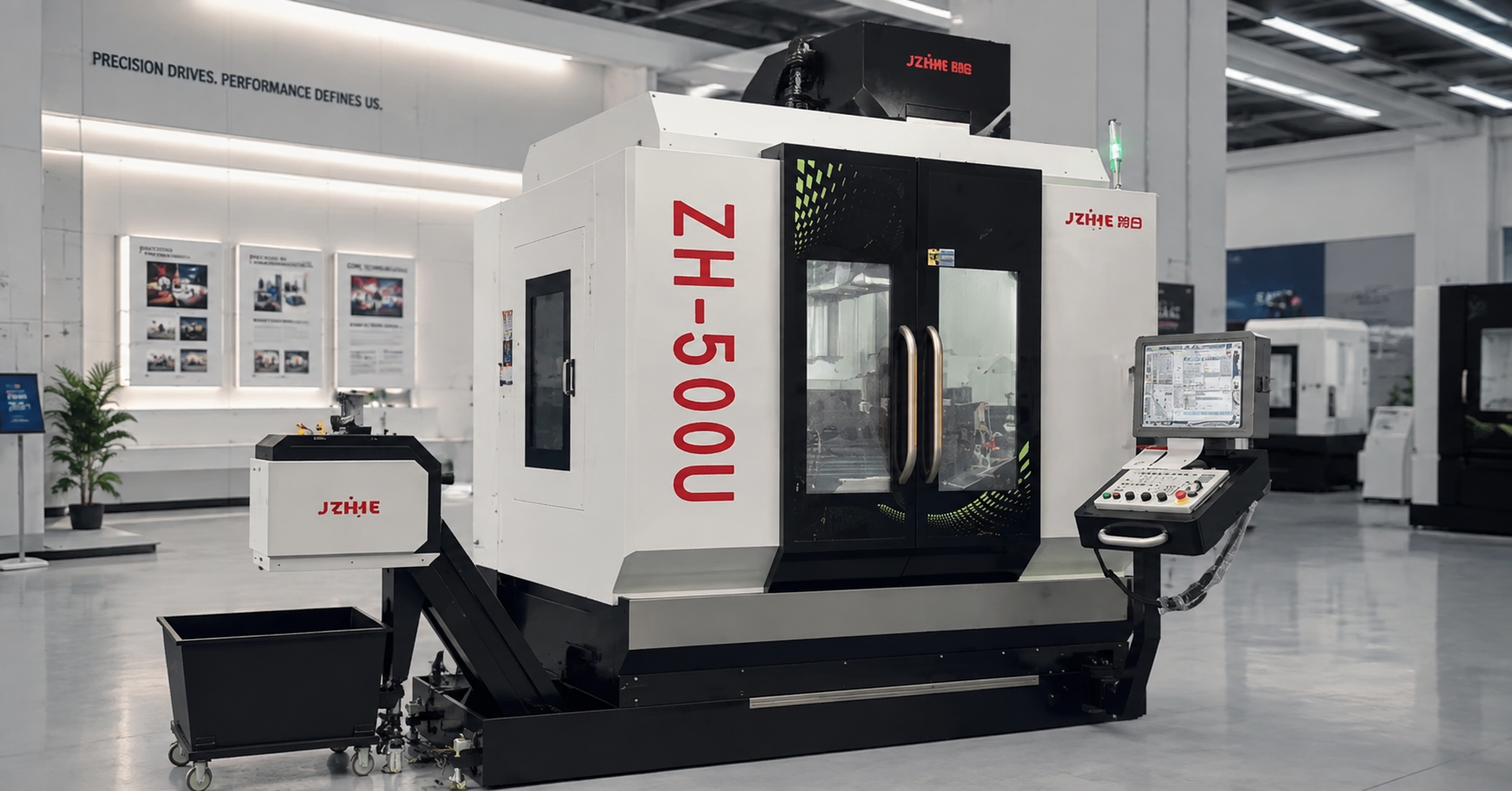
The linked Zhihe CNC product page presents the ZH-500U 5-Axis Trunnion Machining Center as a machine for complex curved surfaces, precision molds, and high-value components. The page lists 750 / 880 / 600 mm X/Y/Z travel, a Ø500 mm trunnion table, 300 kg table load, 20,000 rpm BBT40 built-in motor spindle, and a LYNUC CNC controller.
Product Overview
The ZH-500U is an enclosed five-axis CNC machining center built around a trunnion rotary table. It is designed for workpieces that would be inefficient or risky to complete on a conventional three-axis machining center because of repeated turnover clamping or difficult tool access.
The machine uses a trunnion table with A-axis ±110° and C-axis 360° motion. The product page specifies a DDR direct-drive rotary table, with A/C-axis positioning accuracy of ±6 arcsec and repeatability of ±3 arcsec. For buyers machining impellers, cavity filters, mold inserts, turbo housings, medical components, or optical parts, this rotary-axis accuracy is one of the key points to review before purchase.
From a buyer’s perspective, the value is not only “five-axis motion.” The real value is reducing setup interruptions, improving access to angled and curved surfaces, and keeping more machining operations inside one controlled workflow.
Key Product Specifications
| Item | ZH-500U Product Data | Why It Matters |
|---|---|---|
| X/Y/Z travel | 750 / 880 / 600 mm | Supports complex small-to-medium precision parts |
| Worktable | Ø500 mm trunnion table | Suitable for compact high-value components |
| Max. workpiece capacity | 650 × 500 × 450 mm | Helps buyers compare with actual part drawings |
| Max. table load | 300 kg | Supports many aerospace, mold, and precision parts |
| A-axis / C-axis | A ±110° / C 360° | Enables multi-face and contour machining |
| Rotary drive | DDR direct drive | Supports high-precision rotary response |
| A/C positioning accuracy | ±6 arcsec | Important for complex contour accuracy |
| A/C repeatability | ±3 arcsec | Supports batch consistency |
| Spindle | BBT40 electric spindle | Suitable for precision milling and finishing |
| Spindle speed | 20,000 rpm | Useful for high-speed contour machining |
| Spindle motor power | 20 kW | Balances high speed with cutting rigidity |
| Tool magazine | 32-tool arm-type magazine | Supports multi-process machining |
| CNC controller | LYNUC 5-axis CNC system | Supports five-axis machining control |
The product page also lists Japan NSK C3-grade precision ball screws and Germany Rexroth 45 mm ball linear guideways for the three-axis drive system. These details matter because five-axis performance depends on more than the rotary table. Linear-axis stability, servo coordination, spindle behavior, and structural rigidity all affect the final machining result.
What This Machine Is For
In practical terms, a 5-axis CNC machining center for complex parts is selected when the part cannot be machined efficiently from one direction. The workpiece may include sloped faces, compound angles, deep cavities, blade profiles, thin walls, pocket features, or curved surfaces that must remain consistent from one area to the next.
The product page lists applicable materials including aluminum alloys, titanium alloys, stainless steel, superalloys, and engineering plastics. It also lists target industries such as aerospace, precision molds, automotive turbo housings, medical devices, and optics.
That application range tells buyers how the ZH-500U should be evaluated. It is not simply a general milling machine with more axes. It is a platform for complex contour work, single-setup machining, and high-mix, low-volume production where geometry and process control matter.
Visible Structural and Production Features
The machine shown is an enclosed floor-mounted CNC machining center with a wide base, front double doors, transparent viewing windows, and a side-mounted operator control station. This layout is useful in five-axis work because long cutting cycles, coolant flow, and chip evacuation need to stay controlled during operation.
The product page also lists a spiral-type chip conveyor with chip cart and a coolant system that includes an electrical cabinet heat exchanger, oil chiller, and two submersible high-pressure water pumps, with one pump dedicated to chip flushing. For deep cavities and complex surfaces, chip evacuation is not a small detail. Poor chip removal can shorten tool life, damage surfaces, and interrupt production.
Capabilities Buyers Usually Evaluate
Multi-face machining in one setup
The trunnion table allows the workpiece to tilt and rotate so the tool can reach multiple faces without repeated manual repositioning. This helps reduce cumulative error from turnover clamping and improves consistency between related surfaces.
Complex contour machining
The A-axis ±110° / C-axis 360° DDR direct-drive rotary table supports multi-axis contour work. Buyers producing impellers, precision molds, cavity parts, or optical components should pay close attention to rotary-axis accuracy and repeatability.
High-speed precision milling
The 20,000 rpm BBT40 electric spindle with 20 kW spindle motor power supports high-speed milling, fine finishing, and precision contour machining. This is especially useful where surface quality and cycle time need to be balanced.
Multi-tool process flexibility
The 32-tool arm-type BT40 tool magazine helps the machine support roughing, finishing, drilling, tapping, and contour operations in one programmed cycle. That can reduce manual tool preparation and shorten interruptions between machining steps.
Case Reference: 5G Communication Base Station Cavity Filter
The product page includes a case involving a 5G communication base station cavity filter made from 6061 aluminum alloy, with dimensions of Φ480 × 120 mm. The customer’s previous process required multiple turnover clamping, which caused cumulative positioning error of ±0.05 mm and failed the sidewall perpendicularity requirement of ≤0.02 mm to the base. Poor chip evacuation in deep cavities also caused tool chipping, with up to eight tool changes per piece, while curved surface roughness reached Ra3.2 and required secondary polishing.
The ZH-500U solution used the Ø500 mm trunnion rotary table for five-axis simultaneous machining in one clamping, combined with the 20,000 rpm BBT40 electric spindle, 20 kW motor, ±3 arcsec A/C-axis repeatability, and dual high-pressure water pumps for chip evacuation. Reported results included cumulative positioning error controlled within ±0.012 mm, tool-change frequency reduced to two times per piece, tool cost reduced by 60%, surface roughness improved to Ra0.8, cycle time reduced to 38 minutes, and yield improved from 82% to 96%.
For buyers, this case shows why five-axis machining is not only about moving faster. The improvement came from reducing turnover clamping, improving chip evacuation, stabilizing surface quality, and controlling the whole process more tightly.
Case Reference: Aerospace Engine Impeller
Another product-page case involves an aerospace engine impeller made from TC4 titanium alloy, with dimensions of Φ350 × 150 mm. The customer faced thin-wall blade deformation, obvious chatter, blade profile deviation above 0.03 mm, low five-axis linkage accuracy, poor consistency between adjacent blade profiles, and a batch yield rate of only 75%. Cycle time was about 120 minutes per piece.
The ZH-500U solution used the LYNUC five-axis system with look-ahead preprocessing, a DDR direct-drive rotary table, ±6 arcsec A/C-axis positioning accuracy, and servo configuration intended to improve dynamic response stability. Reported results included blade profile deviation controlled within ±0.01 mm, inter-blade consistency error within ±0.005 mm, cycle time reduced to 78 minutes, yield improved to 94%, and per-piece processing cost reduced by 28%.
This case is especially relevant for buyers producing impellers, blade-type components, turbine-related parts, or thin-wall curved surfaces where dynamic accuracy matters as much as rigidity.
Typical Application Scenarios
The ZH-500U is suitable for manufacturers and job shops that need one machine to handle complex part machining with fewer manual setups.
Typical application scenarios include:
- Aerospace structural components
- Aerospace impellers and blade-type parts
- Precision molds and dies
- Automotive turbo housings
- 5G communication cavity components
- Medical device components
- Optical parts
- Titanium alloy precision components
- Stainless steel complex components
- Engineering plastic precision parts
- High-mix, low-volume job-shop production
A 5-axis machining center for medical devices, for example, is often valued for reaching compact and difficult surfaces. In mold work, the value may come from smoother finishing paths, fewer repositioning steps, and better surface continuity.
Quality Control and Buyer Decision Factors
Five-axis machining performance should be verified, not assumed. The product page lists ±0.005 mm positioning accuracy and ±0.003 mm repeatability. It also lists inspection equipment including a laser interferometer, ballbar, and arc-second calibrator for checking X/Y/Z positioning accuracy, circularity, servo matching, and A/C-axis positioning and repeatability.
When comparing options, buyers should ask for:
- Confirmed axis configuration
- X/Y/Z travel
- Rotary-axis travel and accuracy
- Spindle speed and motor power
- Tool magazine capacity
- Controller system
- Workpiece size and table load
- Accuracy and repeatability verification
- Coolant and chip evacuation configuration
- Trial cutting support
- Installation and training plan
- Spare parts and warranty terms
If the part involves aluminum, titanium alloy, stainless steel, superalloys, mold materials, or engineering plastics, the supplier should review drawings, material data, tolerance targets, surface finish requirements, and expected output before recommending the final configuration.
Commercial and Service Support
The product page lists delivery time of approximately 45–60 working days after down payment and signed contract. It also lists standard export wooden case packaging with moisture-proof, shock-proof, and rust-proof treatment, sea or air freight options, on-site installation and commissioning by supplier engineers, free 2–3 days of on-site training, a 12-month warranty from final acceptance, and long-term genuine spare parts supply.
For overseas buyers, these details should be discussed early. A five-axis machining center is not a simple plug-in purchase. Foundation preparation, power supply, lifting assistance, commissioning, trial cutting, training, and spare parts planning all affect how quickly the machine enters real production.
Customization and Procurement Guidance
For a factory purchase, the best approach is to define the workpiece first. Buyers should prepare:
- Workpiece drawings
- Material
- Dimensions
- Weight
- Required tolerance
- Surface finish target
- Current machining process
- Current number of setups
- Current cycle time
- Tooling requirements
- Expected production volume
- Programming requirements
- Delivery destination
From there, the machine can be matched to the application instead of forcing the application to fit the machine. That is the difference between a machine that looks capable and one that actually pays back in daily production.
Request a Quotation
If you are evaluating a 5-axis trunnion machining center for complex part production, send part drawings, material details, part size, precision requirements, and expected output. A useful recommendation should explain how the spindle, trunnion rotary table, controller, tooling, coolant, chip removal, and service plan fit your actual workpiece.
The ZH-500U is worth evaluating when the buyer needs a five-axis platform with Ø500 mm DDR direct-drive trunnion table, A-axis ±110° / C-axis 360° motion, 20,000 rpm BBT40 electric spindle, 20 kW spindle motor, LYNUC five-axis control, and case data for 5G cavity filters and aerospace impellers.
For quotation or technical discussion, Zhongshan Zhihe CNC lists phone / WhatsApp / WeChat contact as +86 13620089178 and email as zhcnclathe@gmail.com.