CNC machine control cabinet cooling cannot be selected from an enclosure size or a room-temperature guess. Heat enters through drives, power supplies, transformers, contactor coils, braking resistors, filters, sunlight, adjacent equipment, and the production process. Air leaves through a fan, heat exchanger, air conditioner, or an unintended path that carries dust into sensitive electronics.
For a Zhihe CNC project, send the installation country, ambient conditions, machine configuration, duty cycle, cabinet layout, site altitude, contamination concerns, and maintenance constraints. Zhihe CNC can provide configuration-specific cabinet information for the selected machine. The buyer's qualified electrical and facility team remains responsible for the enclosure design, local rules, and installation.
Read the Cabinet as a Thermal Chain
Start with a chain rather than a component list: heat source, conduction path, internal air path, cabinet boundary, external heat sink, and room condition. A drive may be efficient, but its losses still have to leave the enclosure. A fan may be powerful, but it cannot cool reliably if the intake is blocked or recirculating hot air.
Draw the intended airflow and mark every obstacle. Cable ducts, terminal blocks, filters, power supplies, and shielding plates can create hot pockets or bypass paths. The goal is not to make the cabinet visually empty. It is to give each component the temperature and airflow condition required by its manufacturer.
Boundary the review before selecting a product. Does the cooling device cool the entire cabinet, only a sealed electronics section, or a specific drive? Is the external side exposed to shop air, a dirty process area, direct sun, or another enclosure? A CNC machine control cabinet cooling decision made without that boundary is only a guess.
Build a Seasonal Risk Map
Review the cabinet through the year, not only on the day of the site survey. Summer heat, winter condensation, monsoon humidity, dust season, night setbacks, weekend shutdowns, and maintenance openings can create different risks. A system that survives a comfortable spring trial may fail during a humid changeover or a hot afternoon.
| Condition to map | Why it matters | Information to collect | Responsible review |
|---|---|---|---|
| Hot production period | Reduces available temperature difference | Measured room temperature and duty | Facility and controls |
| Cold startup | May create condensation on cold surfaces | Ambient change and startup sequence | Maintenance and controls |
| Humid season | Raises dew-point risk | Room humidity and door-opening practice | Facility and production |
| Dust or oil mist | Blocks filters and coatings | Contamination source and cleaning access | Maintenance |
| Weekend setback | Changes internal and external temperatures | Shutdown and restart procedure | Operations |
| Direct sunlight | Adds an unlisted heat path | Cabinet location and shading | Facility |
This map is a way to ask better questions. The approved enclosure and cooling design should use applicable standards, manufacturer limits, and the site's actual conditions.
Identify Heat Loads by Operating Mode
A cabinet does not produce one constant heat load. During rapid acceleration, braking, spindle changes, axis reversals, or simultaneous auxiliary operation, drive losses can rise. During standby, some electronics remain warm while the machine produces little heat. During a short high-output cycle, thermal mass may delay the temperature response.
Request the selected drive and component data, then record which losses are simultaneous. Do not assume that adding every nameplate value gives a useful design load, and do not assume that an average gives a safe peak. A qualified designer should use the approved method and manufacturer information.
| Operating mode | Main heat contributors | Thermal question | Verification point |
|---|---|---|---|
| Powered standby | Controls, power supplies, heaters, dehumidification | What remains energized overnight? | Cabinet temperature trend |
| Normal cutting | Drives, spindle module, pumps, fans | What is representative simultaneous loss? | Loaded cycle test |
| Acceleration and braking | Drive and braking losses | How long does the peak last? | Drive data and observed rise |
| Tool change and auxiliaries | Solenoid banks, servos, hydraulics, fans | Which operations overlap? | Cycle trace |
| Maintenance opening | External air, dust, moisture, heat | What is the recovery procedure? | Work instruction |
Choose Airflow Direction Before Hardware
Air should move from a cleaner, cooler source toward a hotter exhaust path. The cabinet designer must decide whether filtered forced ventilation, closed-loop circulation, a heat exchanger, an air conditioner, or a combination is appropriate. That decision should follow contamination, ambient temperature, heat load, sealing requirement, and service access. CNC machine control cabinet cooling begins with this intended path, not with the last device used on another project.
Look for recirculation loops. A fan can draw air out of a cabinet and into the same hot corner if the exhaust and intake are too close. Adjacent machines, walls, or cable trays can make the installed condition different from the drawing. Leave enough separation for the cooling device to exchange heat.
Internal circulation also matters. A sealed cabinet with poor mixing can have a cool average temperature and a hot drive. Put temperature sensors where the responsible designer needs them, not only where wiring is easiest.
Understand Fan and Filter Tradeoffs
Filtered fan cooling is often simple to service, but it depends on a clean air supply and a maintainable filter. Differential pressure can rise quietly, airflow can fall, and the cabinet can overheat while the fan still turns. A pressure switch or a maintenance indicator may be useful where the risk justifies it.
The filter protects electronics from particles, but the filter itself becomes a service item. If access requires opening a live enclosure, production interruption, or a difficult reach, maintenance may be delayed. Design the service path before approving the device.
Audit air may also be an option when a clean, dry, and reliable supply exists. It is not automatically cheaper or safer. The air system must remain available during outages and must meet the required quality. A loss of plant air can become a loss of cabinet cooling.
Compare Air Conditioners and Heat Exchangers
An air conditioner can cool below ambient in the right design, but it adds a refrigerant circuit, condensate path, filters, alarms, and service requirements. An air-to-air heat exchanger can reject heat when the external air is cooler than the target internal condition, but it cannot move heat against an unfavorable temperature difference in the same way.
| Cooling approach | Best-fit question | Main strength | Main limitation | Service evidence |
|---|---|---|---|---|
| Filtered fans | Is shop air clean and acceptable? | Straightforward airflow | Dust and humidity enter | Filter condition and airflow |
| Air-to-air exchanger | Is external air cool enough? | Separates air streams | Limited by temperature difference | Clean surfaces and seals |
| Cabinet air conditioner | Must internal temperature be controlled? | Active cooling capacity | Condensate, refrigerant, power, alarms | Filter, drain, and service record |
| Liquid cooling | Is a controlled coolant loop available? | Can move concentrated heat | Leak, pressure, quality, and maintenance risk | Pressure, flow, and leak checks |
| Hybrid or distributed cooling | Are heat sources separated? | Can match different zones | More interfaces and control logic | Zone temperatures and alarms |
The comparison is not a product ranking. It helps engineering, maintenance, and purchasing ask who will clean, monitor, repair, and own each option.
Handle Condensation and Altitude Deliberately
Cooling a warm, humid cabinet can produce condensate. The location of the drain, its slope, freeze risk, blockage risk, and route away from electrical parts should be designed and reviewed. A drain that terminates where nobody can see it may remain blocked until water reaches sensitive equipment.
Altitude affects some cooling devices and fans because air density changes. Manufacturer ratings should be applied at the actual installed condition. The same applies to high ambient temperature and unusual contamination. Do not assume that a catalog rating measured at one condition fits the plant.
IEC 61439-1 provides a framework for low-voltage switchgear and controlgear assemblies. The applicable edition and the buyer's local requirements determine what must be documented. A machine listing, enclosure type, or cooling-device certificate should be reviewed in its actual scope.
Keep Electronics Within Their Own Limits
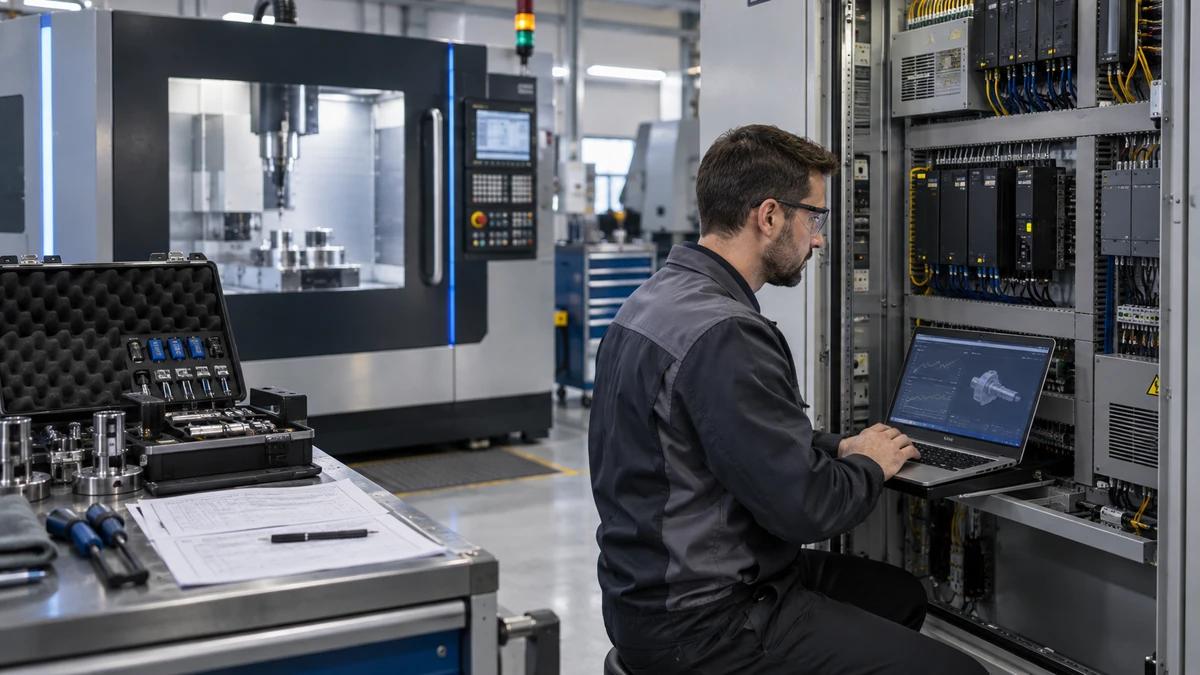
The cabinet air temperature is only one input. Drives, power supplies, controllers, relays, batteries, and communication devices may have different maximum temperatures, altitude derating, mounting orientation, and clearance requirements. Some components need cool air directly; others are more sensitive to rapid temperature change or condensation.
Create a component temperature list from the approved data. Record the measured or calculated local condition and the required margin. If a component has a hot-spot risk, the solution may be a baffle, duct, separated heat sink, or distributed cooling rather than a larger cabinet-wide unit.
Batteries deserve special attention because heat and cold affect service life differently. Encoders, measurement electronics, and network devices may also have limits that are easy to overlook. The responsible designer should decide whether a dedicated zone is needed.
Design Alarms and Diagnostics
An alarm should identify a cooling condition that requires action, not merely report that a fan command was issued. Consider high cabinet temperature, low airflow, filter differential pressure, air-conditioner fault, condensate overflow, coolant flow, and loss of the monitoring device itself. A useful CNC machine control cabinet cooling record states how each signal changes the operating response.
Set alarm thresholds from documented equipment limits and approved engineering practice. Avoid a warning so late that the only remaining response is a crash stop. Define whether the machine pauses, completes a safe cycle, switches to backup cooling, or continues under observation.
Diagnostics should be readable by the people who respond. Record the sensor location, normal range, expected response, and escalation path. If the controls can log temperature trends, use them during commissioning and maintenance rather than only after a failure.
Protect Maintenance Access
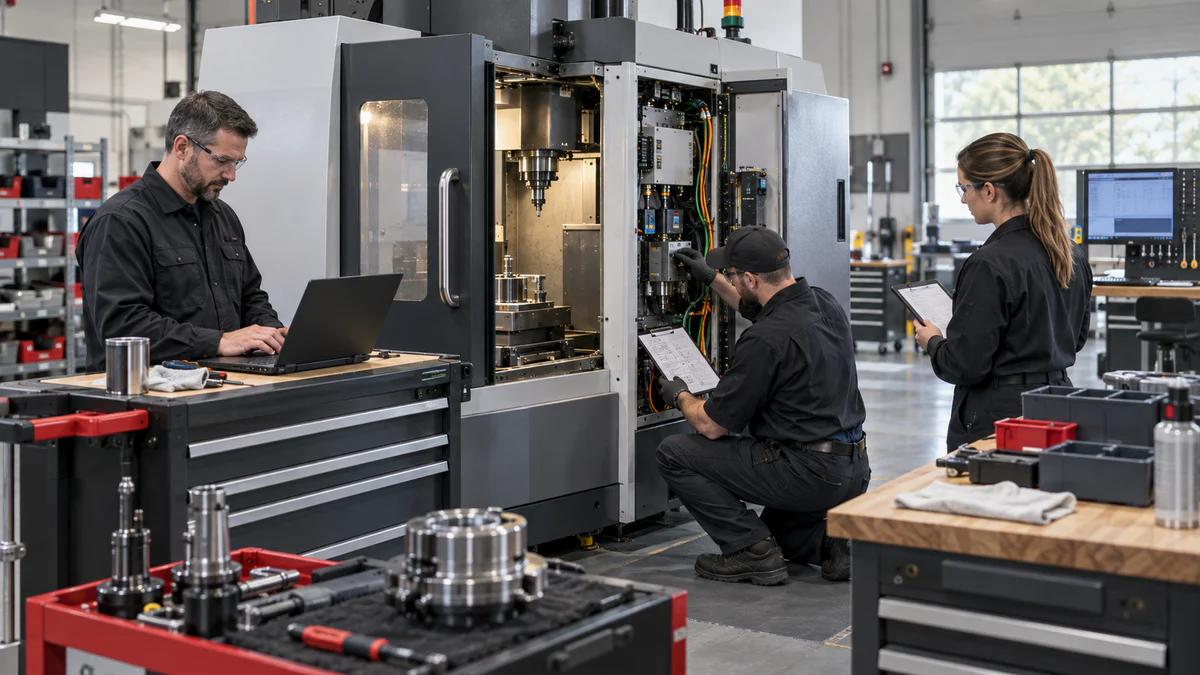
The cooling system needs room for filters, coils, drains, fans, refrigerant connections, and instruments. Confirm that a technician can reach the service point without standing in a traffic path or reaching over a hazard. Keep spare parts and documentation near the maintenance plan.
Consider cleaning frequency, replacement availability, and the effect of shutting down the machine. A filter change that requires entering a guarded area may be safer but slower. A drawer-style filter may be easier to service but still needs a procedure and a training record.
IEC 60529 defines degrees of protection provided by enclosures, commonly expressed as IP codes. The applicable rating and local requirements must be selected for the real environment; a higher number on a label does not replace correct installation and maintenance.
When an air conditioner is mounted on a machine, its hot exhaust and weight become part of the machine layout. Confirm clearance, vibration, and support. Do not let a small cooling accessory undermine the main enclosure's protection.
Commission With a Thermal Test
A commissioning test should use a defined production or load emulation that represents the approved thermal risk. Record ambient conditions, internal temperatures, active loads, filter condition, cooling-device operation, and the time to reach steady state. Test at least the relevant seasonal extremes where practical. The accepted CNC machine control cabinet cooling baseline should identify the exact device configuration and test revision.
Do not create unsafe electrical, mechanical, or process conditions to force heat. Use approved test loads or production cycles and the responsible team's procedure. Confirm that alarms, drain paths, and backup behavior perform as intended.
Keep the baseline record. A later rise in cabinet temperature at the same room condition may indicate a blocked filter, failing fan, changed duty, loose connection, or added option. The baseline turns a vague complaint into a comparable observation.
Link Cooling Choices to Lifecycle Cost
The lowest initial cost may come from a fan and filter, but annual energy, filters, downtime, contamination damage, and service labor belong in the comparison. A sealed air conditioner may reduce contamination but adds refrigerant maintenance and condensate management. The best choice depends on the plant and the machine's operating pattern.
For an OEM or system integrator, the cabinet may be reused across several machine variants. Keep the thermal load model modular so that a changed drive or added axis triggers a documented review. CNC machine control cabinet cooling is not a one-time accessory; it is a configuration-dependent interface.
If Zhihe CNC supplies the machine-side cabinet arrangement, ask for the delivered drawings, component limits, cooling-device information, alarm list, spare recommendations, and maintenance instructions. If the buyer supplies the external cooling or room system, keep that scope visible to avoid a missing interface.
Ten Buyer Questions About CNC Machine Control Cabinet Cooling
Is cabinet cooling necessary if the factory air is below the maximum temperature?
Not automatically. The internal heat load, local hot spots, duty cycle, contamination, condensation risk, and component limits must be evaluated.
Should I choose a fan or an air conditioner?
Choose according to ambient condition, heat load, sealing need, contamination, service capability, and the required internal temperature. The comparison should be documented.
Can a larger cabinet solve the problem?
More volume may slow a temperature rise, but it does not remove heat. It can also increase the distance air must travel and create new hot zones.
What causes condensation?
Temperature changes, humidity, door openings, cold surfaces, and air-conditioner behavior can all contribute. Design the drain and operating procedure together.
Does a sealed cabinet need internal circulation?
It may. A sealed enclosure can still have uneven temperature or local hot spots, so mixing and sensor placement matter.
How often should filters be checked?
Use the manufacturer's guidance and the actual site contamination. A differential-pressure indicator or scheduled inspection can make the need visible.
Can the cooling device be added after installation?
Yes, but it changes power, mounting, alarms, airflow, documentation, and sometimes the enclosure layout. Reopen the thermal review rather than treating it as a minor accessory.
What temperature should be recorded during commissioning?
Record the conditions defined by the responsible thermal plan: ambient, cabinet air, critical component areas, load state, and cooling-device behavior.
Does an air conditioner guarantee clean internal air?
No. Filters, seals, condensate, service practice, and internal contamination still require control.
What should I send to Zhihe CNC first?
Send the installation location, ambient and altitude data, machine configuration, expected duty, selected options, cabinet layout, contamination concern, and maintenance contact.
Decide Before the Cabinet Layout Freezes
Review the Zhihe CNC machining-center portfolio and the company and manufacturing profile. Then use the engineering contact route to share the proposed cabinet, environment, and production cycle.
A practical CNC machine control cabinet cooling record includes heat sources, duty, enclosure boundary, cooling method, alarms, service access, commissioning data, and ownership. It does not promise a universal temperature. It makes the thermal assumptions visible while the machine and its enclosure can still be changed efficiently.