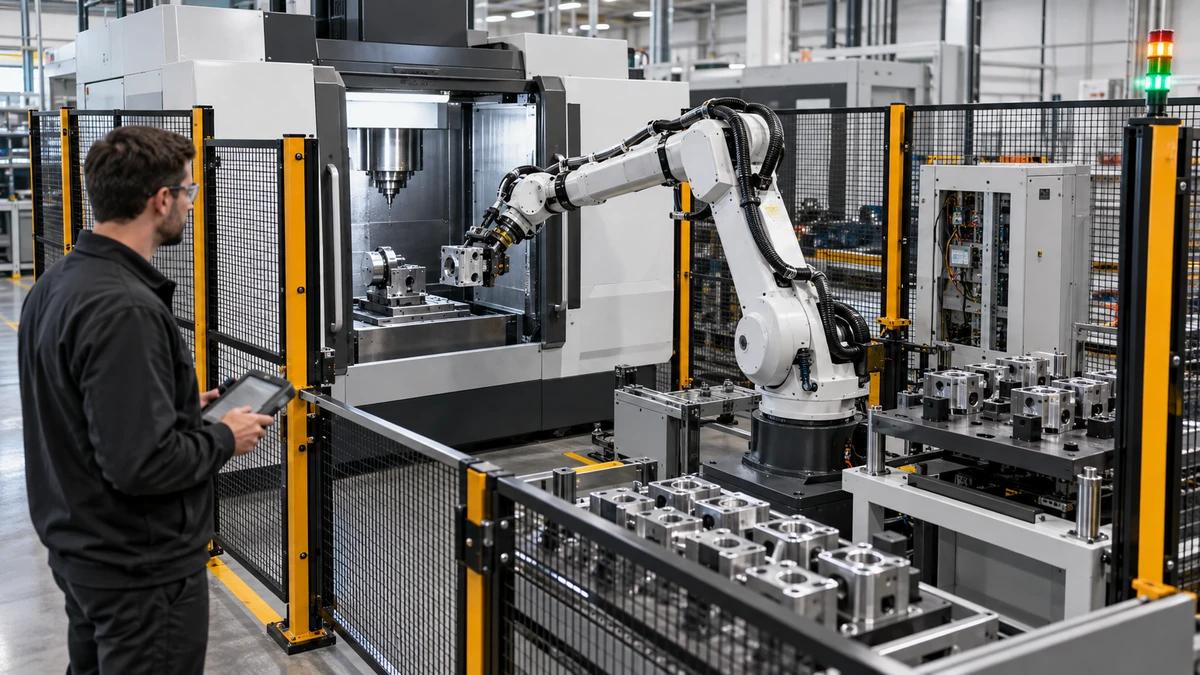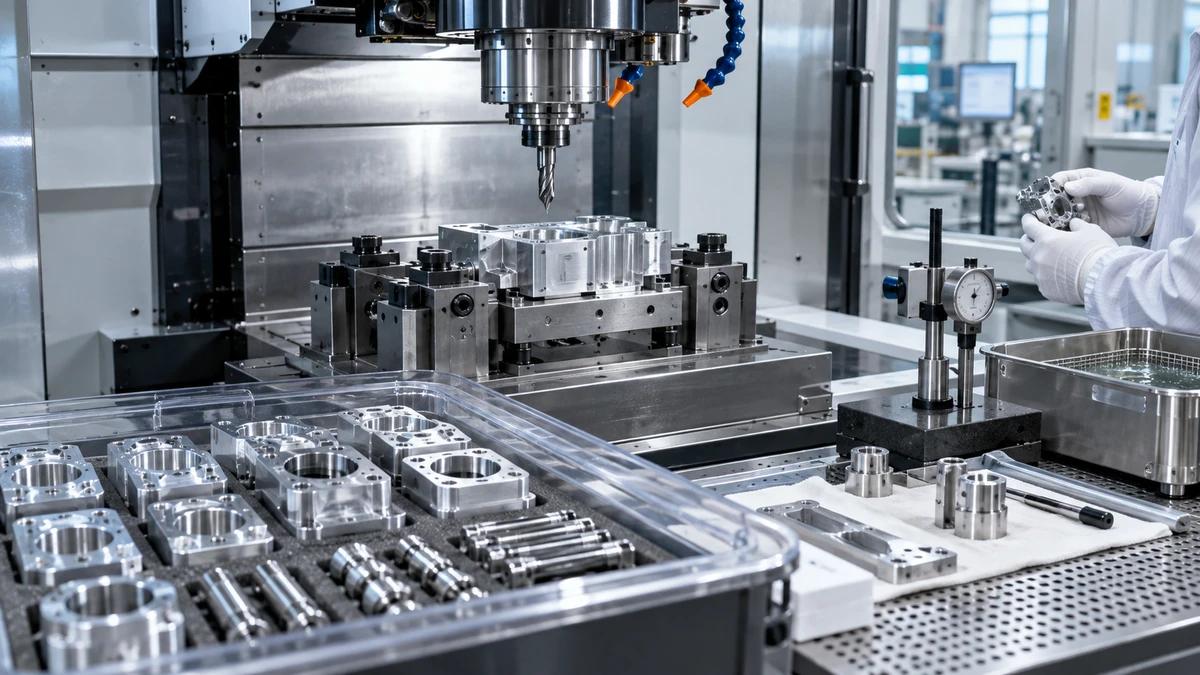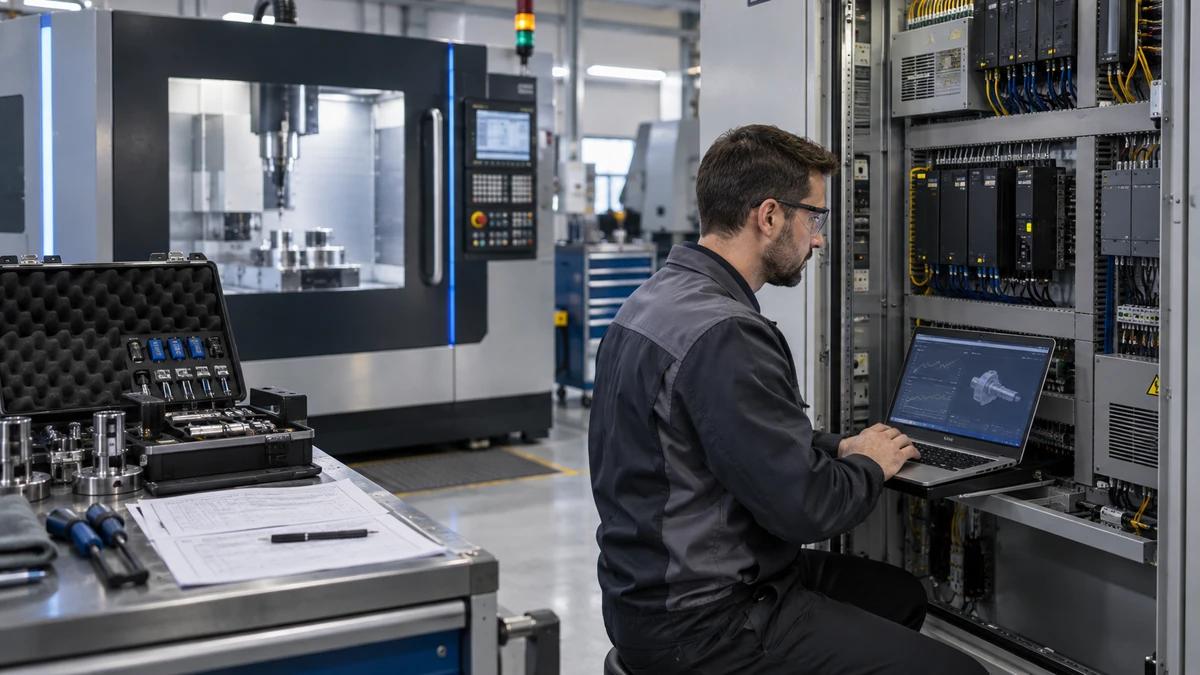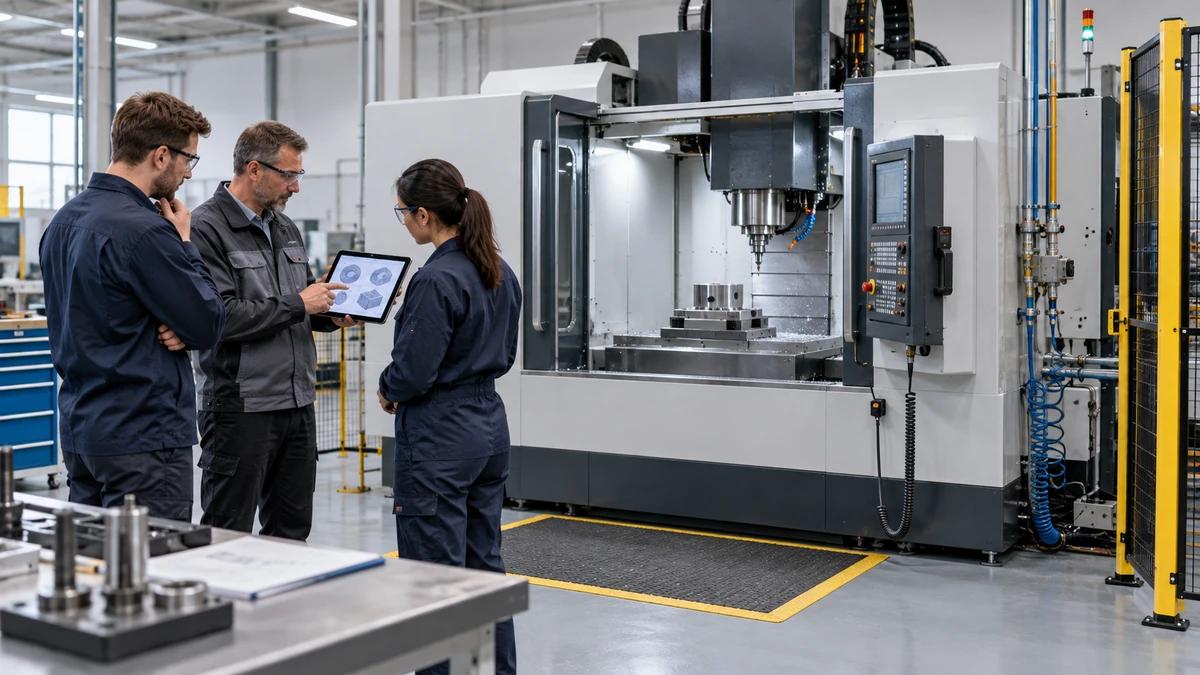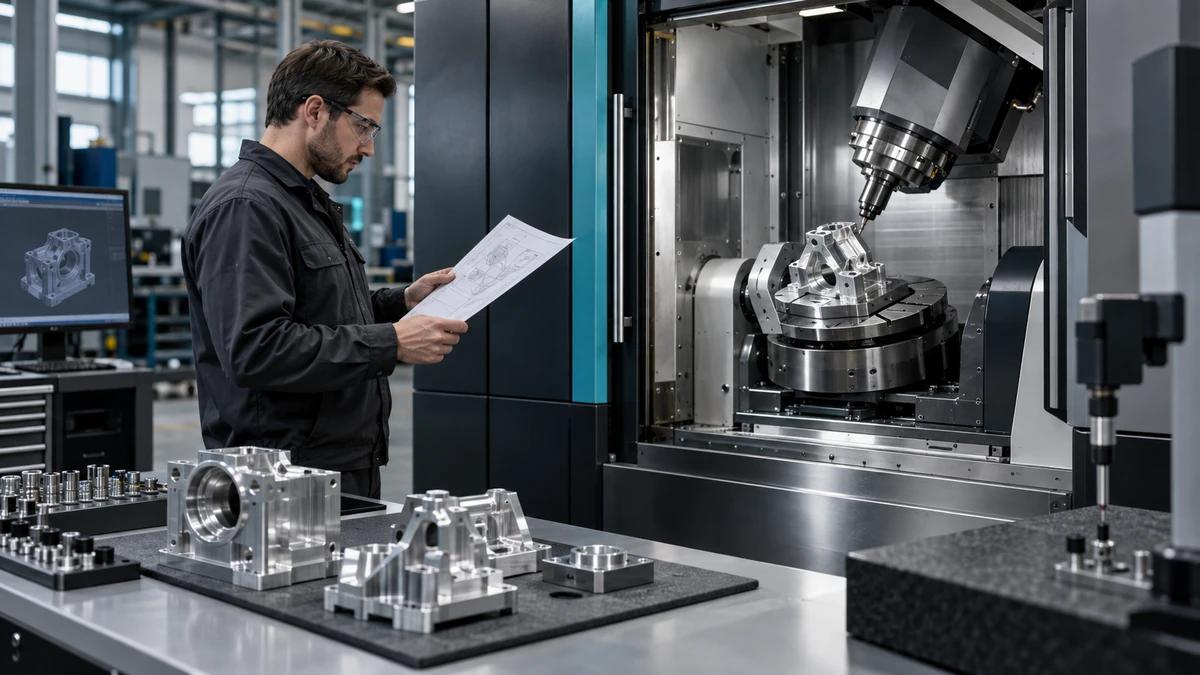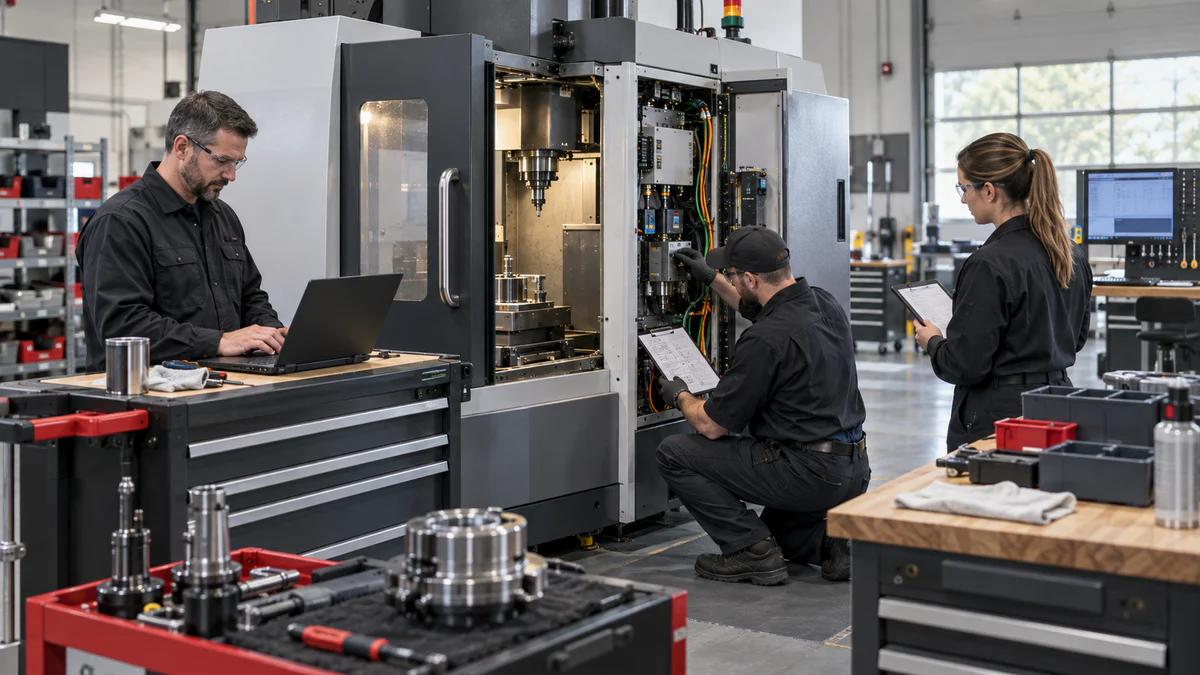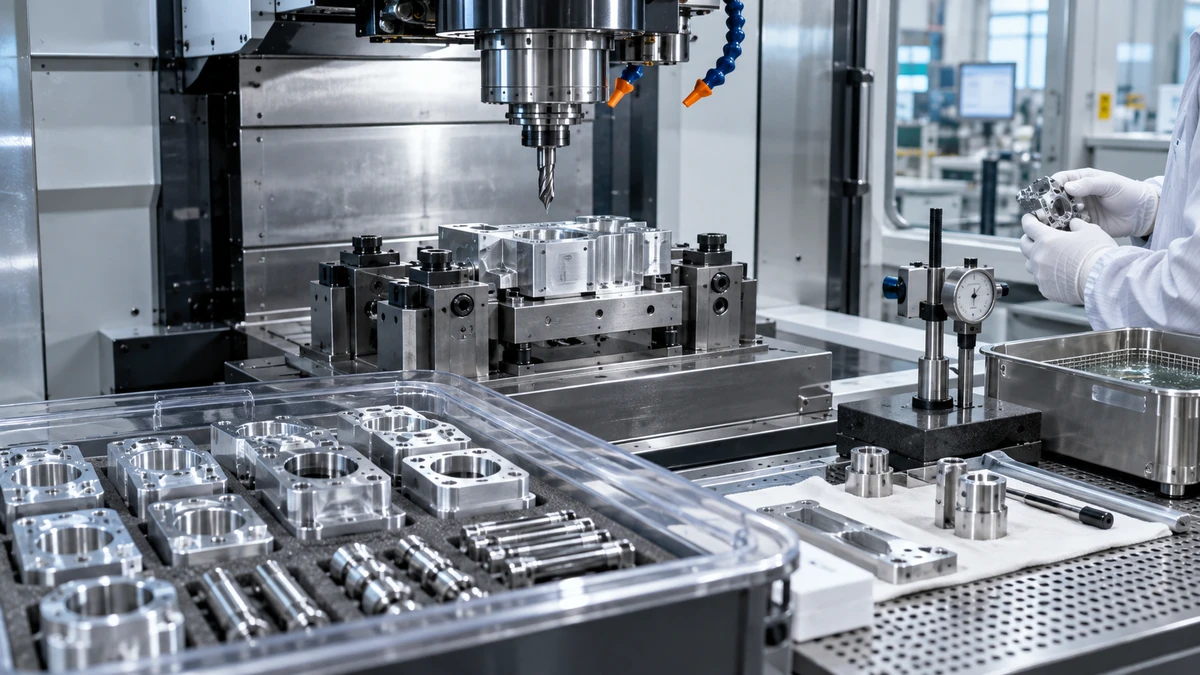
Selecting a CNC machine for lithium battery equipment parts is a process decision, not a simple travel-and-spindle comparison. Battery production equipment often combines tight interfaces, sensitive sealing or vacuum paths, clean handling requirements, thermal loads, and demanding uptime. The machine, workholding, cutting fluids, cleaning method, inspection plan, and release controls must be considered as one chain.
Begin with the equipment interface map
List the parts that the equipment actually consumes: nests, trays, end-effectors, guide components, cooling plates, vacuum manifolds, clamps, alignment blocks, sensor mounts, and change parts. For each, mark the interface that matters most: location, flatness, sealing, sliding fit, electrical isolation, thermal contact, or cleanability.
The right CNC machine for lithium battery equipment parts depends on the hardest relationship, not the largest outer dimension. A small sealing land can be more important than a long structural plate. A tapped hole pattern can govern an entire station. Begin with the function the part must perform and work backward to machining evidence.
Separate contamination risks from dimensional risks
Contamination control includes chips, abrasive residue, coolant carryover, mixed alloys, fingerprints, cleaning agents, and particles trapped in blind features. Dimensional control includes datums, profile, flatness, hole position, surface finish, and burr state. They interact, but they need different controls.
Make the cleanliness boundary explicit. Identify which steps occur in the general machine area, which require dedicated tooling or fluids, and which require a controlled wash, dry, inspection, or packaging step. Do not imply that a clean-looking part automatically satisfies a battery-line cleanliness requirement; define the test and acceptance method.
For a CNC machine for lithium battery equipment parts, this boundary should be approved by both machining and downstream equipment owners. The machine supplier can propose controls, but the process owner must define what cleanliness means at the assembly interface.
| Part risk | Process question | Release evidence |
|---|---|---|
| Seal or vacuum land | How will flatness and burrs be protected? | Surface and form report |
| Sliding guide | How will chips and edge break be controlled? | Fit test and cleaning record |
| Thermal contact | How will plane quality survive clamping? | Flatness and contact check |
| Insulating feature | Which tools, fluids, and cleaners are compatible? | Material and cleaning sign-off |
| Sensor datum | How will location be established and inspected? | Datum report and fixture record |
| Change part | How will identification and packaging prevent mix-up? | Label and traceability record |
Choose machine capability around the datum chain
Draw the datum chain from stock or casting to the assembled equipment. Identify which features must remain in one setup and which can be re-established with a controlled reference. For a CNC machine for lithium battery equipment parts, probing, thermal stability, spindle condition, tool management, and repeatable workholding may matter more than headline rapid speed.
Review table size, access, axis travel, tool reach, coolant management, chip evacuation, enclosure design, and the ability to use dedicated fixtures. Check how the machine supports cleaning and maintenance without introducing uncontrolled material into the process. A machine may be mechanically capable yet unsuitable if its process leaves a residue that the downstream assembly cannot accept.
Treat workholding as part of cleanliness
Fixtures can collect chips and fluids in pockets, vents, threads, and sacrificial surfaces. Design for drainage, access, inspection, and repeatable location. Use protected contact surfaces and a defined cleaning frequency. Mark the fixture revision and the part family it supports.
Before release, prove that the fixture can be loaded without damaging a critical sealing land or trapping contamination. Run a dry cycle and inspect the fixture after representative cutting. The result should inform the standard operating procedure, not remain as a technician's personal trick.
Control tools, fluids, and material families
Tool choice affects burrs, edge integrity, heat, and particle generation. Separate tools by alloy or contamination risk when the process requires it. Record tool identity, coating, life limit, and replacement rule. For aluminum, stainless, copper, engineering plastics, or coated parts, validate the fluid and cleaning route against the material and the downstream interface.
The NIST manufacturing metrology resources are a useful reminder that measurement, process condition, and traceability belong together. A dimensional pass obtained after an uncontrolled tool change is not equivalent to a stable production result.
Build a staged inspection plan
Inspect high-consequence features after the operation that creates them, not only at final inspection. Use in-process probing or a dedicated gauge where it reduces risk. For flatness or thermal interfaces, control support conditions and measurement temperature. For small holes, inspect size, position, edge condition, and cleanliness as separate characteristics.
| Stage | Check | Decision |
|---|---|---|
| After roughing | Stock, distortion, fixture seating | Continue or re-support |
| After datum creation | Datum size, location, burr state | Release next setup |
| After finish cut | Critical geometry and finish | Send to cleaning |
| After cleaning | Particle or residue requirement | Package or rework |
| Before assembly | Fit, sealing, thermal or sensor interface | Release to station |
Record the machine state, tool revision, fixture ID, inspection method, and operator. If a part fails, preserve the evidence long enough to determine whether the cause is tool wear, fixture movement, material variation, cleaning, or measurement technique.
Design the cleaning and packaging handoff
Cleaning should be a defined operation with compatible chemistry, water or solvent quality, drying method, handling rules, and acceptance criteria. Protect critical surfaces after cleaning. Use packaging that prevents recontamination and distinguishes revisions or material families.
Do not place a cleaned part on an unverified bench and call the process complete. Define the handoff point, responsible person, label, and maximum exposure conditions. The ISO 14644 cleanroom standards overview can help teams frame environmental control discussions, but the actual requirement must come from the equipment and battery process owner.
Confirm thermal and structural behavior
Equipment parts may carry heat, vacuum, clamping force, or repeated motion. Validate the assembled interface, not only the free-state dimension. A thin cooling plate can move under fastening; a guide can bind when bolted to an imperfect structure; a manifold can leak because a tiny burr damages a seal.
Use a representative assembly or a qualified simulator. Measure before and after fastening, thermal cycling, or repeated motion when those conditions matter. Keep claims limited to the tested configuration and conditions.
Protect change control and traceability
Battery equipment evolves quickly. A revised cell format, sensor, coating, or station layout can change a machined part. Give each drawing, fixture, program, tool list, cleaning instruction, and inspection plan a revision. Link the part label to the order, material, machine, and inspection record.
The quality-management discipline in ISO 9001 is useful here: document the change, assess impact, approve the new baseline, and verify effectiveness. Do not rely on a filename that differs only by a date.
Choose the supplier by evidence
When comparing a CNC machine for lithium battery equipment parts, ask for a trial that includes a representative datum chain, fixture, tool strategy, cleaning handoff, and inspection report. Ask the supplier to state what the trial does not prove. Honest limits are more useful than a glossy claim of battery-industry experience.
Review how the supplier handles a particle finding, dimensional drift, damaged seal land, or revision change. A strong partner can explain containment, evidence preservation, correction, and re-release. Zhihe CNC's precision machining information can be used as a starting point for that technical discussion.
The best CNC machine for lithium battery equipment parts is the one that gives the equipment team a controlled path from raw material to clean, traceable, assembly-ready components. Capability only matters when the handoff preserves it.
For equipment selection, cross-check the CNC machining center range, the precision machining solution, the CNC milling machine options, and Zhihe CNC contact support before locking the process baseline.
Battery-equipment process questions
What makes a CNC machine for lithium battery equipment parts different?
The process often combines tight interfaces, cleanliness, thermal or sealing functions, repeatability, traceability, and uptime. The machine must support the full chain rather than only cutting speed.
Does a clean-looking part meet a cleanliness requirement?
Not necessarily. Define contamination sources, cleaning steps, test method, handling rules, and packaging conditions with the equipment or battery process owner.
Which features should be inspected in process?
Inspect features that establish datums, seals, thermal contact, sensor location, or sliding fits immediately after they are created when the risk justifies it.
How should fixtures be controlled?
Assign a fixture ID and revision, define contact surfaces and cleaning, record the supported part family, and inspect the fixture after representative cutting.
Can one coolant serve every battery-equipment part?
Do not assume that. Validate fluid compatibility, residue, material family, tool performance, and downstream cleaning requirements for each process.
Is final inspection enough for flatness?
It may miss distortion created during fastening or thermal loading. Measure in the support and assembly conditions that the function consumes.
How should cleaned parts be packaged?
Use defined packaging, labels, protective surfaces, exposure limits, and a controlled handoff. Packaging should prevent mix-ups and recontamination.
What should a trial cut prove?
It should prove the agreed features, datum relationship, tool and fixture concept, cleaning handoff, inspection method, and traceability under representative conditions.
How are drawing changes released?
Record the reason, impact review, new revision, approved program and fixture changes, updated inspection, and effectiveness evidence before the new baseline is used.
What should a buyer ask a machine supplier?
Ask for representative evidence, contamination controls, tool and fixture management, inspection data, recovery procedures, and the limits of every capability claim.