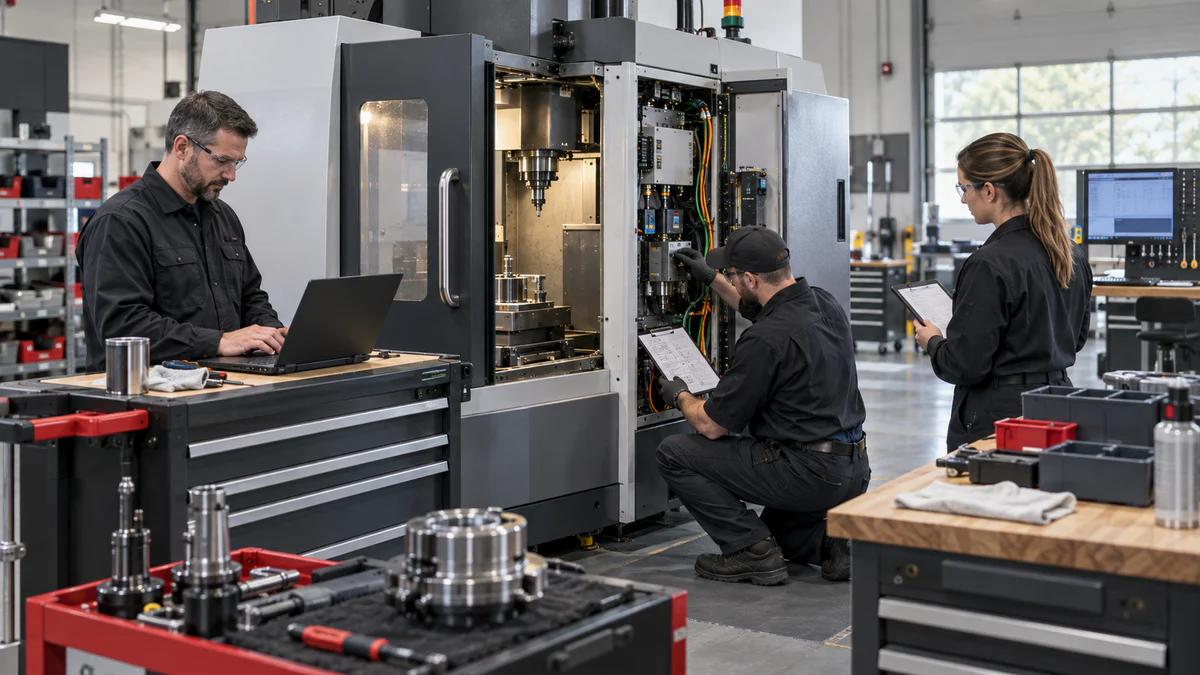
CNC machine spare parts planning should begin while the machine configuration is being confirmed, not when an unidentified component has already stopped production. A useful plan connects an exact part identity to its machine, the consequence of its absence, the approved replacement route and the people who can restore service.
For a Zhihe CNC purchase, ask for that information alongside the machine and service proposal. Avoid starting with a generic box of “essential spares.” The right selection depends on the delivered configuration, site capability, production schedule and support arrangements. This checklist organizes the questions purchasing and maintenance need to resolve together.
First, ask what “a spare” means in this proposal
There are at least three different purchasing situations. A scheduled consumable has an expected replenishment process. A repairable assembly may need a service decision and a return route. A production-critical replacement may need a different availability plan because waiting for it would interrupt an important operation.
Those categories can overlap, and importance can change with the production schedule. A component supporting a single bottleneck machine may deserve different attention from a similar component in a shop with an approved alternative route. Do not classify every item as critical simply because it belongs to an expensive machine.
For CNC machine spare parts planning, write the consequence in plain language. “Machine cannot perform the scheduled job until the fault is diagnosed and the correct item is available” is more useful than an unexplained red label. It also reminds the team that buying a component is not the same as diagnosing the fault.
Checklist A: identification for CNC machine spare parts planning
Record the machine model, serial number, configuration and relevant option. Then identify the manufacturer's part number, description and revision where applicable. Add a photograph or drawing to explain the location, but do not use an image as the sole definition of compatibility.
The importance of machine identity is visible in Haas's official replacement-parts guidance, which directs buyers to identify their machine by model and year or serial number. That is a useful industry example, not the ordering process or parts specification for Zhihe CNC.
Ask the Zhihe service contact what identifiers are required for the specific order. If an item is supplied through another component manufacturer, clarify who confirms compatibility and who remains responsible for the machine-level service decision. Similar labels or connectors do not constitute that confirmation.
| Item record | Information to capture | Question that should remain visible |
|---|---|---|
| Machine identity | Model, serial number and delivered options | Does this record describe the actual machine at the site? |
| Component identity | Part number, description and relevant revision | Has compatibility been confirmed for this configuration? |
| Replacement scope | Component alone, assembly, kit or service exchange | What other items or work are needed for restoration? |
| Documents | Applicable manuals, drawings and approved instructions | Which version is current for this machine? |
| Service resources | Required technician, tools, access and checks | Can the site perform the work, or must support be arranged? |
| Supply conditions | Quoted availability, shipping assumptions and validity date | What must be reconfirmed when an order is placed? |
This is a specification template. It intentionally contains no invented part numbers, stock quantities or delivery promises.
Checklist B: choose a supply arrangement for each category
Buying everything immediately can leave the shop with costly, poorly identified stock. Buying nothing can leave production dependent on unexamined response and transport assumptions. Compare the available arrangements against the consequences of waiting and the practical support available to the site.
| Planning approach | Suitable question to ask | Tradeoff to examine |
|---|---|---|
| Site-held consumables | Which approved items are consumed during routine maintenance? | Storage, replenishment and inventory accuracy |
| Site-held selected replacements | Which confirmed items justify immediate local availability? | Compatibility, preservation and the cost of unused stock |
| Supplier-supported supply | Which items can be sourced through an agreed support route? | Actual availability, dispatch conditions and transport uncertainty |
| Repair or exchange arrangement | Which assemblies have an approved repair or exchange route? | Diagnosis, return conditions, turnaround assumptions and installation work |
Treat this as an options discussion, not a promise that every supplier offers every route. Request confirmation for the quoted machine and destination. Where a repair or exchange program does not exist, leave it out of the plan rather than presenting it as a standard entitlement.
Checklist C: separate diagnosis from component ordering
An alarm message can describe a symptom without uniquely identifying the failed component. Before purchasing a replacement, follow the agreed service process. Provide the machine identity, alarm history, operating context and relevant observations. Do not perform invasive checks based on general web advice.
The Haas operator-manual library demonstrates that operating and maintenance information is published for defined equipment. For a Zhihe machine, use the delivered documentation and authorized service guidance. Instructions for another machine are not permission to change parameters, enter guarded areas or replace electrical components.
Ask what happens after a replacement arrives. Who installs it? What setup, verification or recommissioning is necessary? Which production checks must be completed before the machine returns to work? A service plan that ends at the courier's delivery scan leaves the most important restoration questions unanswered.
Checklist D: preserve the spare so it remains useful
Ask the supplier for the storage and handling conditions appropriate to each item. Keep labels and protective packaging where required. Identify items with relevant shelf-life, inspection or preservation requirements instead of applying one storage rule to every component.
Materials and construction affect these decisions. Seals, lubricants, electronic components and mechanical assemblies do not necessarily share the same handling or preservation requirements. Use the item's documentation and service guidance rather than making assumptions from its category alone.
Make stock movements traceable. Record when an item is received, checked, issued, returned or replaced by another revision. A spare shown as available in a purchasing spreadsheet but already fitted to a machine is not available for the next interruption. Regular physical reconciliation is a practical part of CNC machine spare parts planning.
Checklist E: make the commercial details specific
Ask for dated availability, not a permanent lead-time claim
Separate quotation time, confirmed stock, preparation, dispatch, transport and site scheduling. Ask which items are stocked and which depend on production or external sourcing. Reconfirm availability when placing the order; a historical quotation is not proof of current stock.
For an overseas site, identify the shipping information and destination documents the parties need. The purchasing team should use its qualified logistics and compliance resources for the applicable requirements. This article does not assign import obligations or guarantee a delivery date.
Keep warranty, spares and service scope distinct
A spare-parts quotation should not be treated as the complete warranty or service agreement. Ask which costs, labor, travel, consumables and return conditions are included in each written proposal. Resolve unclear exclusions before production depends on them.
If a customized machine uses a nonstandard assembly or interface, request an identification and support plan for that customization. It should be possible to distinguish the delivered item from a standard catalog reference. Ask what information and verification will be needed if a replacement revision becomes necessary.
Connect the plan to the machine order
Zhihe CNC's company profile describes machine manufacturing, custom solutions and after-sales support. Use those service discussions to request a configuration-specific spare-parts list, document package and support contact. Do not infer a fixed stock level or response guarantee from a general company description.
A simple handover test before the machine enters production
Choose one proposed consumable and one selected replacement from the list. Ask a maintenance colleague who did not create the spreadsheet to identify the machine, find the item record and explain the approved ordering and service route. No equipment intervention is needed for this exercise.
If the colleague cannot tell which revision applies or who confirms compatibility, improve the record before buying more stock. Then check whether purchasing can identify the current quotation and replenishment owner. This small handover exercise tests the usefulness of the plan without inventing a failure or claiming a service performance result.
Ten questions for the purchasing checklist
Should a new machine arrive with a standard spare kit?
Ask what the proposed kit contains and why each item is included. A standard kit may be a useful starting point, but its suitability depends on the actual machine and the site's operating plan.
Is the component model number sufficient?
Not always. Confirm the machine configuration, relevant revision and complete replacement scope. The supplier should identify the information needed to establish compatibility for the actual installation.
Does CNC machine spare parts planning require every item on site?
No universal rule supports that choice. Review production consequence, supply arrangements, preservation and service capability. Document why selected items are held locally and how the others will be obtained.
Can a similar-looking component be substituted?
Do not rely on appearance. Obtain the required technical and compatibility approval through the machine's service process. A substitute may involve more than mechanical fit.
What if the machine is customized?
Request a delivered configuration record and explicit identification of custom items. Ask how future replacements, revisions and support will be managed instead of relying solely on a standard parts list.
Does a spare remove the need for a technician?
No. Installation, diagnosis and return-to-production checks may require qualified personnel. Include those resources in the restoration plan rather than assuming stock alone resolves the interruption.
How often should CNC machine spare parts planning be reviewed?
Review it after relevant configuration changes, consumption, service events or changes in supply information. Set a routine appropriate to the site so the list remains usable between those events.
How should obsolete items be handled?
Ask the supplier for the approved replacement or service route and the compatibility conditions. Keep the decision linked to the machine identity. Do not treat a newer catalog item as an automatic substitute.
What documents should accompany purchased spares?
Request the identification, handling information and relevant quality or conformity documents specified for the order. Requirements differ by item and destination; confirm them with the responsible specialists.
What should I ask Zhihe CNC before ordering the machine?
Ask for the delivered configuration, proposed spare categories, identification method, documentation, support contacts and availability assumptions. Identify any operating constraint that makes restoration particularly time-sensitive.
Make the first list small enough to verify
Start CNC machine spare parts planning with a short, justified list whose identities and responsibilities are complete. Expand it when production or service evidence supports doing so. A well-maintained record is more useful than a long list that nobody trusts.
Send your machine configuration, production context and service region through Zhihe CNC's contact page. Request a dated proposal that separates parts, documentation and service work. The aim is to know how production will be restored, not simply to fill a shelf.