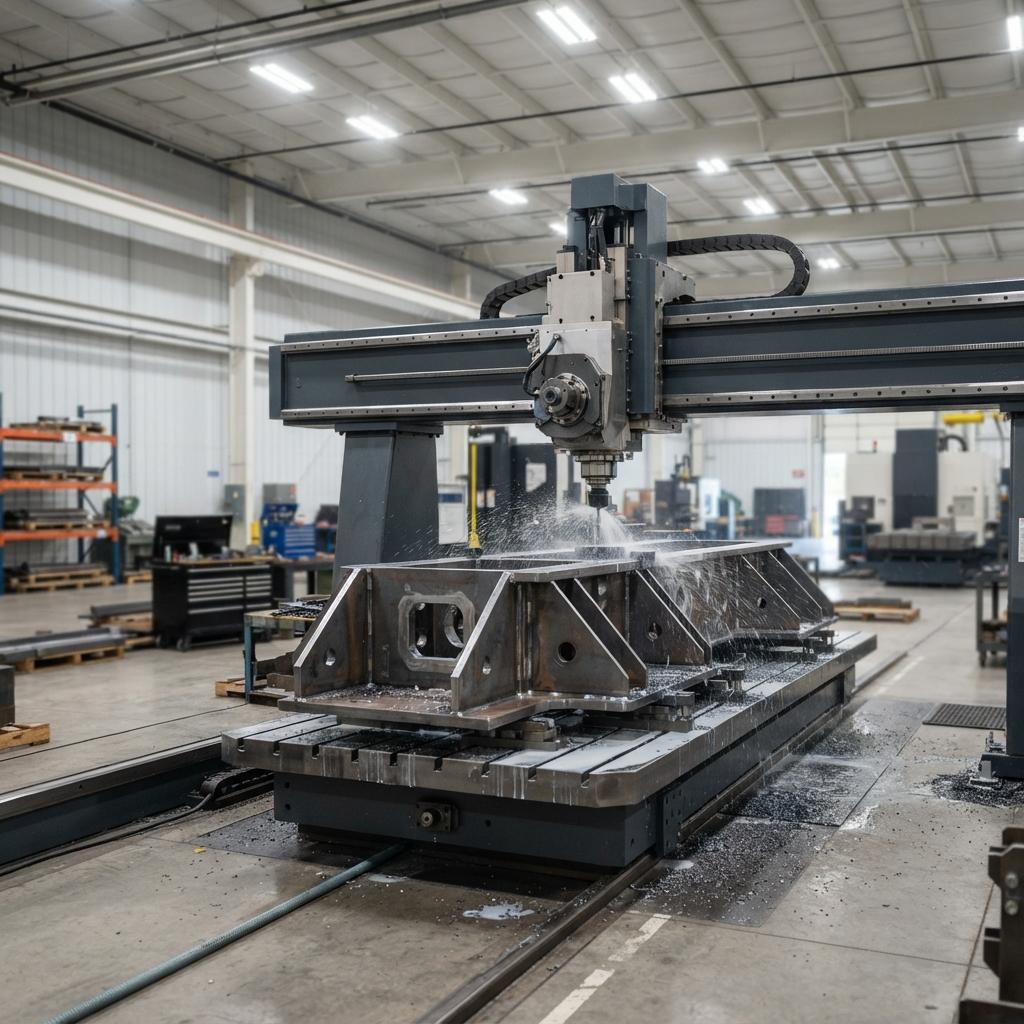
A CNC machining center for mining equipment parts is selected by matching work envelope, rigidity and multi-face access to the part family you actually produce — usually large weldments, wear plates, housings and bore-heavy components. The machine must hold bore-to-face relationships through long, interrupted cuts, not merely reach the drawing's outside dimensions.
In mining equipment machining, the parts that fail are often the ones where a bore, a seal face and a mounting datum drifted apart during production. A CNC machining center for mining equipment parts must therefore be judged as a process decision: which faces can be cut in one setup, how much stock variation the first cut must absorb, and what evidence proves the machine can repeat the result after installation.
Why mining equipment parts punish a general-purpose machine
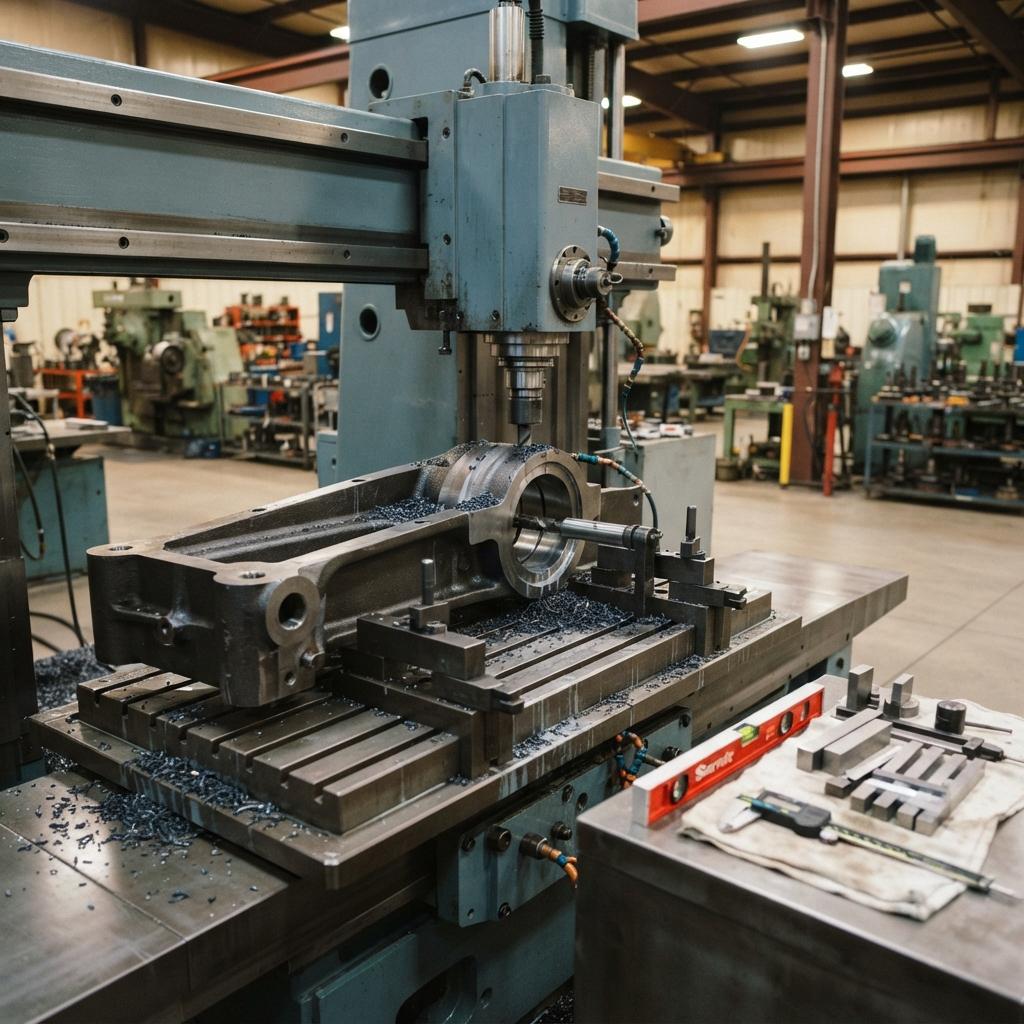
Most mining machinery components combine three difficulties that are manageable separately but expensive together. The parts are heavy, so workholding and table load dominate the setup. The surfaces are often abrasive or work-hardened, so cutting forces stay high and tool life is short. And the functional features — bearing bores, pin bores, seal grooves, mounting faces — sit on several sides of a boxy or welded structure, which multiplies the number of setups if the machine cannot rotate or reposition the work.
CNC machining weldments adds a fourth problem: the blank is not a clean casting. Plate distortion, weld beads, flame-cut edges and inconsistent stock mean the first cut may be interrupted and unbalanced. A machine that is rigid enough for finishing but not stable during roughing will produce a good surface on a bad datum, and the error shows up at assembly.
Finally, mining sites are frequently far from the machine builder. A configuration that needs frequent specialist intervention, or a spare-parts plan that assumes next-day delivery, becomes a production risk long before the first year ends.
Which mining part families should you qualify first?
Do not qualify a machine against a catalogue of "typical" parts. Choose the two or three families that represent most of your revenue and most of your risk. The table below shows how the machining problem changes by family.
| Part family | Typical features | Main process risk | Machine fit to examine first |
|---|---|---|---|
| Large weldments and frames | Mounting faces, hole patterns across long spans, rib intersections | Distortion and datum transfer over distance | Gantry machining center |
| Wear plates, liners and cheek plates | Large flat faces, countersunk holes, edge profiles | Flatness, thickness variation, burr at edges | Gantry or heavy vertical machining center |
| Gearbox and drive housings | Bearing bores, split faces, seal faces, lubrication ports | Bore alignment and roundness after clamping | Horizontal machining center |
| Valve and hydraulic blocks | Intersecting bores, cartridge ports, sealing faces | Cross-hole burr and leak-path control | Horizontal or vertical machining center |
| Pin, bushing and shaft supports | Bored holes, shoulders, snap-ring grooves | Concentricity and surface finish | Vertical machining center |
Large part machining accuracy is set by the family with the tightest tolerance chain, even when that family is not the largest part. A gearbox housing with two bearing bores in line will expose a machine or a fixture problem faster than a large plate with generous hole positions, which is why the acceptance plan for the CNC machining center for mining equipment parts should start there.
Gantry, horizontal or vertical: what fits mining work?
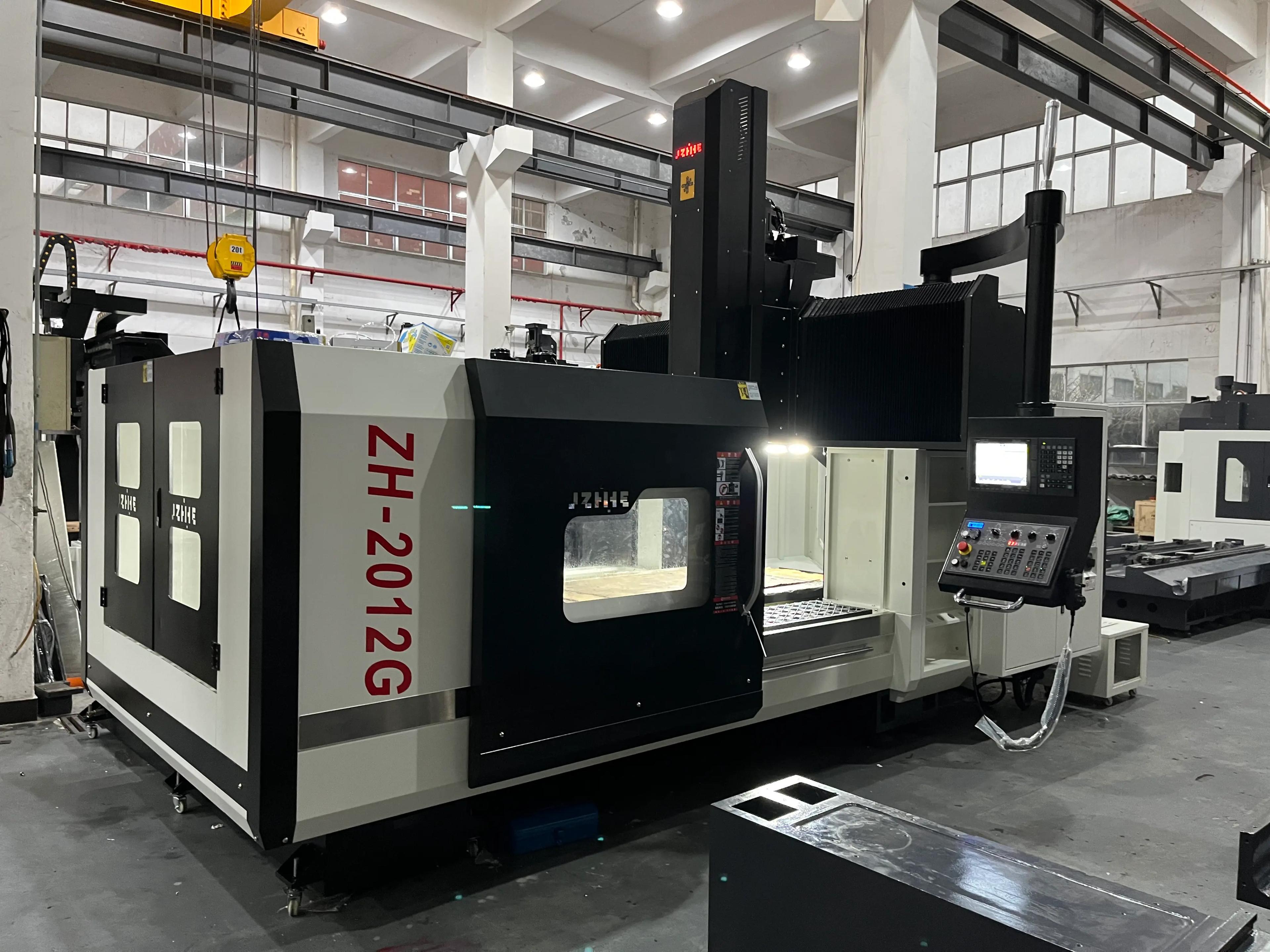
For a CNC machining center for mining equipment parts, a gantry machining center for large parts is usually the first candidate: long frames, wear plates and structural weldments. On the Zhihe gantry configuration, the columns and crossbeam stay stationary while the worktable moves along the X axis, which keeps the cutting structure away from the heaviest moving mass. The X and Y axes use heavy-duty roller linear guides, and the Z axis uses a four-sided embracing rectangular hard rail to resist offset loads during interrupted cutting. Those are structural choices aimed at rough milling, deep cavities and mixed rough-finish work on large parts.
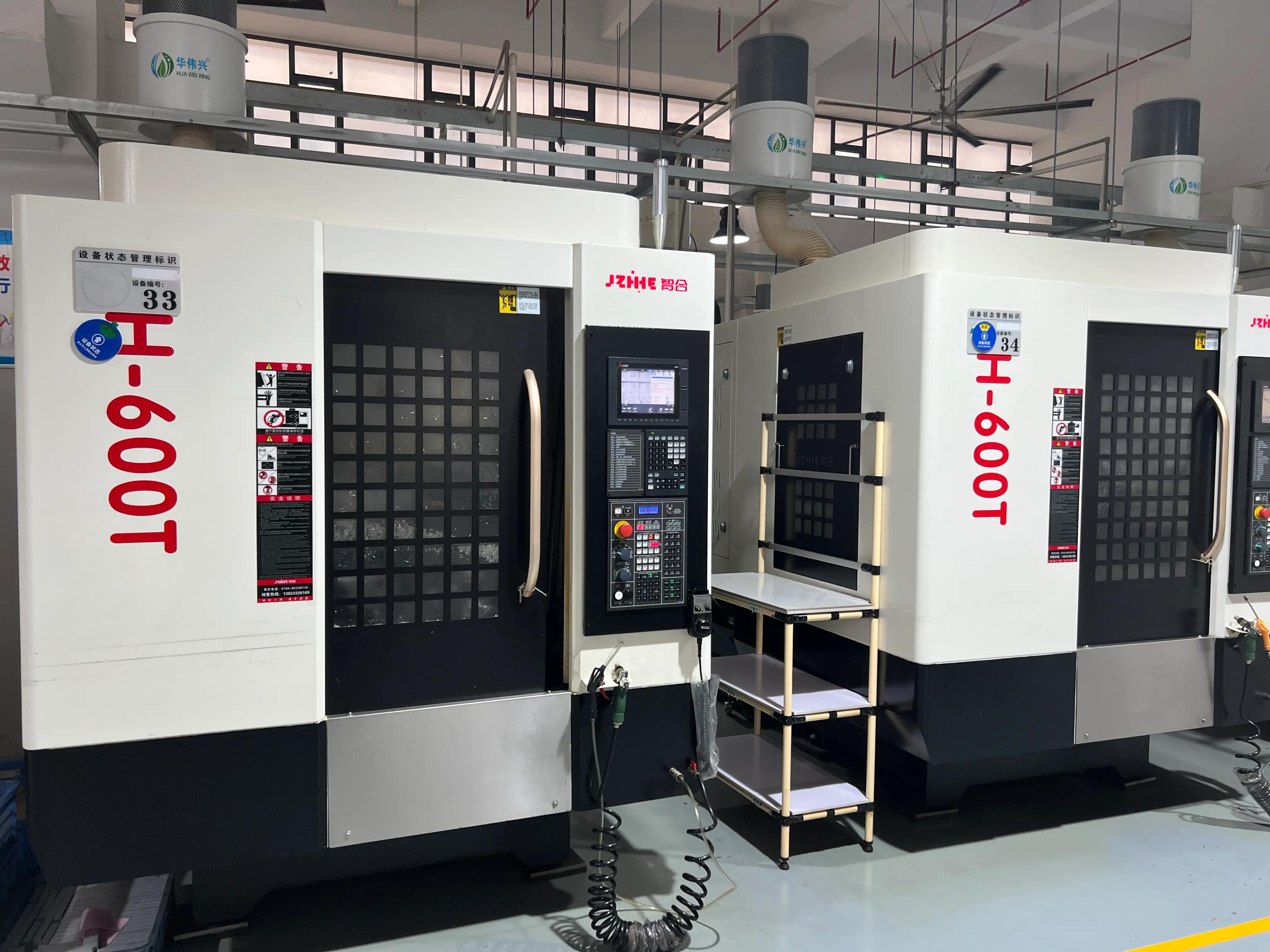
A horizontal machining center for housings is the better fit when the part is a box with features on four sides. The Zhihe horizontal configuration uses a fixed-column integral structure with a cross-slide table, an extra-large monolithic base and a wide-span A-shaped column, and it carries a CNC rotary table with arbitrary angle positioning. That combination is intended to cut several faces in one setup, which removes repeated clamping — often the largest single source of bore-to-face error on housings.
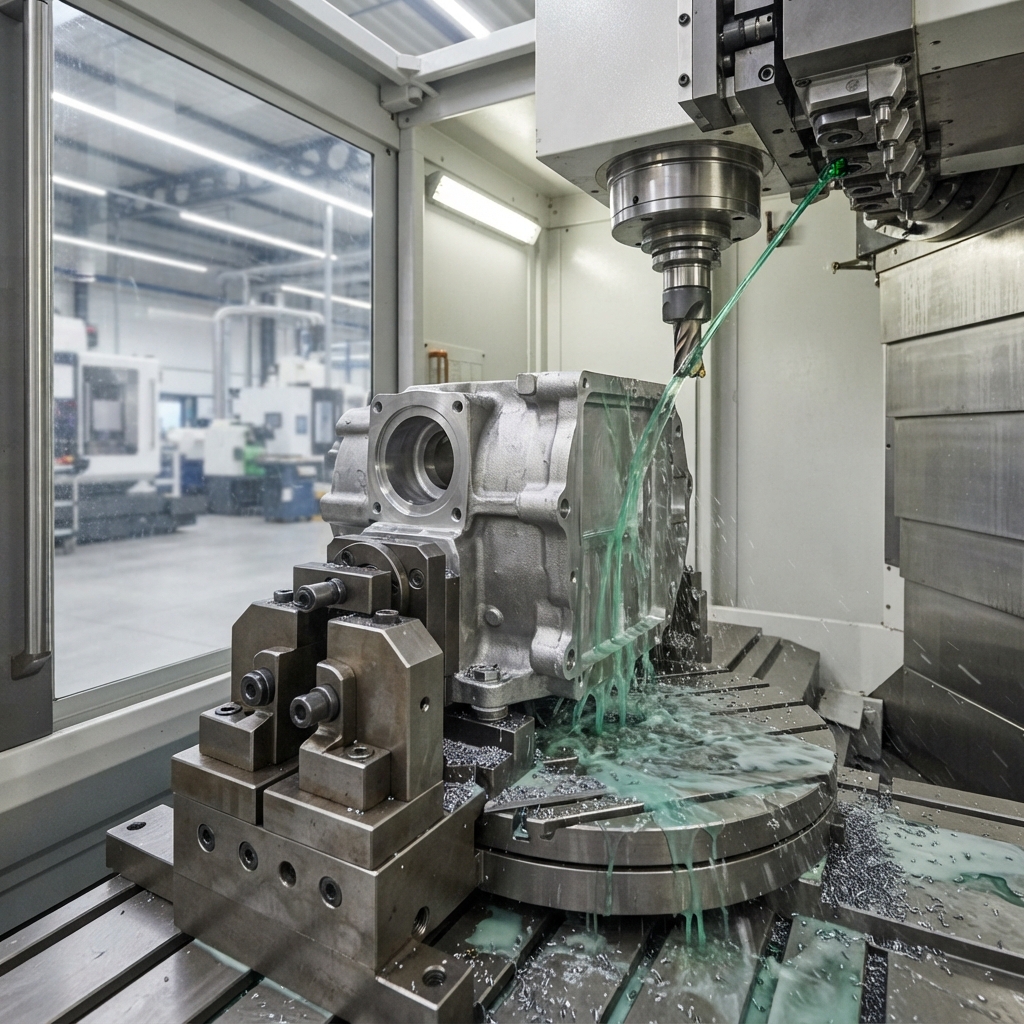
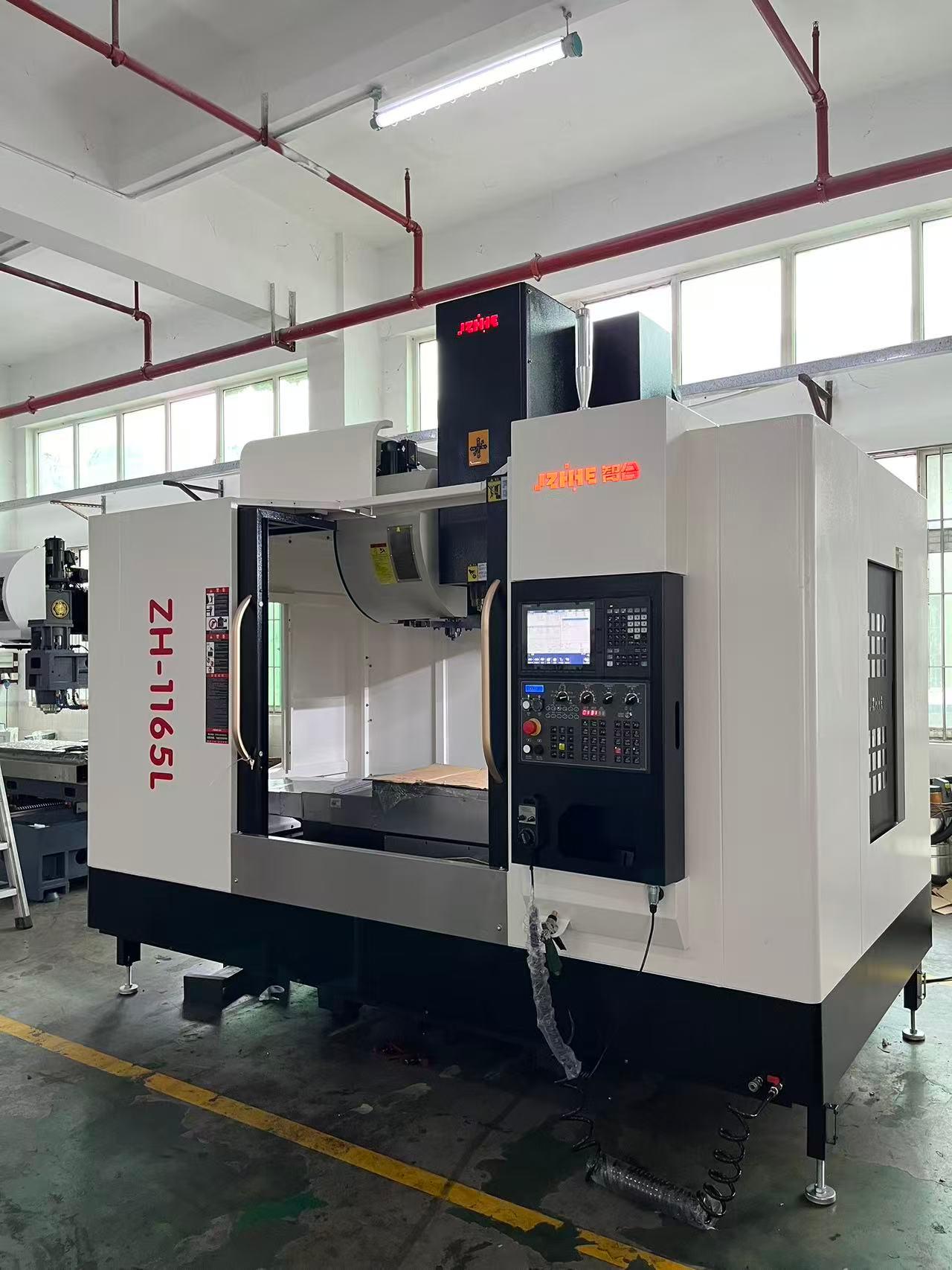
A vertical machining center remains the practical choice for brackets, covers, pin supports and smaller valve bodies, where the part fits comfortably and one or two setups are enough. Using a gantry for these parts usually adds cost and floor space without improving the tolerance chain.
How do you qualify a CNC machining center for mining equipment parts against one real drawing?
The fastest way to separate machines is to walk one representative drawing through the same eight questions. Ask every supplier for the same answers so the comparison is like for like.
- Declare the complete part envelope. Record length, width, height, mass, lifting points and fixture height — not just the largest dimension. The work envelope must contain the part plus the fixture plus clearance for tool changes.
- Map the tolerance chain. List every functional relationship that matters: bore to face, bore to bore, face to face, hole pattern to datum. Mark which ones must be cut in the same setup.
- Count the faces and setups. Compare that count with the machine architecture. A four-face housing that needs three setups on a vertical machine may need one on a horizontal with a rotary table.
- Check tool reach and access. Confirm that the spindle nose, tool holder and quill can reach the deepest feature without collision, and that the tool magazine can hold the full tool set for the family.
- Define the blank condition. For weldments, state stock allowance, distortion, weld-bead height and whether stress relief happens before or after the first cut.
- Agree the workholding concept. Fixture type, clamping points, support positions and whether the fixture is built by the machine supplier or by you.
- Name the acceptance parts. One easy part, one representative part and one worst-case part. State the features to be measured and the instrument to be used.
- Plan spares and service. List the wear parts and critical spares you expect to hold, and confirm who is responsible for installation, leveling and first-part support.
What acceptance evidence belongs in the contract?
A machine tool acceptance test without a stated method is a marketing number. For a CNC machining center for mining equipment parts, two standards give buyer and seller a common language. ISO 10791-1:1998 defines geometric tests for machining centres with horizontal spindle and accessory heads, and ISO 230-2:2006 defines how to determine and evaluate the accuracy and repeatability of positioning of numerically controlled axes.
Use them to write acceptance clauses that name the test, the instrument, the ambient condition, the warm-up routine and the number of approach directions. Then add part acceptance: the dimensions and relationships on your own drawing, measured the way your assembly team will measure them. A machine can pass a geometric test and still fail your part if the fixture, the tooling or the post-processor is wrong, so both layers belong in the handover.
Ask for the raw records, not a summary certificate. Trend data for positioning over the stroke is more useful than a single best-case figure, because it shows where the machine is likely to drift as it warms up or wears.
Which Zhihe CNC machines fit mining work?
Zhongshan Zhihe CNC Technology Co., Ltd. was established in 2018 and operates as a National High-tech Enterprise in Zhongshan, Guangdong. The company builds vertical, horizontal, gantry, drilling and tapping, milling and five-axis machining centers, holds more than 21 patents and offers OEM/ODM and customized machine solutions. Every machine goes through final trial cutting before delivery, which is the right moment to insist on your own acceptance part. Choosing a CNC machining center for mining equipment parts from this range starts with the part, not the model name.
For large structural work, the Zhihe gantry machining center is the relevant starting point. Its published description covers the fixed-beam structure, the moving-table layout, the roller linear guides on X and Y, the rectangular hard rail on Z and micron-level accuracy retention, and it lists heavy machinery structural components, wind power components, hydraulic equipment parts and energy equipment among its applications. The description does not publish travel or table-load figures, so those must be confirmed against your drawing in the quotation.
For housings, valve bodies and multi-face work, the Zhihe horizontal machining center is the counterpart. Its description states a fixed-column integral structure, cross-slide table, monolithic base, A-shaped column, fully enclosed protection, a CNC rotary table with arbitrary angle positioning and optional five-axis linkage, with construction machinery components and energy equipment parts among its listed applications. Again, the envelope and table load need to be matched to your part rather than assumed.
If the part family is mixed, read the construction equipment impact route and the heavy-duty gantry load-path proof before shortlisting. They show how impact loads and load paths change the machine specification, and both are closer to mining duty than a general milling guide.
What are the most common buying mistakes?
- Buying on table size alone. The table must carry the part, the fixture and the clamping load, and the spindle must still reach every feature.
- Ignoring lifting and foundation. A large gantry or horizontal machine changes the building, the crane plan and the installation schedule.
- Assuming one setup without checking access. Multi-face machining only works if the tool can reach the feature at the required angle.
- Comparing accuracy figures without test conditions. Ask for the standard, the instrument and the raw records.
- Underestimating weldment variation. Roughing strategy, stress relief and fixture support decide whether the finish cut is stable.
- Leaving spares planning until after installation. Remote sites need a defined critical-spares list and a named service route.
Frequently asked questions
What size of mining part can a gantry machining center handle?
A CNC machining center for mining equipment parts is limited by its published travel, table size and table load, plus the fixture height and lifting clearance. Give the supplier the complete part envelope and mass, not one dimension, and ask for the usable envelope after the fixture is mounted.
Can a horizontal machining center machine all faces of a mining housing in one setup?
Often it can machine four sides in one setup using the rotary table, but it depends on feature access, tool length and whether the part can be balanced and clamped safely at each index position. Confirm the actual face list with the supplier's process engineer.
Do I need a five-axis machine for mining parts?
Usually not. Most mining housings and structures are 3-axis work plus a rotary table for indexing. Five-axis simultaneous machining matters when angled ports, complex contours or single-setup access to compound faces justify the cost.
How do you control distortion when machining large weldments?
Stress-relieve the weldment before finishing, establish a stable datum from the machined surface rather than the raw edge, support the part at the same points used in assembly, and leave enough stock for a light finishing pass after the part has been released from clamping stress.
Which acceptance tests should be written into the purchase contract?
Reference ISO 10791-1 for geometric tests and ISO 230-2 for positioning accuracy and repeatability, then add your own part acceptance with named features, instruments and ambient conditions. Require the raw measurement records at handover.
Can Zhihe customize a machine for a specific mining part family?
The company states that it offers customized CNC machine solutions and OEM/ODM work, and its engineers evaluate the workpiece, material, accuracy requirement and production capacity before recommending a configuration. The specific fixture, tooling and acceptance scope should be fixed in the quotation.
Conclusion
Choosing a CNC machining center for mining equipment parts comes down to the tolerance chain, not the specification sheet. Qualify the machine against your heaviest and tightest part, decide which faces must be cut in one setup, and write acceptance evidence into the contract using ISO 10791-1 and ISO 230-2. A gantry suits long structural work, a horizontal suits multi-face housings, and a vertical covers the smaller supports and valve bodies around them.
If you want a second opinion on a drawing, send it to the Zhihe CNC engineering team with the material, envelope and accuracy requirements, and ask for the machine configuration and acceptance scope in writing before you compare prices.