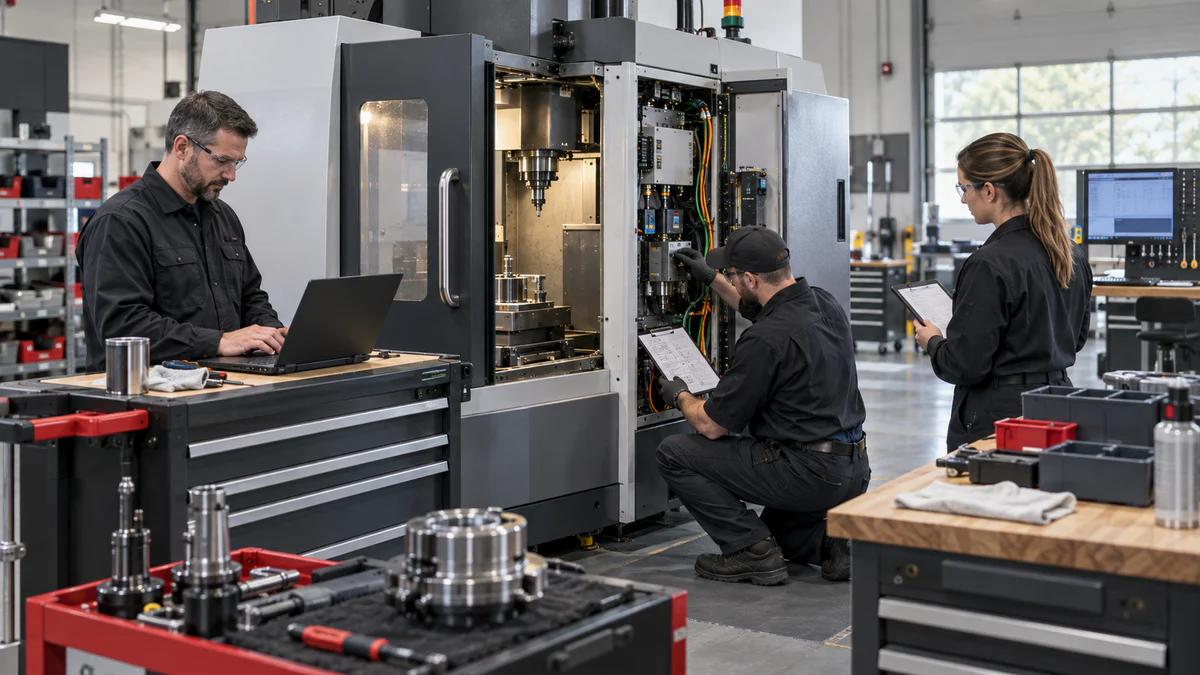
When a buyer requests a CNC machining center quotation, the lowest visible number is rarely the lowest delivered cost. A serious comparison starts by making every supplier quote the same machine configuration, acceptance evidence, delivery boundary, and ownership assumptions. This guide shows how to turn a loose price request into a controlled commercial and technical brief that suppliers can answer without hidden exclusions.
The real purpose of a quotation
A quotation should help a team decide whether a machine can earn its place on the shop floor. It is not only a price sheet. It should connect the intended part family, utilization pattern, required accuracy, workholding, automation, utilities, training, warranty, and after-sales responsibilities. Without those connections, two prices can describe materially different projects.
Treat the CNC machining center quotation as the first controlled version of the purchase specification. If a requirement cannot be traced to a line in the quote, an attachment, or an agreed open question, it is not yet part of the decision.
Use the quotation as a decision record. Ask which assumptions are fixed, which are optional, and which are still unknown. A supplier such as Zhihe CNC's machining center range can then respond with a configuration that is technically legible instead of guessing what the buyer meant.
For the equipment shortlist, compare the relevant CNC milling machine options, review the precision machining capability, and route unresolved scope questions through Zhihe CNC contact support.
Start with a one-page scope brief
Before asking for a CNC machining center quotation, summarize the application in one page. Include material families, largest and smallest workpiece, target batch size, critical surfaces, tolerance bands, surface-finish expectations, annual hours, operator model, and the planned first production date. Add drawings or neutral 3D files when available, but keep the written summary because it exposes assumptions that a model file does not.
Separate must-have requirements from preferences. For example, a through-spindle coolant system may be mandatory for deep-hole work, while a larger tool magazine may be a future option. This distinction makes the offer easier to compare and prevents an attractive base price from hiding an essential upgrade.
Define the machine configuration boundary
The same nominal model may be quoted with different control versions, spindle tapers, motors, travels, table loads, probing systems, chip conveyors, coolant packages, guarding, and electrical standards. Put every boundary into the request. A quote should identify the exact model, control, spindle rating and duty basis, tool capacity, axis travel, rapid rates, worktable details, accuracy test method, and included accessories.
The buyer should also specify what is excluded. Foundation work, rigging, transformers, air dryers, bar feeders, rotary tables, workholding, cutting tools, CAD/CAM licenses, and local code modifications can shift the project total. An explicit exclusion is useful; a silent omission is not.
Compare like with like
Use a normalized sheet rather than a single price column. Each supplier receives the same rows and must mark included, optional, excluded, or to-be-confirmed. This makes the commercial review auditable and gives engineering a direct route to challenge a mismatch.
| Quote line | Supplier A | Supplier B | Supplier C | Buyer decision |
|---|---|---|---|---|
| Base machine and control | Included / model | Included / model | Included / model | Lock exact revision |
| Spindle and cooling | Duty, taper, chiller | Duty, taper, chiller | Duty, taper, chiller | Check material fit |
| Tool magazine | Capacity and holders | Capacity and holders | Capacity and holders | Size for changeover plan |
| Probing and inspection | Probe, software, macros | Probe, software, macros | Probe, software, macros | Separate measurement needs |
| Delivery and site work | Incoterm, rigging | Incoterm, rigging | Incoterm, rigging | Assign owner |
| Training and warranty | Days, scope, trigger | Days, scope, trigger | Days, scope, trigger | Record service boundary |
Do not let a supplier replace a missing specification with a marketing phrase such as high precision or heavy duty. Request the test condition, instrument, sample, and acceptance limit that make the phrase meaningful. The NIST guidance on measurement traceability is a useful reminder that a number without a measurement context is incomplete.
Make acceptance part of the price
An accurate CNC machining center quotation includes an acceptance path. Define whether the buyer will review a geometric accuracy report, spindle runout, thermal behavior, positioning results, a sample part, or all of these. State who supplies material, tools, programs, gauges, and inspection equipment for a trial. Define how deviations are recorded and how corrective work affects delivery.
Factory acceptance and site acceptance should be distinct. Factory acceptance proves that the shipped configuration meets the agreed baseline. Site acceptance proves that installation, utilities, leveling, guarding, software, and operator handover are complete. A machine can pass one and fail the other without either party acting in bad faith.
Price the ownership conditions
Purchase price is only one line in the total-cost view. Estimate freight, insurance, duties, installation, utilities, consumables, preventive maintenance, calibration, software renewals, spare parts, training refreshers, and expected downtime. Ask for the warranty start trigger and the response method for a service case. A quote that makes these items visible is more valuable than one that simply discounts the machine.
| Ownership item | Question to ask | Evidence to retain |
|---|---|---|
| Utilities | What voltage, air, cooling, and extraction are required? | Site-readiness sheet |
| Maintenance | Which tasks are operator-level and which need a technician? | Maintenance schedule |
| Spares | What is recommended for the first 12 months? | Part list and lead times |
| Software | What is licensed, perpetual, or subscription-based? | License statement |
| Training | Which roles are covered and how is competence checked? | Attendance and skills record |
| Warranty | What starts the clock and what is excluded? | Warranty terms |
Use a risk-weighted scoring model
When prices are close, score the requirements that affect production risk. Weight process capability, acceptance evidence, service access, change control, and documentation more heavily than cosmetic preferences. Keep technical scorecards separate from the commercial total, then review the combined result with finance and engineering.
For a practical method, assign each requirement a weight from one to five and each supplier a performance score from zero to five. Require a written reason for any score above four. This does not turn a purchase into false mathematics; it simply makes tradeoffs visible and creates a record for the approval meeting.
Verify changes between quote and order
The final CNC machining center quotation should be versioned. When a supplier revises a spindle, control, safety device, or included accessory, the revision should show what changed, why it changed, and whether the price or acceptance plan changes. Link the quote to the purchase order, approved layout, electrical specification, and trial-part plan.
A simple change log prevents a common failure: the buyer approves a price for one configuration while production receives another. Use controlled filenames, dates, and approvers. The principles of documented configuration control also align with the quality-management approach described in ISO 9001.
Ask for proof without creating a test theater
Request evidence that matches the risk. A machine for aluminum covers may need a representative enclosure and burr review; a machine for hardened steel dies may need cutting data, thermal stability, and tool-life evidence. Avoid demanding a showcase part that has no relationship to your production. The most useful trial uses your material, datum scheme, workholding concept, and inspection method.
Keep the trial connected to the Zhihe CNC product guide so the quoted configuration, application evidence, and later service discussion use the same vocabulary.
Ask for raw inspection results, not only a pass statement. Retain the program revision, tool list, material certificate, environmental conditions, gauge information, and any rework record. This helps engineering decide whether a deviation is a machine issue, a process issue, or simply a mismatch between the test and the intended product.
Finish with a decision-ready commercial record
Before approval, the team should be able to answer five questions: What exact machine is being purchased? What is included and excluded? How will capability be accepted? Who owns site readiness and training? What happens when the configuration or delivery changes? If any answer is vague, pause the commercial comparison and clarify the scope.
The best CNC machining center quotation is the one that makes a later purchase order unsurprising. Invite suppliers to flag ambiguity, but keep the buyer's baseline under version control. When the offer, acceptance plan, ownership assumptions, and service route agree, the price becomes a useful decision input rather than a misleading headline.
Quotation questions buyers ask
What should a CNC machining center quotation include?
It should include the exact machine configuration, included options, delivery boundary, site requirements, acceptance method, training, warranty, service scope, payment terms, and exclusions.
How many suppliers should receive the same request?
Three qualified suppliers is often enough for a meaningful comparison. More important than the count is giving each supplier the same drawings, scope version, acceptance criteria, and response deadline.
Should installation be listed separately?
Yes. Show machine delivery, rigging, leveling, commissioning, training, and utility work as separate lines so responsibilities and costs remain visible.
Is a sample part necessary before ordering?
It is valuable when the application has tight tolerances, difficult materials, or complex workholding. The sample should represent the production risk rather than serve as a showroom demonstration.
How do I compare a low base price with a higher complete offer?
Normalize mandatory options, site work, training, freight, warranty, spares, and software first. Compare the total configured project, not only the base machine number.
What does acceptance testing normally cover?
It may cover machine geometry, positioning, spindle behavior, safety functions, sample-part dimensions, surface finish, and documentation. The exact list belongs in the agreement.
When should the warranty start?
State whether it starts at shipment, delivery, commissioning, or site acceptance. Align the trigger with the party that controls installation and the evidence needed to confirm readiness.
How can a buyer control quote revisions?
Assign a revision code, date, and approver to every quote and attachment. Record every change and require both parties to acknowledge its impact on price, delivery, and acceptance.
Are technical references more important than a discount?
For a production machine, credible references and comparable acceptance evidence often reduce risk more than a small discount. Evaluate references for the same materials, duty, and service geography.
What is the best next step after a quotation review?
Create a clarification list, hold a configuration meeting, issue a final scope revision, and request a signed offer that incorporates the agreed acceptance and ownership conditions.