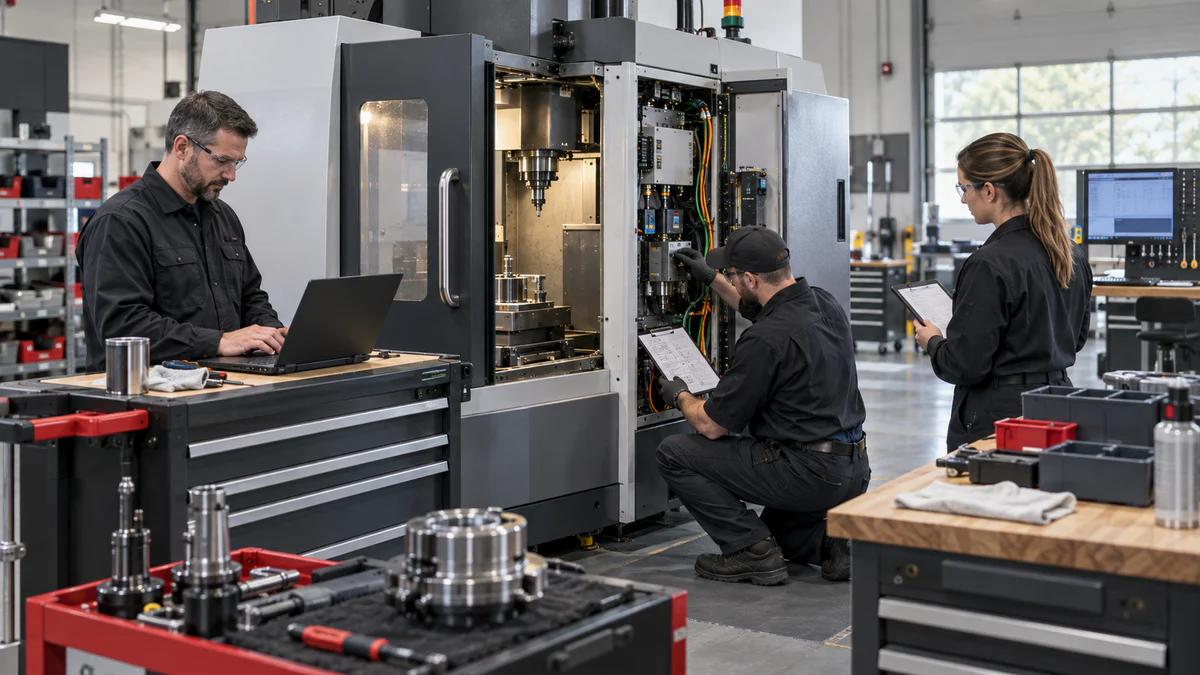
To understand how to choose a CNC machining center, start with the accepted part and the production loss you need to remove, not with travel, spindle speed, controller brands, or a supplier catalog. Zhihe CNC uses a reverse selection funnel that moves from parts to process, constraints, architecture, evidence, lifecycle cost, and release.
This guide is for first-time buyers, expanding factories, job shops, engineering managers, and procurement teams. It prevents attractive specifications from becoming a substitute for a controlled requirement. Every machine choice should be traceable to a part, operation, risk, capacity objective, or recovery need.
Step Back: Name the Loss Before the Machine
Write the present loss in measurable terms: too many setups, long queues, external processing, unstable tolerance, excessive polishing, slow changeover, limited capacity, unsafe handling, poor chip control, high inspection delay, or difficult recovery. Record the baseline, sample period, affected parts, and business consequence.
Zhihe CNC recommends choosing no architecture until the team agrees which losses the project is expected to improve and which remain outside scope.
Choose the Part Family That Must Be Accepted
Select representative parts by envelope, mass, material, number of faces, difficult access, deep features, tolerances, surfaces, volume, batch size, tool reach, chip form, and inspection. Include the extreme part and the common part; a machine that handles only one may create poor economics for the other.
Translate Features Into a Process Route
| Feature question | Process decision | Machine implication |
|---|---|---|
| How many faces? | Setup and orientation | Vertical, horizontal, or five-axis |
| How heavy is the cut? | Roughing strategy | Spindle and structure duty |
| How deep is access? | Tool and holder plan | Travel, head, and clearance |
| What must repeat? | Datum and probing route | Thermal and measurement control |
| What output is needed? | Batch and staffing model | Automation and tool capacity |
The route should show datums, fixtures, tools, operations, intermediate checks, chip escape, cleaning, deburring, and final inspection. It is the bridge from the part to machine specifications.
Decide Whether Vertical, Horizontal, Gantry, or Five-Axis Fits
Vertical platforms often offer direct access and flexible job-shop use. Horizontal machines can consolidate faces and support palletized flow. Gantry machines address large envelopes and heavy setups. Five-axis systems reduce orientation transfers and improve complex access. Drilling and tapping or milling-focused platforms may serve narrower duty profiles efficiently.
The answer to how to choose a CNC machining center is rarely one universal architecture. Compare at least two credible routes against the same parts and accepted output.
Calculate the Usable Envelope, Not Nominal Travel
Add blank, fixture, clamps, rotary device, probe, tool length, holder diameter, spindle nose, safe approach, door opening, load path, table capacity, chip space, and service access. Review extreme orientations and tool-change positions.
Zhihe CNC recommends a controlled 3D envelope for the hardest setup. A part that physically fits may still be unreachable, unsafe to load, or dependent on unstable tools.
Match the Spindle to a Duty Portfolio
List material, cutter, diameter, engagement, depth, speed, torque, power, duration, projection, coolant, and surface objective for roughing, drilling, tapping, semi-finishing, and finishing. Compare the duty portfolio with the complete spindle curve and thermal behavior.
Maximum rpm is only one point. The correct spindle supports the operations that control cycle, quality, and tool life.
Budget Tools, Chips, Coolant, and Cleaning
| Support system | Capacity question | Hidden loss |
|---|---|---|
| Magazine | Do real assemblies fit? | Manual tool swaps |
| Tool life | Are sister tools and triggers defined? | Unplanned stops |
| Coolant | Is pressure, flow, and filtration sufficient? | Heat and tool failure |
| Chips | Can chips leave the cut and enclosure? | Re-cutting and cleaning |
| Cleaning | How is the next setup protected? | Contamination and delay |
A large accessory list does not prove process support. Each option should close a documented loss or risk.
Define Accuracy as a Feature-and-Condition Question
State the critical feature, tolerance, datum, material, thermal condition, fixture, tool, program, sample, inspection method, uncertainty, and production duration. Machine positioning, part accuracy, and long-run process capability are related but not interchangeable.
The ISO 10791 series reference offers machining-centre test context. Zhihe CNC still connects test evidence to the buyer's representative features and conditions.
Model Accepted Capacity Instead of Ideal Cycle
Include loading, setup allocation, cutting, tool changes, probing, cleaning, deburring, inspection, queue, planned maintenance, expected recovery, staffing, yield, and changeover. Use ranges for uncertain tool life, downtime, inspection, and demand.
Learning how to choose a CNC machining center means comparing accepted output per shift, not one uninterrupted simulation cycle.
Add Factory Interfaces Before Comparing Price
Assign foundation, route, rigging, power, grounding, transformer, air, coolant, drainage, chips, extraction, network, tooling, fixtures, gauges, trial material, programs, postprocessor, training, spares, and acceptance. Mark each item included, optional, buyer-supplied, estimated, or unknown.
Zhihe CNC uses the interface map to prevent scope from disappearing between quotation lines.
Compare Lifecycle Cost With a Boundary Table
Add purchase, options, freight, customs, rigging, installation, utilities, tooling, fixtures, inspection, software, training, maintenance, consumables, spare strategy, downtime, changeover, labor, quality losses, and expected useful life. State assumptions and discount speculative savings.
A lower purchase price can be more expensive when it requires repeated external work, manual intervention, excessive tools, or slow recovery.
Design Acceptance Before Ordering
Freeze serial configuration, machine tests, trial part, material, blank, fixture, tools, programs, thermal state, inspection, sample, limits, exceptions, retest, open-issue classes, and factory-versus-site responsibilities. Acceptance should reproduce the risks that justified the purchase.
Do not wait until shipment to decide what a pass means.
Include Safety and Recovery in the Selection
The OSHA machine guarding resource offers general guarding context. The responsible teams must evaluate the delivered machine, fixtures, doors, interlocks, robots, ejection, chips, coolant, loading, maintenance, and local requirements.
Also request backups, drawings, parameters, software versions, service contacts, fault data requirements, spare identification, and verification after repair.
Run a No-Catalog First Meeting
For the first supplier meeting, share the controlled part family, losses, process route, output, site, and acceptance needs before allowing a specification presentation. Ask the supplier to explain its reasoning, assumptions, alternatives, evidence, and exclusions.
How to Choose a CNC Machining Center: The Final Shortlist
The final shortlist should contain machines that close the same controlled requirements under comparable assumptions. Score part-family fit, process consolidation, usable envelope, spindle duty, tools and chips, thermal and accuracy evidence, accepted capacity, factory interfaces, lifecycle cost, acceptance, safety, and recovery. Keep unknowns visible instead of replacing them with optimistic points.
When deciding how to choose a CNC machining center, Zhihe CNC recommends a decision meeting where engineering explains process fit, production explains capacity and staffing, quality explains acceptance, maintenance explains recovery, safety explains integration, and procurement explains commercial boundaries. A single weighted score should not hide a critical failure in any one function.
The practical answer to how to choose a CNC machining center is the option that produces accepted work with a controlled launch and recoverable baseline. The best choice may not have the largest specification or lowest price; it should have the clearest evidence linking requirements to output.
Know What the Reverse Funnel Cannot Guarantee
The funnel cannot guarantee demand, yield, uptime, cycle, tool life, surface, or payback. Results depend on material, fixtures, tools, programs, utilities, environment, staffing, maintenance, inspection, and management discipline. It creates a defensible selection and test plan; it cannot remove every production uncertainty.
FAQ
What is the first number to collect?
Collect the current accepted output and the measurable loss the project is meant to improve.
How many machine architectures should be compared?
Compare at least two credible routes unless one is eliminated by a clearly documented constraint.
Is the largest part enough for selection?
No. Include the common high-volume part and the features that create the greatest access, load, tolerance, or recovery risk.
When is a vertical machine the better choice?
It can fit direct-access work, flexible batches, simpler fixtures, and operations that do not benefit enough from additional orientations.
When is a horizontal machine useful?
It can consolidate multiple faces, improve chip fall, and support pallet flow when fixtures, tools, and volumes justify it.
Does five-axis always reduce cost?
No. It can reduce setups and improve access, but programming, calibration, collision control, tooling, inspection, and skills add requirements.
How should accuracy claims be compared?
Compare the feature, condition, method, uncertainty, sample, configuration, and duration behind each result.
What belongs in total cost?
Include acquisition, launch, tools, fixtures, utilities, quality, labor, maintenance, downtime, recovery, and useful-life assumptions.
Why define acceptance early?
It aligns engineering, quotation, trials, site readiness, payment, open issues, and production release.
What should be sent to Zhihe CNC?
Send representative drawings, CAD, materials, blanks, volumes, current losses, tools, fixtures, inspection, site data, and schedule.
Plan a Reverse Selection Workshop With Zhihe CNC
To apply how to choose a CNC machining center, send Zhihe CNC the representative part family, present process losses, drawings, CAD, materials, blanks, fixtures, tools, tolerances, surfaces, accepted output, site constraints, inspection, and budget boundary. Explore the Zhihe CNC product range, review the engineering background, and use the contact page to begin with requirements instead of a catalog.