Vertical Machining Center for Long Aluminum Profiles: What Production Buyers Should Know
A vertical machining center for long aluminum profiles is usually considered when ordinary machining capacity starts to create production friction. The part may be too long for one-time clamping. The operator may need to divide the process into several setups. Hole positions may drift. Flatness may become hard to control. Cycle time stretches, and suddenly a machine that looked “good enough” becomes the reason orders cannot move faster.
For B2B buyers, this is where machine selection becomes practical. The question is not only whether a vertical machining center can mill, drill, or tap. Most can. The real question is whether the machine can support long-profile machining with stable accuracy, enough travel, proper fixturing space, efficient tool changes, and reliable batch output.
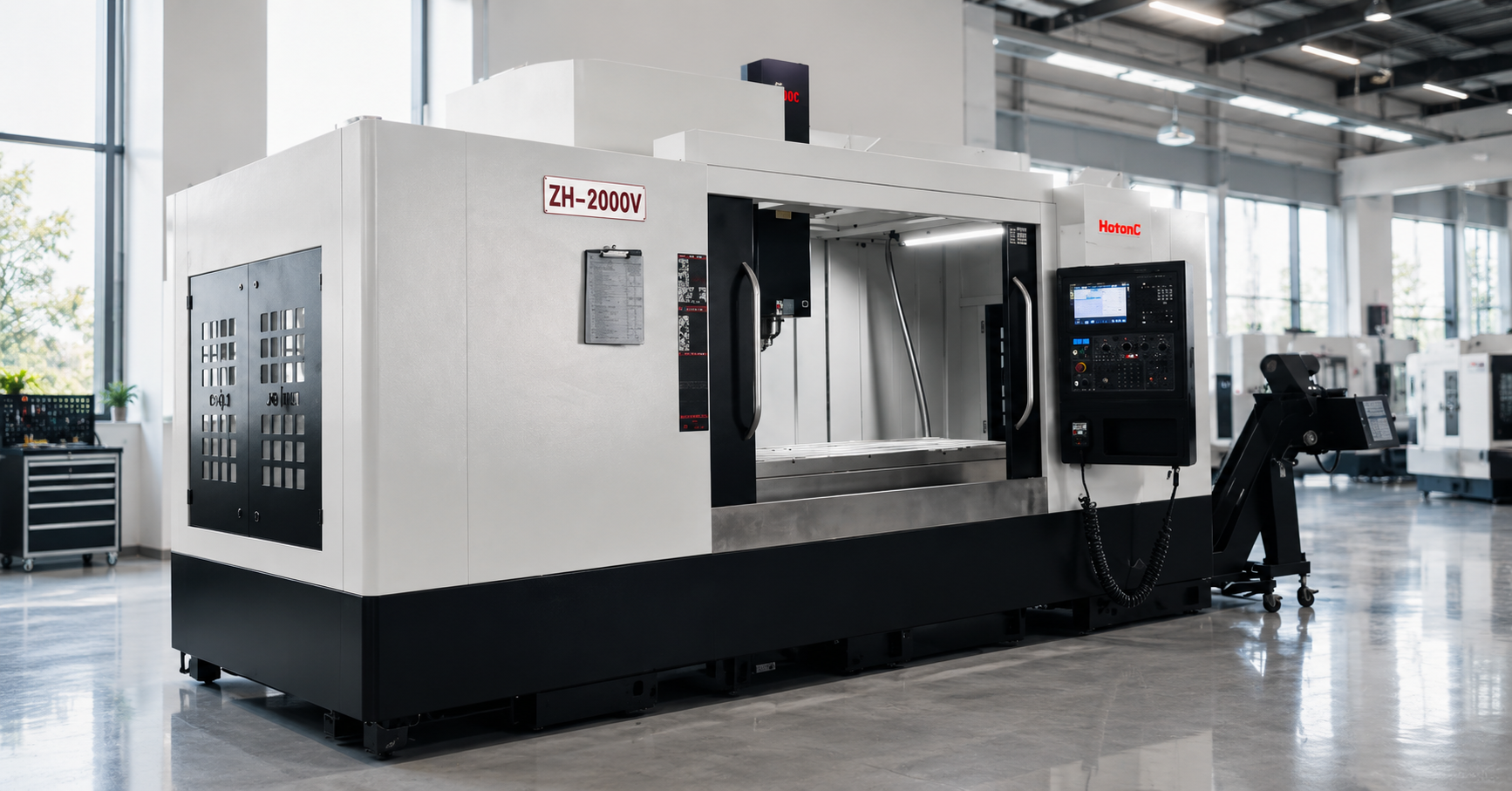
The ZH-2000V Vertical Machining Center from Zhihe CNC is designed around this type of production need. The product page lists 2000 / 500 / 500 mm X/Y/Z travel, a 2000 × 500 mm worktable, 500 kg maximum table load, BT40 spindle, 7.5 kW spindle motor, and MITSUBISHI M80VB CNC controller. Its listed applications include 3C electronic frames, lithium battery and PV aluminum structures, robot guide rails, automotive parts, and automation equipment.
Why Long-Profile Machining Needs a Different Machine Choice
Many buyers first try to process long profiles on existing equipment. It may work for prototypes or small batches. Once production volume increases, the weakness becomes obvious.
A long aluminum part may need repeated drilling, face milling, slotting, tapping, and end machining across its full length. If the machine travel is not enough, the operator must machine one section, reposition the part, reset the datum, and continue. That extra handling may look harmless, but it usually creates four problems: more labor, more accumulated error, longer cycle time, and greater inspection pressure.
For long aluminum profiles, one-time clamping is often more valuable than buyers first expect. It helps protect dimensional relationships from one end of the part to the other. It also reduces the chance that a hole pattern, slot, or mounting surface shifts after repositioning.
The ZH-2000V product page includes a battery tray aluminum profile case using 6061 aluminum alloy, with part size 1800 × 300 × 80 mm. The listed customer problem was insufficient travel on existing equipment, which required segmented clamping and caused cumulative positioning error of ±0.08 mm. After using the ZH-2000V, the page reports that segmented clamping was eliminated and cumulative positioning error was controlled within ±0.015 mm.
For a buyer, that is the kind of result that matters. The advantage is not just a longer X-axis. It is a more controlled process.
Key Features of the ZH-2000V for Production Use
The ZH-2000V is not positioned as a small general-purpose machine. Its value comes from combining long travel, practical spindle configuration, production-oriented tooling capacity, and accuracy verification.
| Feature | Product Data | Why It Matters to Buyers |
|---|---|---|
| X/Y/Z travel | 2000 / 500 / 500 mm | Supports long-profile and medium-sized part machining |
| Worktable area | 2000 × 500 mm | Gives space for long aluminum profiles and fixtures |
| Maximum table load | 500 kg | Useful for medium-sized parts and heavier fixtures |
| Spindle taper | BT40 | Common tooling interface for milling, drilling, tapping |
| Spindle speed | Max. 10,000 rpm, optional 12,000 rpm | Supports aluminum and steel profile machining |
| Tool magazine | 24-tool arm-type magazine | Reduces manual tool change interruptions |
| Controller | MITSUBISHI M80VB | Supports production machining, rigid tapping, and compensation functions |
| Accuracy | ±0.010 mm positioning, ±0.005 mm repeatability | Helps maintain batch consistency |
These details are listed on the product page and standard specification section.
From a buyer’s point of view, the table length and travel are the first things to check. But they are not the only things. Tool magazine capacity matters when a part needs milling cutters, drills, taps, chamfer tools, and finishing tools in one program. Accuracy matters when holes must align across the whole length. Controller capability matters when the shop needs stable tapping, compensation, and repeatable batch programs.
Where This Machine Fits Best
The ZH-2000V is especially suitable for manufacturers that produce long or medium-sized parts rather than small compact components. The product page lists applicable materials including aluminum alloys, copper alloys, carbon steel, and low-carbon alloy steel. It also lists target industries such as 3C electronic frames, lithium battery/PV aluminum structures, robot guide rails, automotive, and automation equipment.
That means the machine is a good fit for factories such as:
- Aluminum profile processing plants
- New energy battery tray manufacturers
- PV frame and structure suppliers
- Automation equipment frame producers
- Robot guide rail and linear beam manufacturers
- 3C electronic frame machining factories
- Medium-sized precision part workshops
- Automotive component suppliers
These buyers often have similar problems. They need stable machining over long distances. They want to reduce segmented clamping. They care about hole position consistency, flatness, cycle time, and fixture repeatability.
A small VMC may be cheaper, but it may force the factory to split the job. A long-travel vertical machining center is more useful when the workpiece needs continuous machining along the full length.
Production Case: Battery Tray Aluminum Profile
The product page gives a clear case involving a new energy battery tray aluminum profile made from 6061 aluminum alloy, with dimensions of 1800 × 300 × 80 mm. The customer’s previous process had three main problems: insufficient travel required segmented clamping, vibration during long-overhang cutting affected hole concentricity, and cycle time was about 45 minutes per piece.
The ZH-2000V solution used the 2000 mm X-axis travel for one-time clamping, a BT40 spindle with 7.5 kW motor for rigidity, and positioning accuracy of ±0.010 mm/300 mm for long-travel consistency. The reported results were practical: cumulative positioning error controlled within ±0.015 mm, cycle time reduced to 28 minutes, efficiency increased by 38%, yield improved from 85% to 97%, and daily output increased from 12 to 20 pieces.
This case gives buyers a useful way to think about ROI. The machine’s value does not come only from its price or travel size. It comes from fewer setups, faster cycles, better yield, and more daily output.
Why It Can Be Better Than an Ordinary VMC
An ordinary vertical machining center may be suitable for compact plates, molds, brackets, and small housings. But for long profiles, it may create limitations.
The ZH-2000V offers several advantages compared with a standard smaller VMC:
| Buyer Concern | Ordinary VMC Limitation | ZH-2000V Advantage |
|---|---|---|
| Long aluminum profiles | May require segmented clamping | 2000 mm X-axis travel supports one-time clamping |
| Profile hole accuracy | Datum shift may accumulate | ±0.010 mm positioning and ±0.005 mm repeatability support consistency |
| Tool change efficiency | Manual or limited tools may slow production | 24-tool arm-type magazine supports multi-process machining |
| Batch production | Repeated setup affects output | Longer travel and stable structure reduce non-cutting loss |
| Application range | Better for small/medium compact parts | Better for long aluminum/steel profiles and medium-sized parts |
This does not mean every factory needs a ZH-2000V. If the workpiece is small, a smaller VMC may be more economical. But if the factory repeatedly machines long profiles, the longer travel can remove a bottleneck that a standard machine cannot solve.
How Buyers Should Choose This Type of Machine
Before buying a long-travel vertical machining center, buyers should prepare real part data. Do not start only with machine price.
Send the supplier:
- Workpiece drawings
- Material grade
- Maximum length, width, and height
- Part weight
- Current setup count
- Hole position tolerance
- Flatness requirement
- Current cycle time
- Fixture method
- Batch quantity
- Surface finish requirement
- Preferred controller or tooling standard
This information allows the supplier to judge whether a 2000 mm X-axis machine is necessary and whether the fixture can support the process.
Buyers should also confirm the final technical specification carefully. The product page headline lists a rapid traverse rate of 30 / 30 / 30 m/min, while the detailed parameter table lists rapid traverse of 48 / 48 / 48 m/min. Buyers should confirm the final value in the quotation and technical agreement before purchase.
Service, Acceptance, and Export Considerations
For overseas buyers, machine performance is only part of the purchase. Delivery, installation, training, warranty, and spare parts matter too.
The ZH-2000V page lists delivery of approximately 45–60 working days after down payment and signed contract, standard export wooden case packaging with moisture-proof, shock-proof, and rust-proof treatment, sea or air freight options, on-site installation and commissioning by supplier engineers, free 2–3 days on-site training, 12-month warranty from final acceptance, and long-term genuine spare parts supply.
The page also states that buyers may conduct pre-acceptance trial cutting at the supplier’s facility after assembly and commissioning, followed by final acceptance trial cutting after delivery, installation, and commissioning at the buyer’s facility.
For buyers, this is important because a machine should not be judged only after it arrives. Trial cutting and acceptance help confirm whether the machine can produce the actual part to the required standard.
FAQ
What type of factory should consider the ZH-2000V?
Factories machining long aluminum profiles, battery tray structures, PV aluminum parts, robot guide rails, automation beams, 3C frames, and medium-sized precision parts should consider this model.
Why is 2000 mm X-axis travel important?
It allows many long-profile parts to be machined in one clamping instead of segmented setups, reducing accumulated positioning error and setup time.
Is the ZH-2000V only for aluminum?
No. The product page lists aluminum alloys, copper alloys, carbon steel, and low-carbon alloy steel as applicable materials.
What should buyers confirm before ordering?
Confirm the final travel, spindle speed, rapid traverse rate, controller, tool magazine, fixture plan, accuracy requirement, delivery terms, installation support, and acceptance method.
Conclusion
A vertical machining center for long aluminum profiles should be purchased based on process problems, not only machine size. If the factory struggles with segmented clamping, accumulated error, long cycle time, or unstable batch output, a long-travel VMC may create real production value.
The ZH-2000V stands out because it combines 2000 mm X-axis travel, BT40 spindle, 7.5 kW spindle motor, 24-tool arm-type magazine, MITSUBISHI M80VB controller, verified accuracy, chip conveyor, coolant support, and application cases for new energy battery trays and automation beams.
For buyers, the next step is simple: start with the part drawing. Once the material, length, tolerance, fixture method, and output target are clear, it becomes much easier to judge whether the ZH-2000V is the right machine for production.