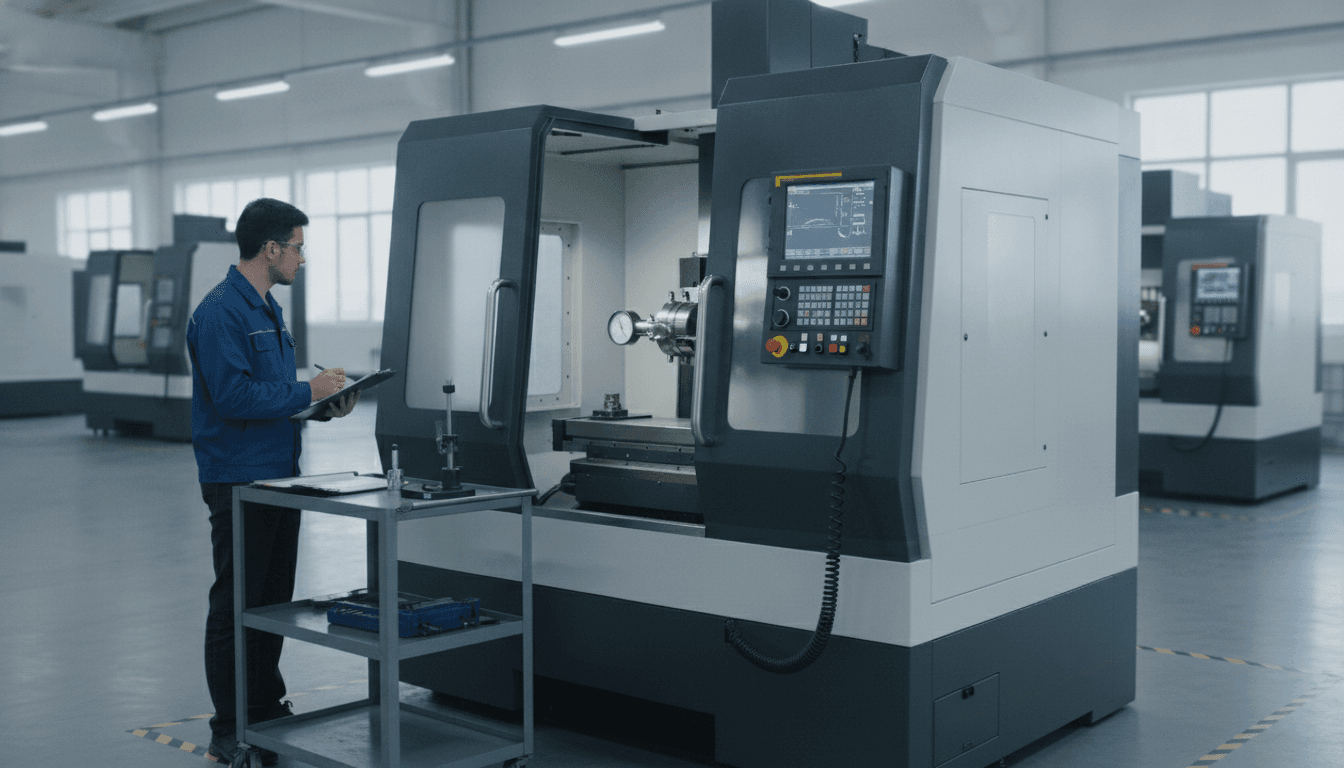
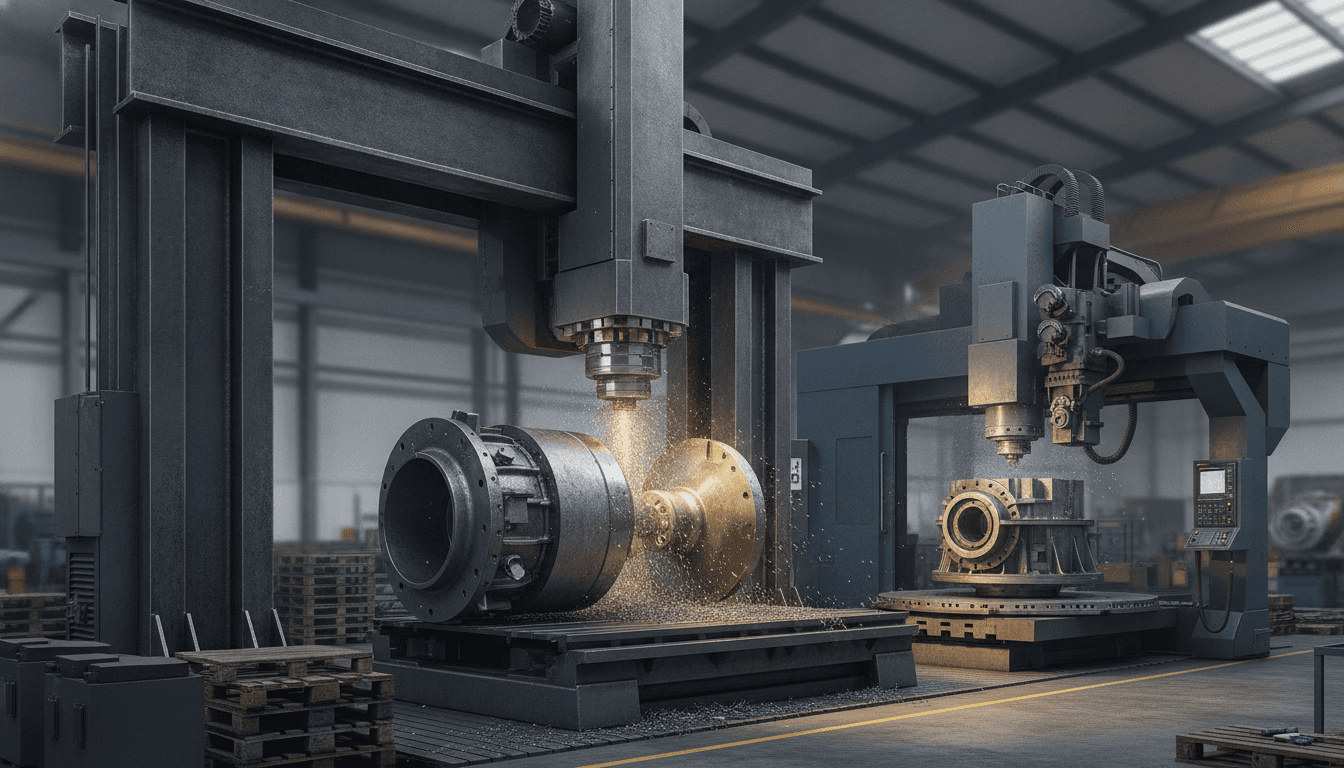
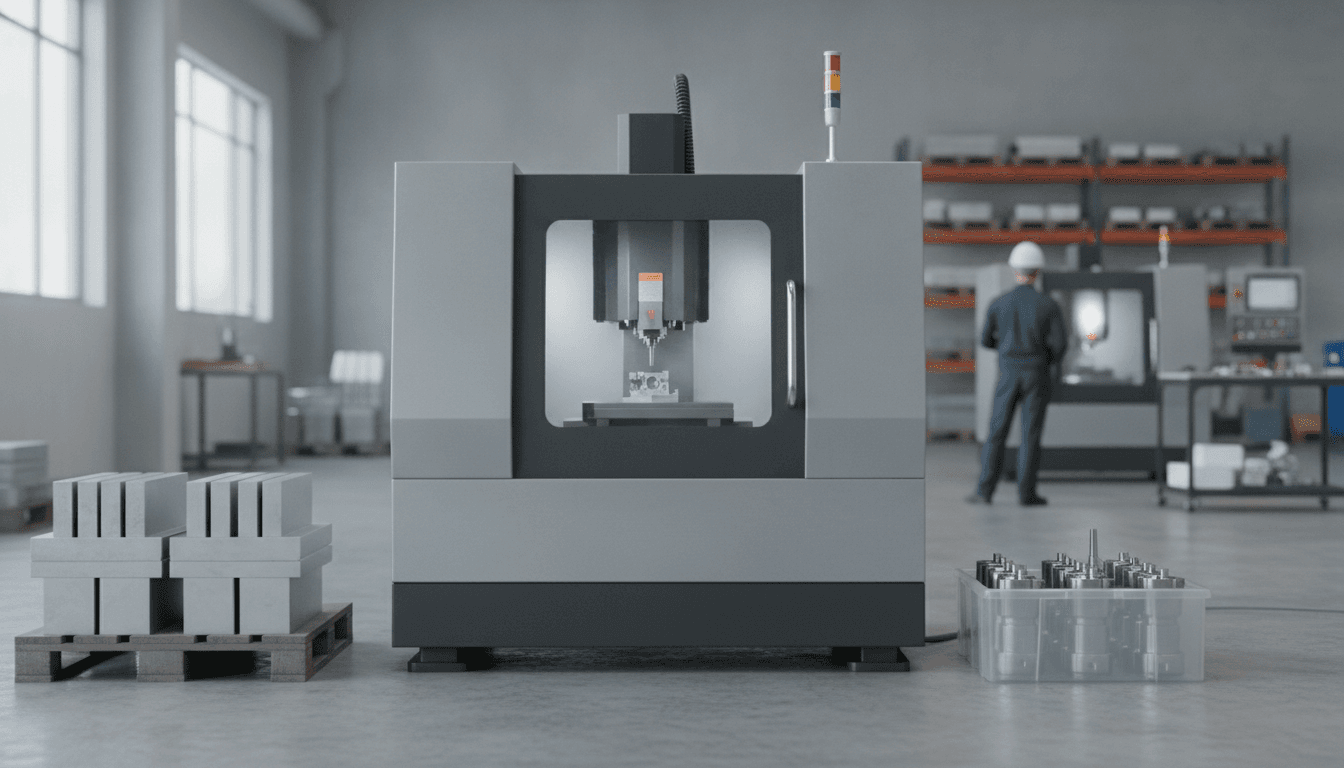
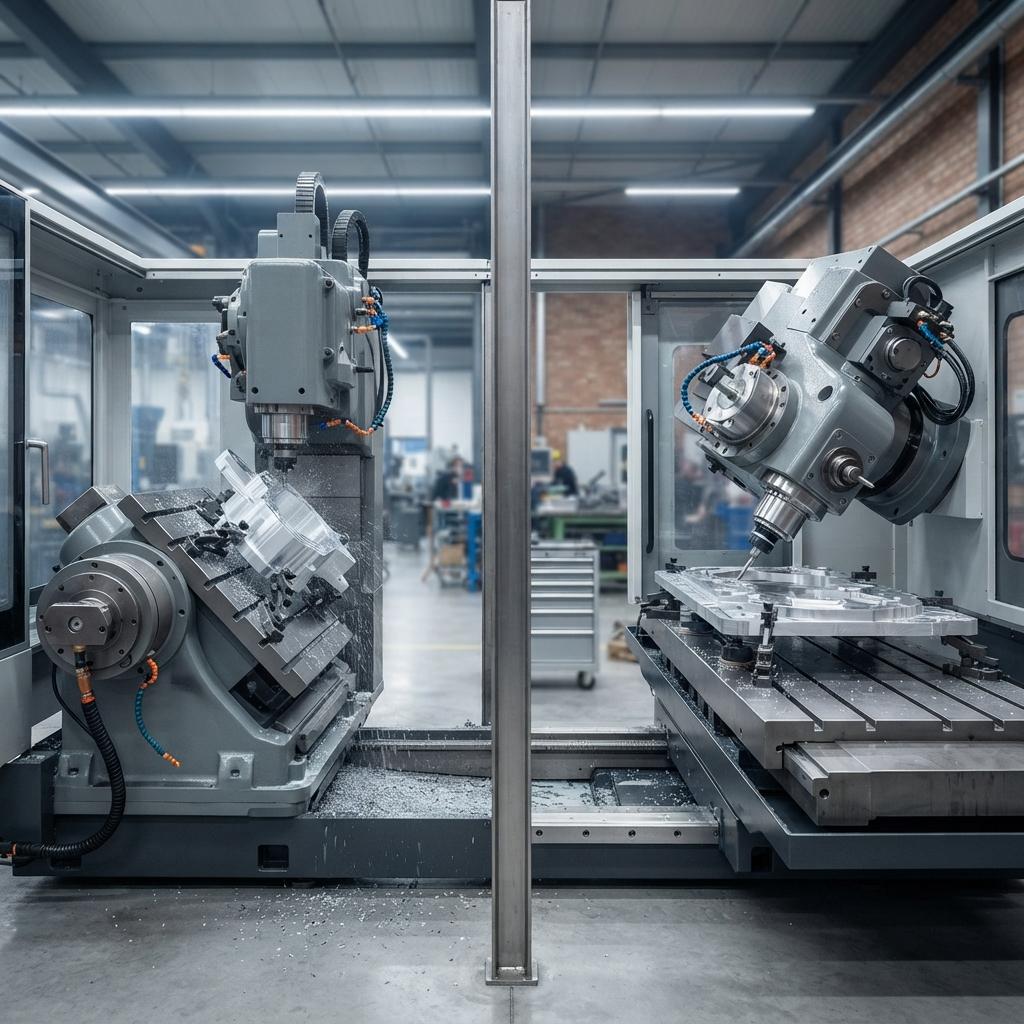
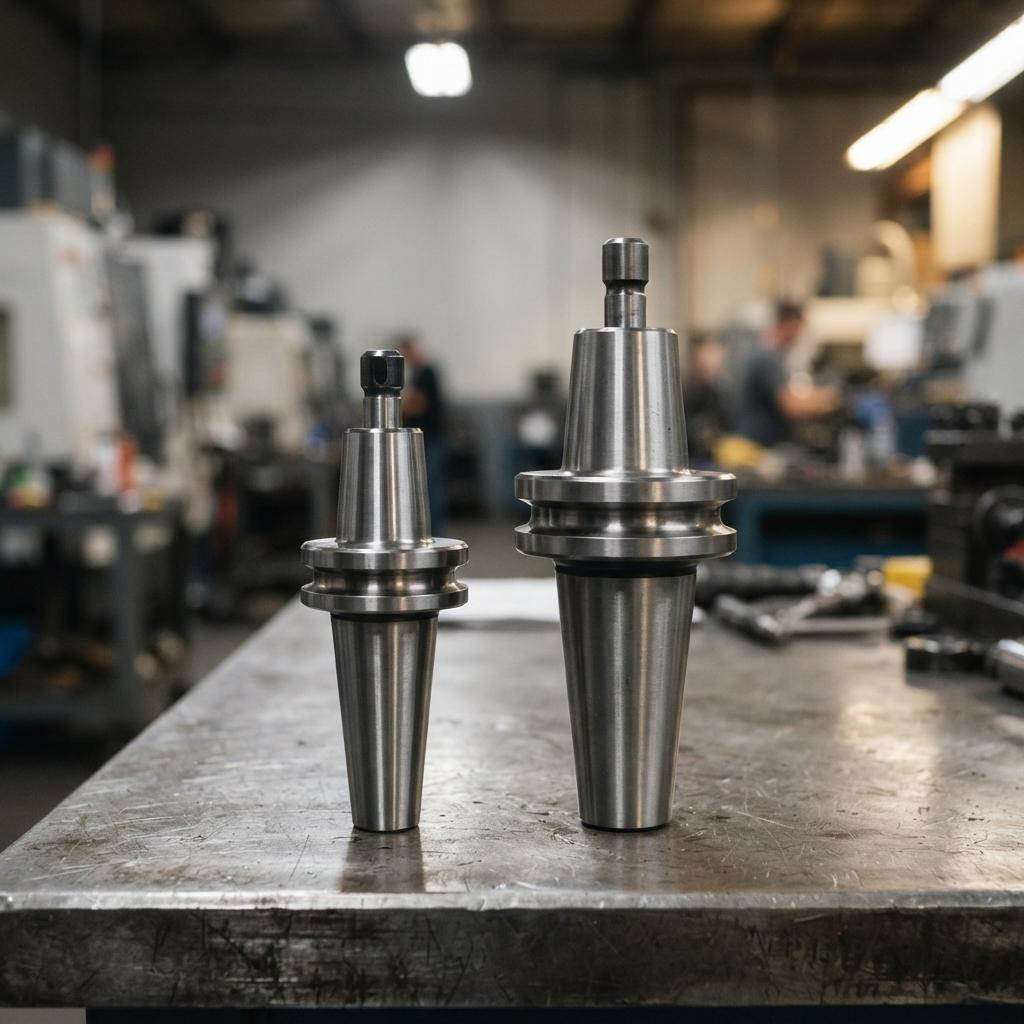
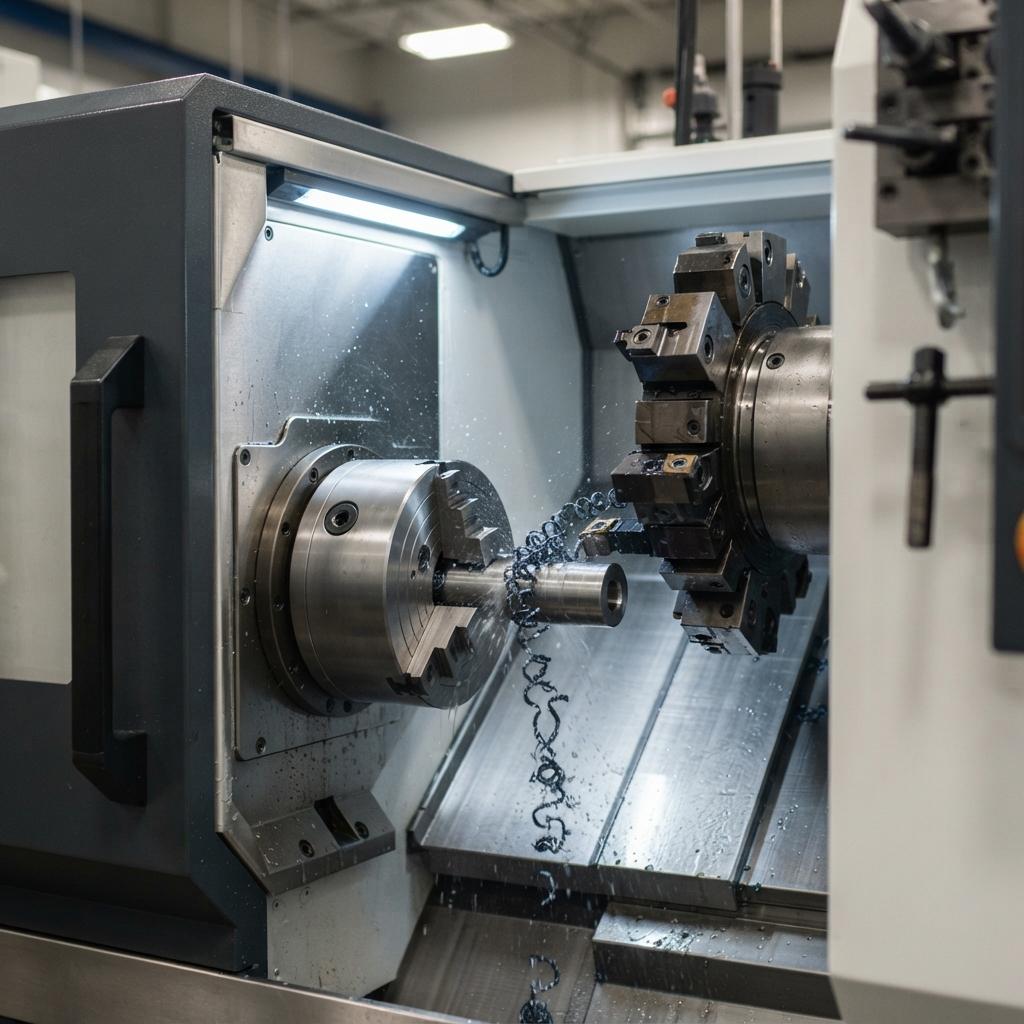
A cnc machining center for heavy parts is a machine whose base, column and guideways are sized so that both the workpiece mass and the cutting force travel through a stiff load path — you don't get one by ordering a standard vertical with a larger table bolted on. That distinction decides every comparison after it. So before you open a single spec sheet, run three tests: weigh the part, count the faces, look at your floor.
Weigh the heaviest workpiece you will realistically load, per setup, with fixture and pallet. Count the faces you must reach without re-fixturing, because multi-face machining of heavy parts is where a horizontal with a CNC rotary table earns its price, and where a gantry's open front wins on awkward geometry. Then look down. Floor thickness, foundation, and the crane or forklift route decide whether the machine you picked can even be installed.
Skip those three numbers and you'll spend weeks comparing spindle tapers that don't matter. Get them, and the shortlist writes itself: a gantry machining center for heavy parts when the workpiece is wide, tall and miserable to lift; the ZH-1095 horizontal when it's a compact housing with four or five faces to reach.
How Do You Match a CNC Machining Center for Heavy Parts to Part Weight and the Load Path?
Weight alone tells you little. Where that weight sits, and how it reaches the floor, decides which machine class you actually need. Run these five checks in this order.
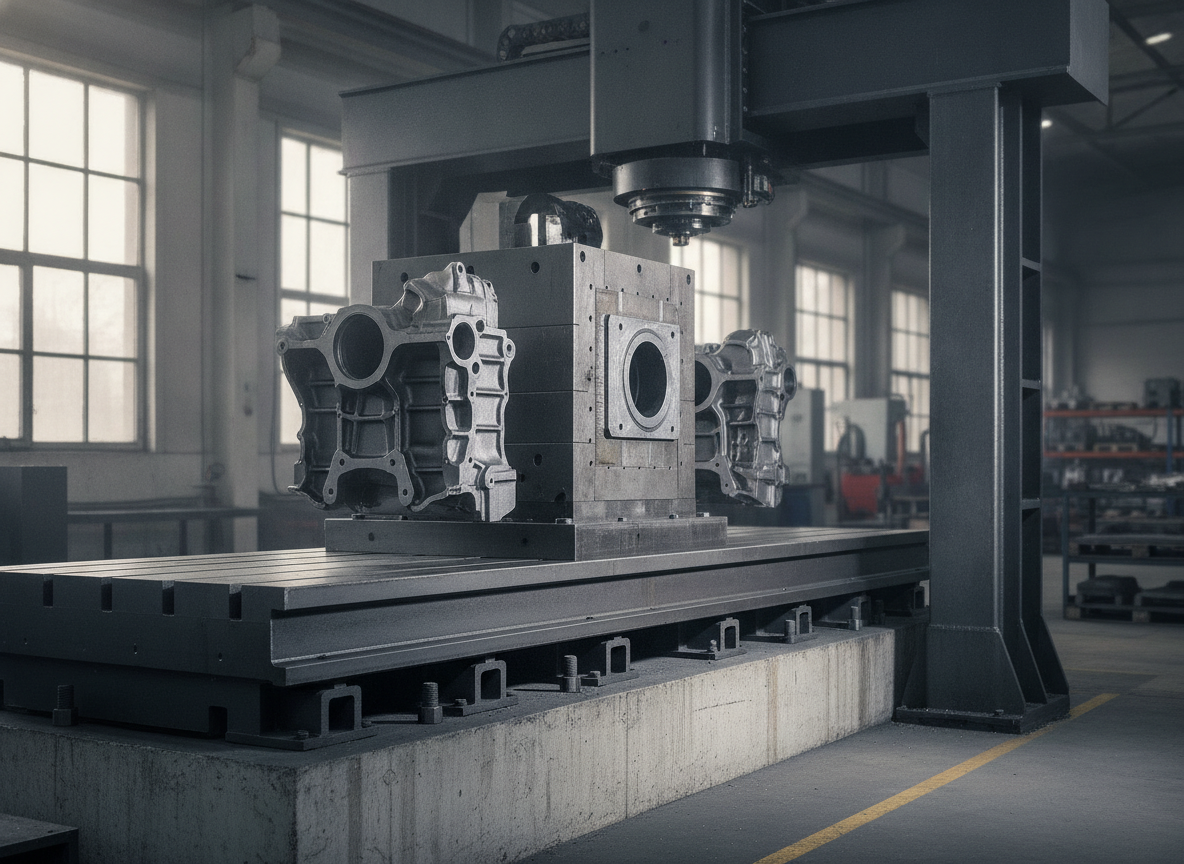
- Mass per setup.Weigh the part plus fixture plus tombstone, not the casting by itself. A 4-tonne housing on a 1.2-tonne angle plate is a 5.2-tonne question, and that's the number the table and the drives have to carry all shift.
- Lifting.Craneway height and sling angle cap what you can physically load. If the hook can't swing over the pallet, a larger envelope buys nothing.
- Fixture stiffness.A soft fixture spends the machine's rigidity before the tool touches steel. Short, low-profile clamping keeps cutting force inside a closed loop.
- Structural load path.Follow the force from part to fixture to table to bed to slab. Zhihe's fixed-beam gantry closes that loop vertically; the ZH-1095 horizontal uses a monolithic base and cross-slide table instead. This heavy duty cnc machining center load path reviewof turbine bases shows what breaks when the path bends.
- Floor.Static mass and cutting vibration both land on the slab. A thin bay floor forces isolation work that costs more than the difference between two machine classes.
Five numbers agreeing beats a brochure table size, every time. That's how a cnc machining center for heavy parts gets qualified instead of guessed at.
Why a Bigger Table Does Not Make a Heavy Duty CNC Machining Center
A wide table is easy to weld on. Holding tenths under a 4-ton casting is not. Table area tells you what fits; it says nothing about what the machine can cut without deflection, chatter, or a scrapped finish.
Follow the load path. Mass runs from the workpiece through the fixture, table, guideways, saddle, column and base into the floor. Every joint adds compliance. A long table on a light base flexes more, not less. So a heavy duty cnc machining center earns the label at the base and column, where cast mass and ribbing absorb interrupted cuts, and at the guideway, where damping decides whether the tool sings or cuts.
Zhihe's gantry design shows it. The fixed-beam structure keeps the spindle on a short, rigid loop, and the hybrid guideway configuration trades pure rolling speed for damped stiffness, which is why that machine is built for micron-level accuracy retention rather than a big envelope alone. The ZH-1095 takes another route: a monolithic base and cross-slide table for large housings.
Chip and coolant volume matter too. Deep pockets in a heavy casting make swarf fast, and a machine that can't clear it will rub chips instead of cutting. Ask what a cnc machining center for heavy parts does in hour six, not what its table measures on a spec sheet.
Gantry or Horizontal Machining Center for Heavy Parts: Which Fits Your Work?
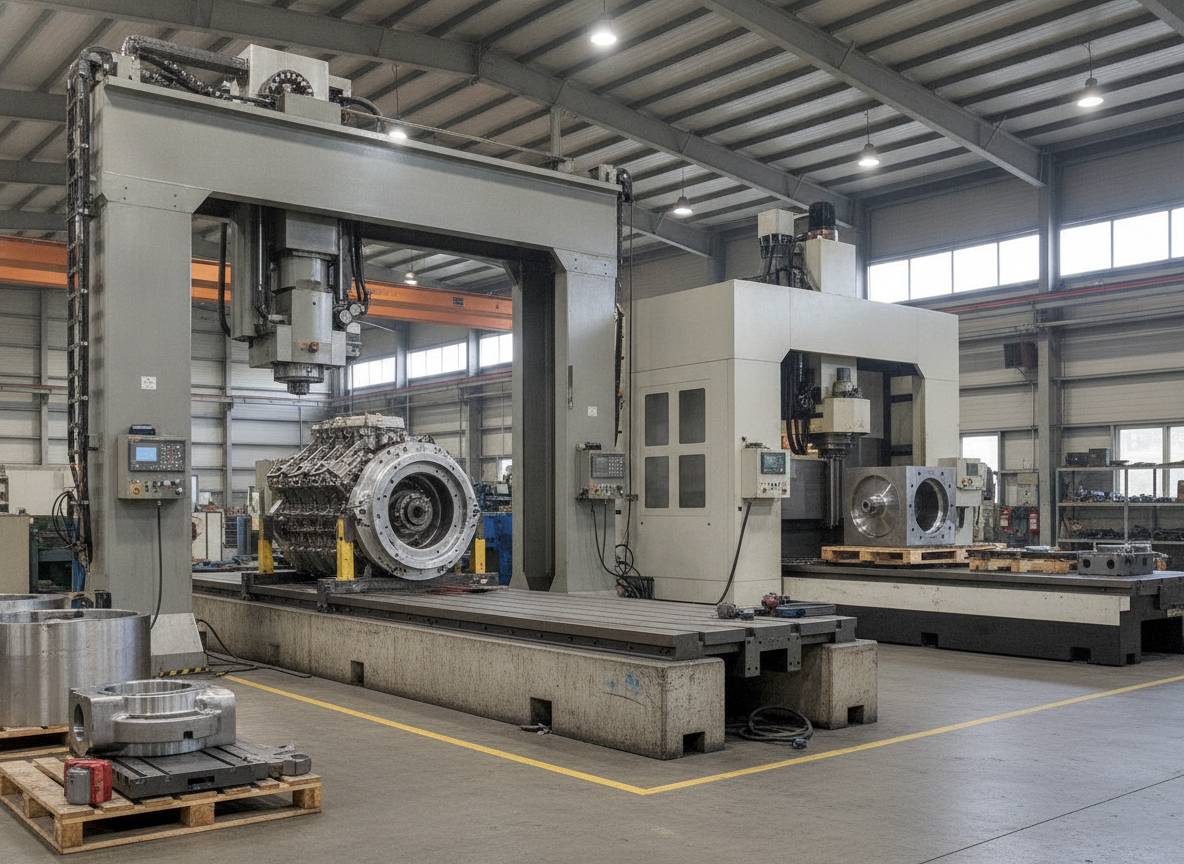
Most buyers start from the machine they already run and then discover the part never fit it. Four things decide the answer: geometry, faces per setup, foundation, and how the workpiece gets in and out.
| Decision point | Gantry | Horizontal (ZH-1095 class) |
|---|---|---|
| Part geometry | Long, wide, flat-bodied work: plates, frames, mold bases, fabricated weldments. The table carries the mass, and the fixed beam keeps the spindle working over it. | Boxy, cubic work. As a horizontal machining center for large housings, it lets valve bodies, gearbox casings and industrial enclosures rotate around a horizontal spindle. |
| Faces per setup | Top face is easy. Sides usually cost you a second clamping or an angle head. | Multi-face machining of heavy parts is the reason this machine exists. A precision rotary table puts four faces in one clamping, often five. |
| Floor and foundation | Long footprint, and a fixed-beam gantry deserves a properly poured foundation. Budget for that before you sign. | Smaller footprint, monolithic base, simpler siting. On installed cost the horizontal usually comes out ahead. |
| Load, unload, throughput | Overhead crane drops the part straight on the table. Great for one-offs, slower on repeating batches. | Fixture-based loading and a shorter load-to-chip rhythm when the same family runs again and again. |
Read the table top-down and stop at the first row where your part fails. That single mismatch will cost more than any spindle specification you compare afterwards.
Here's the verdict rule. If two or more faces of the same part must be cut in one setup and the work repeats in batches, take the horizontal route. If the workpiece is a long, heavy plate or weldment where the mass has to sit still and one face does most of the work, a gantry machining center for heavy parts is the honest answer. Still torn? Check the published gantry specifications, applications and RFQ pointsagainst your part drawing before you shortlist either machine.
What Does Multi-Face Machining of Heavy Parts Require?
Take a cast gearbox housing with bearing bores on four sides. On a horizontal machining center for large housings, the part stays clamped while the table indexes. On a three-axis vertical, it comes off the table four times, and that's where bore alignment usually goes wrong.
Here's the sequence I'd run on a ZH-1095, and why each step earns its place.
- Datum choice.Pick the machined mounting face plus one bearing bore as the primary datum before the first cut. Why: every later bore is chained to that pair, and a rough cast surface used as a datum throws the whole stack off. The tolerance chain matters more than any single bore size, as this breakdown of how gearbox housing tolerances stack up shows.
- Fixturing.Clamp onto support pads directly under the bore bosses and torque the bolts in sequence. Why: a heavy casting flexes between clamps, so you can cut a straight bore into a part that springs oval when released.
- Rotary indexing.Index the precision CNC rotary table 90 degrees after each face. Why: multi-face machining of heavy parts is won right here, because the part keeps one datum for all four faces. Lose the index and you re-clamp; re-clamp and you re-introduce error.
- In-process probing.Probe the first finished bore before cutting the opposite face. Why: it catches thermal drift and casting shift while there's still stock to correct.
- Release.Measure bore-to-bore with a pin, log the numbers on the setup sheet, then release. Why: the next operator inherits evidence, not a guess.
Skip the rotary table and the machine can still cut every face. It just can't hold them to each other. Would you really re-clamp that housing four times to save a table?
How Much Cutting Force Can the Structure Take?
More than the spindle datasheet suggests. What limits cutting force is how far the whole loop, from base through column, guideway, fixture and part, deflects under load. Kilowatt ratings tell you what the motor can pull. Stiffness tells you what the machine can hold.
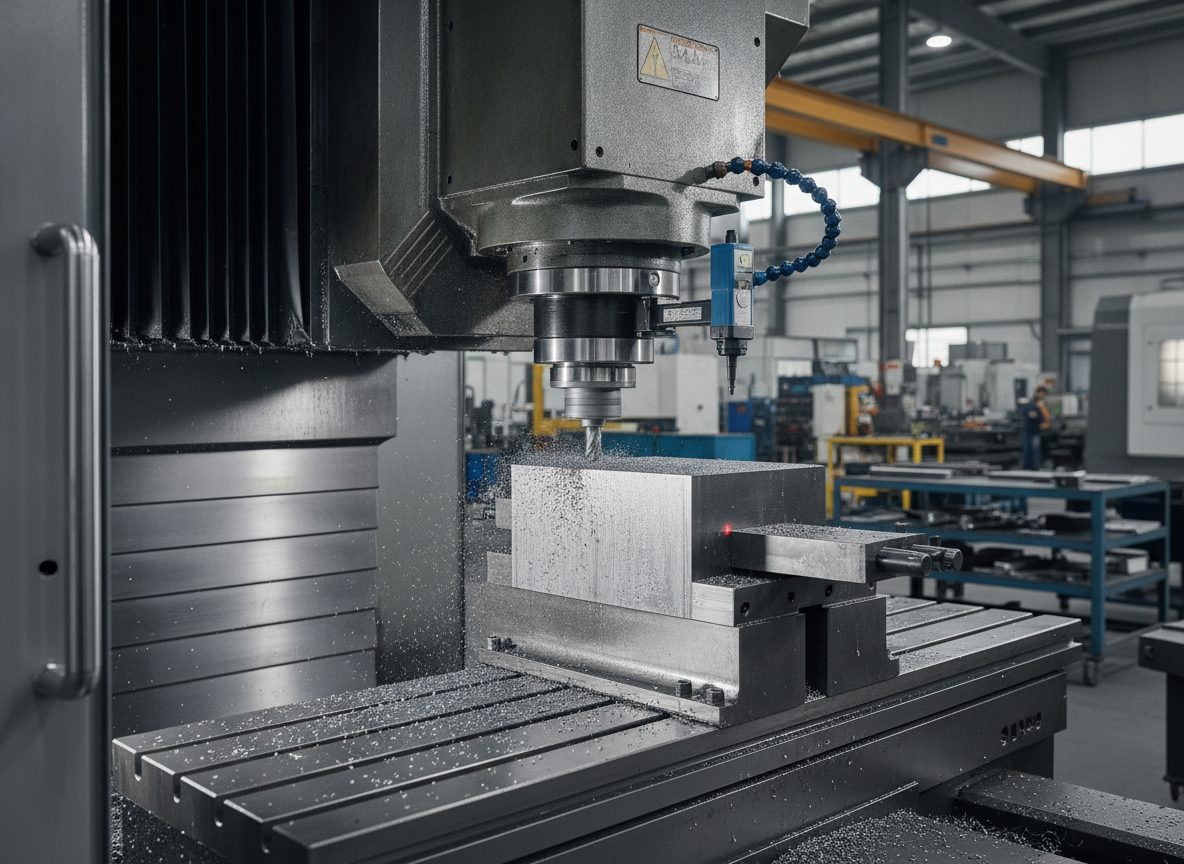
Interrupted cuts are where this shows up first. Cast skin with sand inclusions and hard spots, or a weldment with spatter and tack welds, turns a steady load into an impact at every insert entry. The cutting edge absorbs those hits directly. A structure that rings after each impact dulls tools faster than the same machine taking a heavier, continuous cut.
Then overhang. Every millimetre of tool stickout and holder length costs stiffness, and no spindle upgrade buys it back. Damping decides the rest, because the machine that soaks vibration into cast iron and way contact cuts quietly where a lighter frame starts to sing. Chatter is a structural argument, not a power argument. Where does the tool tip sit relative to the column when your part is at full height?
On a heavy duty cnc machining center, that geometry is the design. The Zhihe gantry machining center uses a fixed-beam structure, so the head travels along a beam that stays locked instead of climbing a moving cross rail, and stiffness holds steady across the table width. Hybrid guideways blend sliding contact with rolling elements, which keeps damping where a pure linear-guide machine gives it away. For a gantry machining center for heavy parts cutting cast iron and weldment skin, that pairing matters more than another 10 kW.
Which Zhihe Machine Fits Which Heavy Part?
Shortlists get short fast once you name the part family. Zhihe builds six platforms, and only two of them belong in a heavy-part conversation.
| Workpiece family | Machine | Why it earns the slot |
|---|---|---|
| Gearbox and pump housings, valve bodies, industrial enclosures, any part needing four or five faces | ZH-1095 horizontal machining center | Monolithic base, cross-slide table, precision CNC rotary table. Faces come from indexing, not from re-fixturing a 2-ton casting. |
| Mid-size multi-face components | HMC-1000 | The other horizontal in the range. Size your part envelope first, then pick between it and the ZH-1095. |
| Mold bases, energy and automotive frames, outsized weldments | Gantry machining center for heavy parts | Fixed-beam structure and hybrid guideway, built for heavy-duty cutting on large parts rather than for speed on small ones. |
| Medium-to-large parts machined mainly from the top | ZH-1370V | Simpler fixturing when a fourth face buys you nothing. |
| Long aluminum profiles | ZH-2000V | Length is the design driver here, not mass. |
| Small drilled and tapped batches | ZH-700T | Fast on light work. Wrong tool for a 3-ton casting. |
My default: shortlist the ZH-1095 first for housings — it's a horizontal machining center for large housings, and the qualification guide covers fixture and probing decisions in detail. Reach for the gantry only when the part is too heavy or too awkward for a rotary-table setup. Size still wins over table size, as always.
Machining Center for Large Weldments: What Changes When the Part Is Fabricated
A weldment isn't a casting with a rougher skin. It moves — and it keeps moving after you cut it. That one fact reshapes how you qualify a machining center for large weldments.
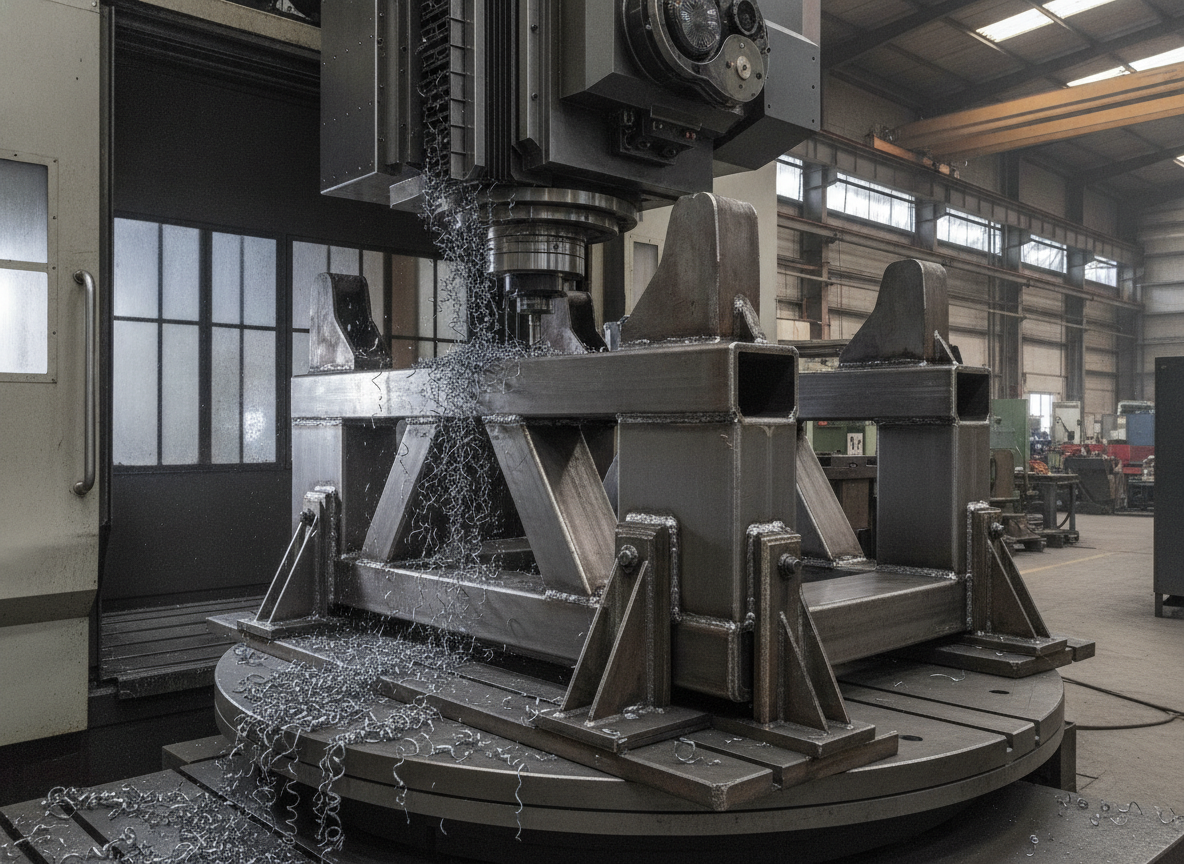
Five checks, ordered by what they cost you if skipped:
- Stress relief before the first cut.Residual weld stress releases as stock comes off, so a frame roughed today can bow overnight; relieve it, then finish.
- Stock allowance sized to distortion, not to the drawing.Flame-cut plate rarely lands within 2 mm, so leave enough to clean the worst corner and still hold the tolerance band.
- Interrupted cuts planned, not survived.Weld beads and tacks break the chip path and hammer the insert; a fixed-beam gantry takes that punishment better than a light frame.
- Clamping that supports instead of squeezes.Jack and shim to the machined datum and torque lightly, because a part pulled flat springs back the moment the clamps come off.
- In-process probing between faces.Fabricated parts drift; checking after each index lets you correct before the second face inherits the first face's error.
Welded gearbox shells with four faces to reach suit the ZH-1095 and its rotary table, which cuts setups. Long frames go on the gantry. Neither saves a part whose geometry the weld already ruined. A cnc machining center for heavy parts cuts metal; it doesn't undo heat.
What Drives the Cost of a CNC Machining Center for Heavy Parts?
Structure takes the biggest bite. A fixed-beam gantry carries more cast iron per metre of travel than a horizontal, and the quote tracks that weight — not the table size. Zhihe's breakdown of how a machine's price and landed cost are built upis worth reading before you compare two numbers side by side, because the cheap quote usually stops at the factory gate.
Foundation and rigging come next, and they never appear on the machine quotation. A heavy duty cnc machining center needs a poured and cured base, crane access, and a rigging crew with slings rated for the castings. You'll also want to read what the floor has to carry before the machine arrives— slab thickness and load path decide more of the civil bill than buyers expect.
Workholding and tooling: oversized fixtures, large boring bars, a rotary table matched to the part. Floor space is rent paid monthly for a decade. Setup hours matter most on a cnc machining center for heavy parts, since each load, indicate and release cycle can cost a full shift.
Running cost — spindle load, coolant, chip volume — separates the two architectures less than people assume. Verdict: four or more faces per part, in repeat batches, and the horizontal route (ZH-1095, cross-slide table, rotary table) pays back through fewer setups. Long, single-setup, lift-awkward workpieces go gantry, every time.
Key Takeaways: Qualifying a CNC Machining Center for Heavy Parts
Paste these five lines into your RFQ note — they stop a vendor quoting on table size alone.
- Start from mass per setup.A 12-tonne housing flexes a light column no matter how wide the table is.
- Follow the load path.Base, column, guideway, damping: Zhihe's fixed-beam gantry with hybrid guideways is built around that chain, not around footprint.
- Count faces before spindles.Multi-face machining of heavy parts is won or lost at the rotary table; the ZH-1095 pairs a cross-slide table with a CNC rotary table for large housings.
- Ask how the structure behaves in an interrupted cut.Cast skin and weld spatter decide chatter more than spindle kilowatts.
- Price the floor and the rigging.Foundation, lifting and setup hours can outweigh the machine line on a cnc machining center for heavy parts.
Frequently Asked Questions
What does a cnc machining center for heavy parts cost?
No list price means much here, because the structure is the product. Zhihe publishes a price and quotation-scope article that separates the machine from foundation, rigging, workholding and tooling — those items often add more than buyers expect. So compare quotations on what's inside them, not on the bottom line.
How long is lead time on a gantry machining center for heavy parts?
Standard builds move faster than anything customised, and a gantry with a non-standard table or an extra axis sits at the far end. Ask for a milestone list rather than one number. Site installation and commissioning count too, so add them to your plan.
How do I verify accuracy instead of trusting the brochure?
Witness a test cut, ideally on your own part or a blank that mimics it. Ask for geometric checks under ISO 10791 test conditions and positioning measurement to ISO 230-2. Micron-level retention claims mean little until you see them held after four hours of heavy cutting.
Will it machine large weldments without distortion?
It cuts what you clamp, so the preparation is yours. Stress-relieve the weldment before finishing, leave uniform stock, and expect interrupted cuts because scale and weld bead are never even. A machining center for large weldments earns its keep on stock discipline, not on spindle power.
Do I need a special foundation?
A gantry usually wants an isolated block with mass of its own. A horizontal machining center for large housings is more forgiving on a good industrial slab. Commission a floor survey first; correcting concrete after the machine lands costs far more than the concrete ever would.
Can Zhihe customise a machine for our part family?
Yes. OEM machine manufacturing and custom CNC automation sit alongside the standard vertical, five-axis, gantry and horizontal lines. Bring drawings with mass, envelope and faces-per-setup marked on them.
What tooling should I order with the machine?
Start from the heaviest face mill and the longest boring bar your part needs, then work back to what the spindle and magazine will take. Tooling bought after delivery is tooling bought badly. Two big roughing tools that fit beat twenty small ones that don't.
Which machine for large housings: ZH-1095 or the gantry?
Multi-face housings on a rotary table point to the ZH-1095, with its monolithic base, cross-slide table and precision CNC rotary table. Long, heavy single-setup plates lean gantry. When a part needs five faces and weighs more than your crane crew enjoys, the horizontal wins on access.
What happens after installation?
Zhihe offers installation, training and after-sales service. Insist that operator training happens on your parts, not on a demo block. A crew that has already cut your casting once won't be learning it mid-run.