5-axis trunnion vs swivel head is a question about where the two rotary axes live: on the worktable, or in the spindle head. A trunnion carries the part and tilts it under a fixed spindle, which suits small and medium complex parts that need short, stiff tools; a swivel head moves the tool around a stationary part, which suits large or heavy workpieces and deep cavities that a tilting part cannot present. The right choice follows the part envelope, the fixture mass and the reach each feature demands.
Both layouts can interpolate five axes simultaneously, so the difference does not appear in the axis count. It appears in what the machine has to move, how far the tool must reach, how the fixture is built and how you prove accuracy at acceptance. This 5-axis trunnion vs swivel head guide sets out those differences plainly, then gives a decision checklist you can apply to a real drawing.
What the two layouts actually are
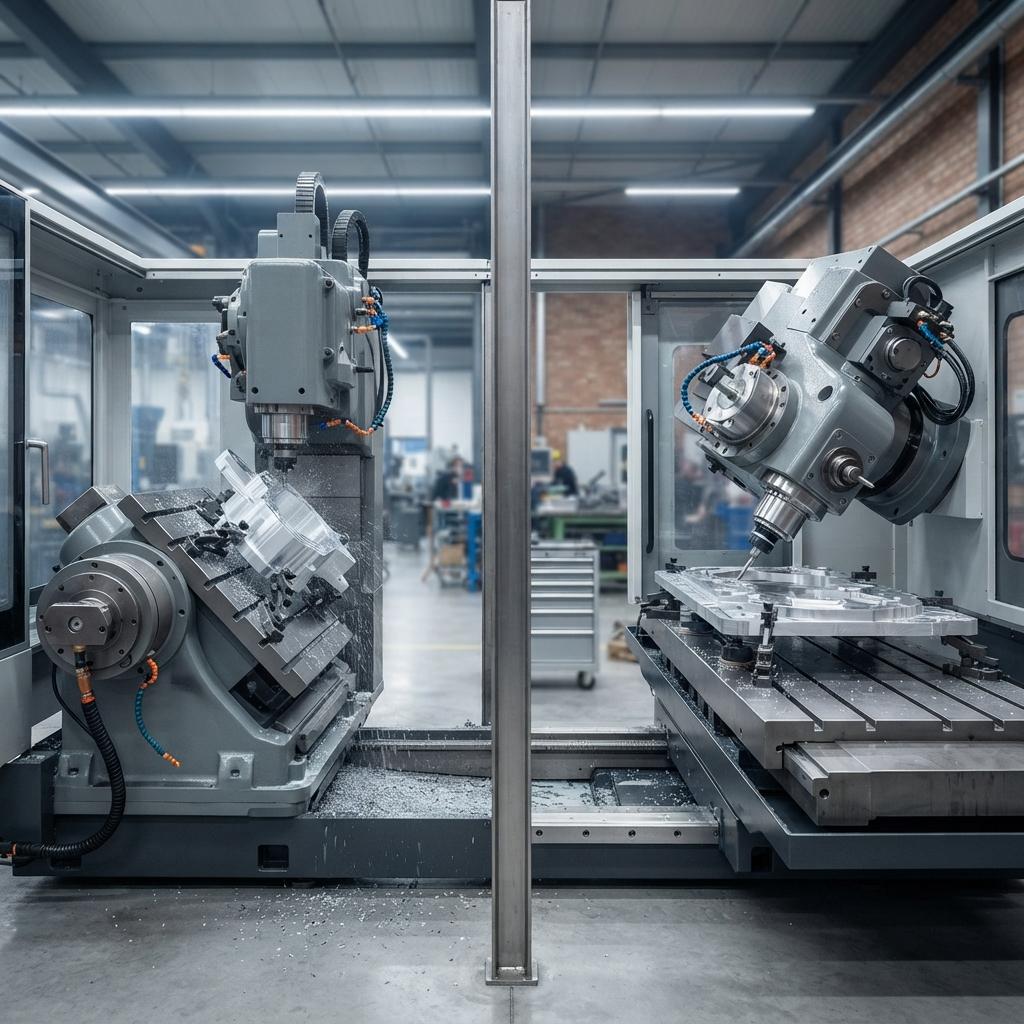
In a trunnion design, the C axis rotates the table and the A axis tilts the trunnion cradle, so both rotary motions act on the workpiece. This table-table configuration places the pivot below the part, and the part is presented to a spindle whose orientation stays fixed in most designs. Because the spindle only moves linearly, its structure can be stiff and compact.
In a swivel head 5-axis design, the rotary axes are built into the head. The spindle tilts and rotates around the workpiece, which normally stays clamped flat on the table. The part can therefore be large and heavy, because the machine no longer has to accelerate it. The cost is that the head carries the rotary drives, and access into deep cavities depends on tool length rather than part rotation.
A third arrangement, the head-table design, splits the axes: one rotary axis in the head and one in the table. It is a genuine compromise, and it is worth understanding before you treat the 5-axis trunnion vs swivel head choice as binary.
5-axis trunnion vs swivel head: direct comparison
The table below compares the two layouts on the criteria that decide most purchases. The figures describe typical practice; confirm the actual values for the model you are quoting.
| Criterion | Trunnion (table-table) | Swivel head (head-head) |
|---|---|---|
| Where the rotary axes are | Both on the worktable | Both in the spindle head |
| Workpiece mass | Limited by table load and rotary drive capacity | Limited mainly by table load, so heavy parts are practical |
| Moving mass during rotary motion | Part plus fixture | Head assembly only |
| Tool length needed | Short, because the part is oriented to the tool | Longer for deep or angled features |
| Work envelope per part size | Rotary swing consumes envelope | Envelope stays usable for flat, large parts |
| Typical rotary accuracy driver | Table drive, brake and encoder | Head drive, brake and structural stiffness |
| Chip and coolant behaviour | Chips fall away from the part face; good for pocketing | Chips can collect in cavities on a horizontal table |
| Fixture design | Fixture must be compact and balanced for rotation | Fixture can be large and simple, but must resist tool reach |
| Best fit parts | Impellers, housings, medical parts, mould inserts, small structural parts | Large moulds, long structural parts, deep-cavity work, heavy castings |
| Main limitation | Part size and mass ceiling | Reach and head dynamics |
Where a trunnion wins
A trunnion machining center wins when the part is complex rather than large. Because the part rotates, the tool can approach five faces with short, rigid tools, which is exactly what impellers, turbine components, medical housings and mould inserts need. Short tools reduce deflection, and deflection is usually the largest error source in five-axis finishing.
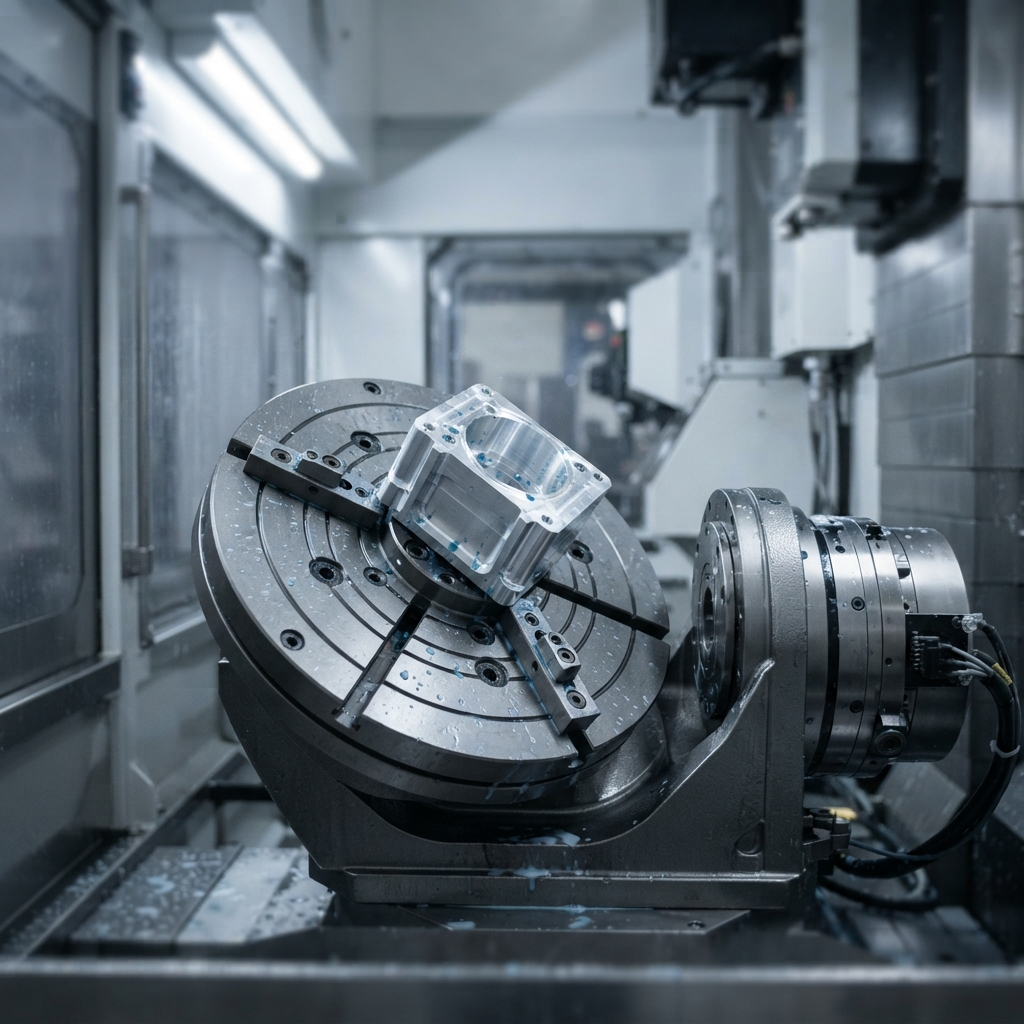
Trunnions also handle chip evacuation well. When a pocket is tilted towards the operator or towards the drain, chips leave the cutting zone instead of being recut. That improves surface finish and reduces the risk of a chip being pressed into a sealing face.
The limits are physical. Every kilogram of fixture and workpiece has to be accelerated and braked by the rotary drives, so part mass and fixture mass compete for the same capacity. Rotary swing also consumes work envelope: a part that fits the linear travel may still collide with the table when it tilts.
Where a swivel head wins
A swivel head wins when the part is large, heavy or awkward to rotate. Large moulds, long structural components and heavy castings are difficult to clamp securely at every index position, and rotating them multiplies the risk of movement. Leaving the part flat and moving the head removes that risk, which is the main reason large-part shops choose a swivel head 5-axis layout.
Reach is the other advantage. A swivel head can present the tool at an angle to a deep cavity without needing the part to tilt, which is useful on tall moulds and on parts whose underside cannot be exposed.
The penalty is stiffness at the head. The rotary drives and clamping mechanism sit at the end of the Z structure, so the design must resist the bending moment that a long tool creates. This is why swivel-head machines are usually specified with attention to head mass, clamping torque and the length of tool you actually intend to use, not only to their rotary range.
How rotary table accuracy is specified, and what it means
Buyers often compare rotary table accuracy in arcseconds without asking what is being measured. A published figure usually describes positioning accuracy of the rotary axis under defined conditions, not the accuracy of a feature machined five axes away from the datum.
Ask three questions. Is the figure positioning accuracy or repeatability? Is it measured with the brake engaged or during motion? And what test instrument and ambient condition were used? A direct-drive table and a worm-gear table can publish similar numbers while behaving differently under interrupted cutting.
For geometric and positioning claims, two standards keep the comparison honest. ISO 10791-1:1998 sets out geometric tests for machining centres, and ISO 10791-7:2014 specifies standard test pieces cut under finishing conditions, which is where simultaneous five-axis accuracy actually shows up. ISO 230-2 provides the method for evaluating positioning accuracy and repeatability of numerically controlled axes. Use these references to make rotary and linear claims comparable between suppliers, and require the raw records rather than a single best-case number.
Fixture, chip and coolant consequences
The layout decides the fixture concept before the fixture is designed. On a trunnion, the fixture has to be compact, balanced and clamped hard enough to survive rotation. That usually means a purpose-built tombstone or a dedicated nest, and it means fixture mass is part of the rotary load calculation.
On a swivel head, the fixture can be a simple plate with conventional clamps, but it must hold the part rigidly against a tool that approaches from unusual angles. Support positions and clamp locations need to be checked against the tool path, not just the part outline.
Coolant strategy differs too. A trunnion can use the part's own rotation to drain pockets; a swivel head often needs directed coolant and air blast to clear chips from horizontal surfaces. If your process is deep-pocket milling in aluminium, this affects cycle time more than the rotary specification does.
Programming and post-processor reality
Both layouts need a post-processor that matches the kinematic chain, and neither tolerates a generic post. On a trunnion, the part moves and the machine's singularity appears when the tilt passes through the C-axis pivot. On a swivel head, the head moves and the limiting condition is usually reach and head clearance rather than part collision. In both cases, 5-axis simultaneous machining is only as good as the kinematic model behind the programme.
Ask for the post-processor, the machine simulation model and a proven programme for a part similar to yours as part of the package. Then verify them in a trial cut. A five-axis machine that is accurate but awkward to program will sit idle, and the cost of that idle time is rarely in the quotation.
A decision checklist for a real drawing
Use the same six checks for every part family, so the 5-axis trunnion vs swivel head comparison rests on data rather than preference.
- Part envelope and mass. Record length, width, height, mass, centre of gravity and fixture mass. Compare against rotary capacity, not only linear travel.
- Feature access. Mark every face that must be machined. Count how many need the part tilted versus how many need the tool angled.
- Tool length. Measure spindle-nose-to-cutting-edge distance at the deepest feature. If the answer is long, the head layout starts to win.
- Batch and changeover. High-mix work rewards fast fixturing; long runs reward the layout that gives the most stable cut.
- Accuracy chain. Identify the relationships that must be cut in one setup, and check that the chosen kinematics can reach them without re-clamping.
- Acceptance plan. Name the geometric tests, the rotary checks and the test piece before the order.
Which Zhihe CNC machine fits which side of the comparison
Zhihe CNC publishes model-level data, which makes this 5-axis machining center comparison practical rather than theoretical.
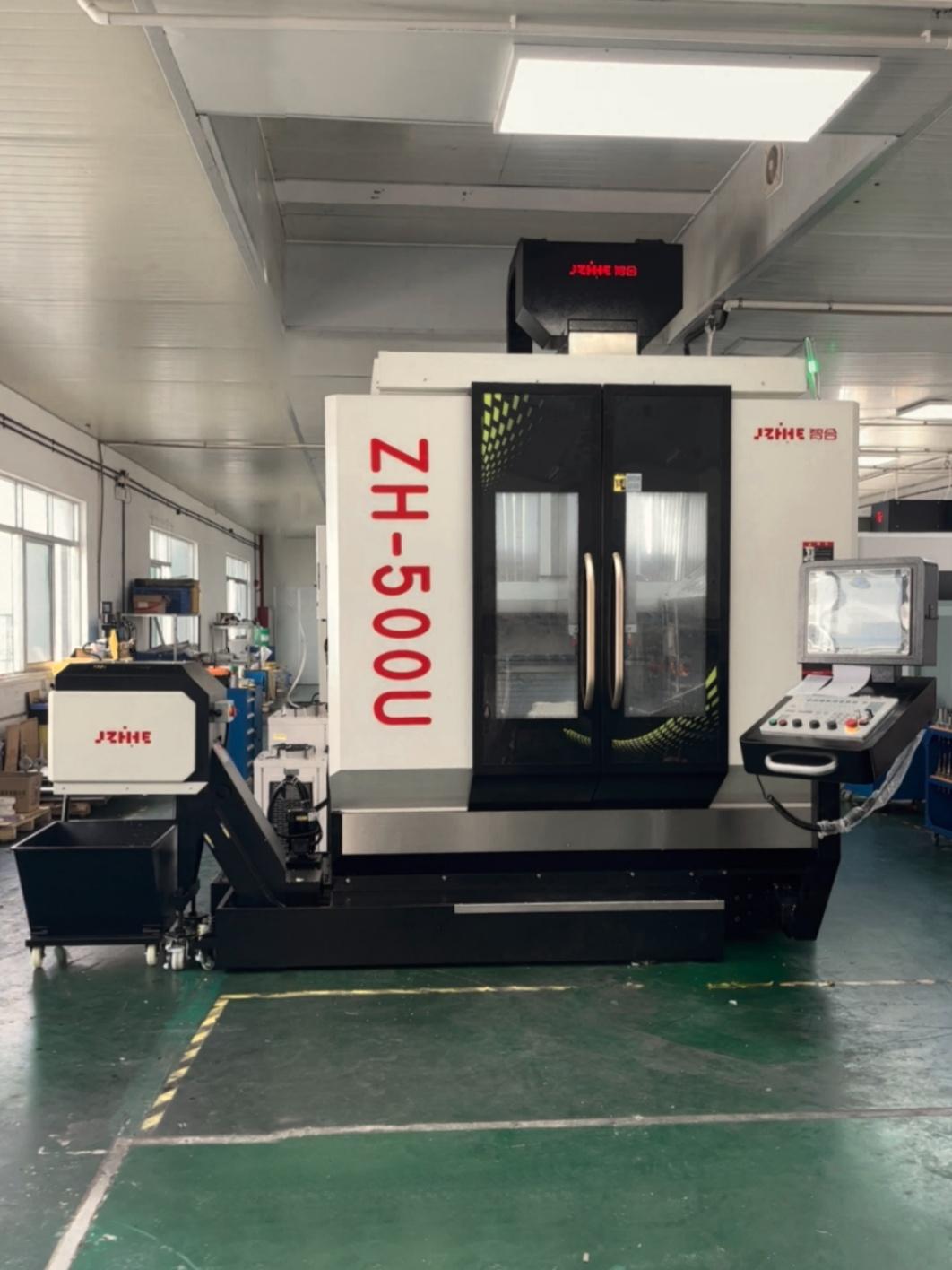
On the trunnion side, the ZH-500U 5-axis trunnion machining center is published with 750 / 880 / 600 mm X / Y / Z travel, a Ø500 mm trunnion table rated to 300 kg, A-axis ±110° and C-axis 360° on a direct-drive table with ±6 arcsec positioning accuracy, a built-in BBT40 spindle at 20,000 rpm, 15 / 15 / 15 m/min rapid traverse and a LYNUC controller. Its published workpiece capacity is 650 × 500 × 450 mm, which is the number to test against your part rather than the travel alone.
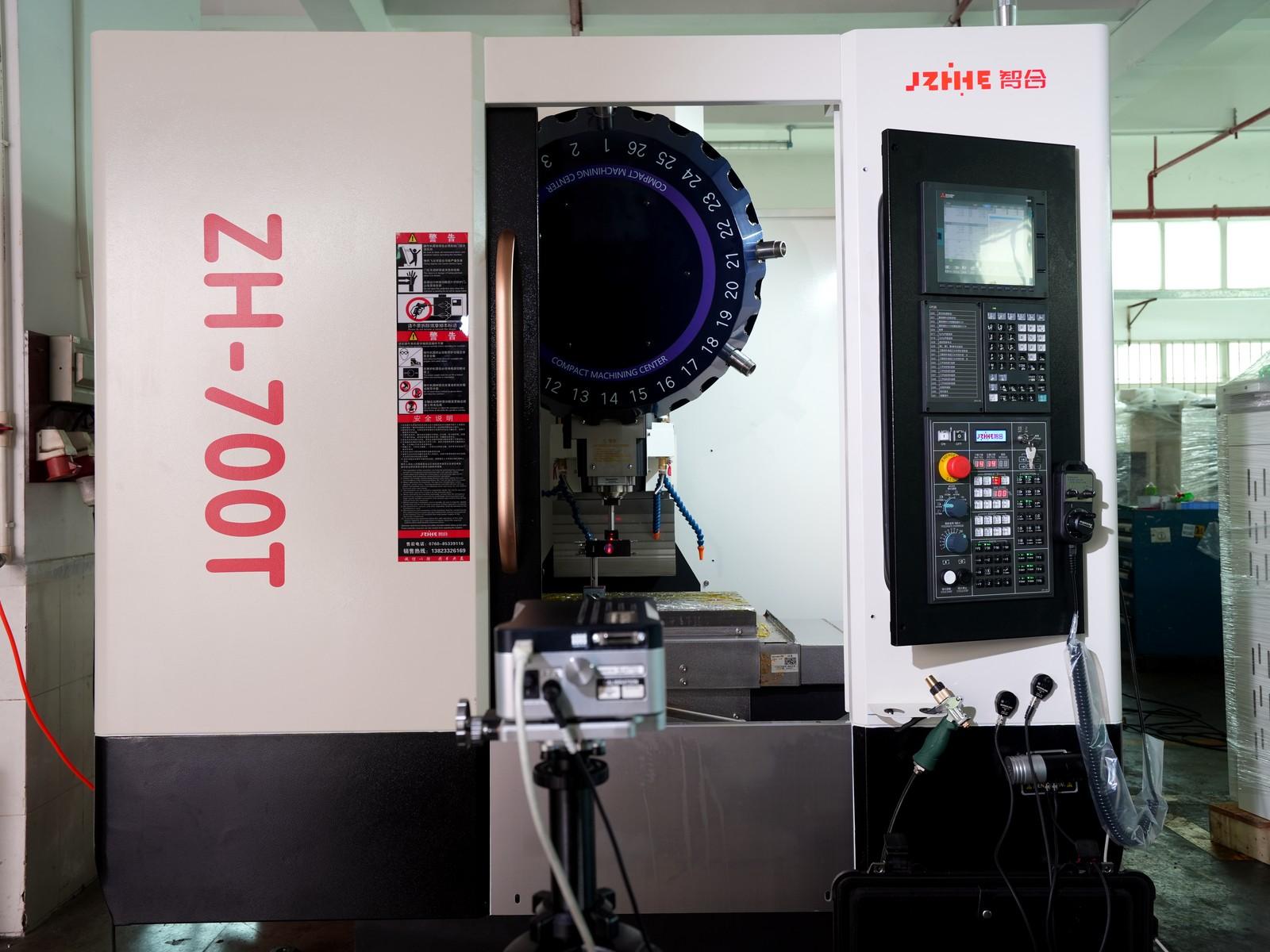
On the compact side, the five-axis machining center for precision complex parts is described as a cradle-type integrated structure with five-axis simultaneous control, an electric spindle up to 12,000 rpm and micron-level positioning accuracy, aimed at aerospace, medical, optical, mould and impeller work where floor space is limited.
If your part is larger than a trunnion can rotate safely, the honest next step is to compare a different architecture rather than to force the part onto a smaller table. The engineering review should start from the drawing, the fixture and the feature list.
Common mistakes in this decision
- Comparing rotary ranges as if they were capability. A wide tilt range means little if the part collides with the table at the extremes.
- Forgetting fixture mass. The rotary load includes the fixture, clamps and any riser, not just the workpiece.
- Buying reach you do not need. A swivel head specified for reach, used on small parts, adds cost and programming complexity without benefit.
- Ignoring chip behaviour. Pocket-heavy work on a horizontal surface can double cycle time if chips are recut.
- Accepting a generic post-processor. Five-axis accuracy depends on the kinematic model matching the machine exactly.
- Testing with a demonstration part. Insist on a representative part, because geometry that looks impressive in a demo often avoids the difficult features.
Frequently asked questions
Is a trunnion more accurate than a swivel head?
Not automatically. A trunnion often gives more accurate five-axis finishing because short tools are used and the spindle structure is simple, but the result depends on the table drive, the fixture and the thermal state. A well-built swivel-head machine with a rigid head and a good post-processor can hold tight tolerances on parts that a trunnion could not carry.
Can a 5-axis trunnion machine heavy parts?
Only within its rotary capacity. Part mass, fixture mass and rotational swing all count against the table rating and the drive. For heavy castings and large moulds, a swivel-head or gantry-based layout is usually the realistic option.
What does ±6 arcsec rotary accuracy mean in practice?
It is a published positioning figure for the rotary axis under stated conditions. The error it can create at the part depends on the distance from the pivot to the feature, so a feature 300 mm from the centre is affected more than one close to it. Always connect the number to the tolerance chain on your drawing.
Do I need simultaneous five-axis or is 3+2 enough?
3+2 positioning covers most prismatic parts and is easier to program. Simultaneous interpolation is needed for contoured surfaces, impellers and undercut geometry. The 3+2 versus simultaneous decision map walks through that boundary.
How is the choice different from 3-axis versus 5-axis?
The 3-axis versus 5-axis question is about how many setups and faces you need. The 5-axis trunnion vs swivel head question is about how the machine delivers those axes on a specific part. Start with the 3-axis vs 5-axis comparison, then choose the kinematics.
Which standards should the acceptance test reference?
ISO 10791-1 provides geometric tests for machining centres, and ISO 10791-7 specifies standard test pieces cut under finishing conditions, which is the practical check for simultaneous five-axis accuracy. Add ISO 230-2 for positioning evaluation and your own part trial with named features and instruments.
Can the fixture be reused if I change layout later?
Rarely without redesign. A trunnion fixture must be balanced and compact for rotation, while a swivel-head fixture can be a simple plate. Assume the fixture is specific to the layout unless the supplier confirms otherwise.
Conclusion
5-axis trunnion vs swivel head is decided by what has to move. If the part is complex but can be rotated safely, a trunnion gives short tools, good chip evacuation and strong finishing accuracy. If the part is large or heavy, or the features sit deep inside a cavity, a swivel head keeps the part still and moves the tool instead. Head-table designs exist for buyers who need part rotation without carrying the whole mass.
Take the decision to a drawing, count the faces and measure the tool lengths. Then fix the rotary checks and the test piece in the acceptance agreement, because that is where the two layouts can be compared on evidence rather than description.
If you are weighing the two for a specific part, send the drawing, material, fixture concept and tolerance chain to the Zhihe CNC engineering team, and ask for the recommended kinematics to be justified against your features in writing.