Choosing between CNC machining centers and turning centers comes down to two things: the part's dominant geometry, and the feature that controls its tolerance. Shafts, discs and sleeves with rotational surfaces belong on a lathe — the workpiece spins, the tool stays put. Plates, housings and brackets with pockets, holes and flat faces belong on a machining center, where the spindle brings the tool to a fixed workpiece.
Check the tolerance-controlling feature before you compare prices. A 2 mm internal fillet in a 40 mm deep cavity is EDM work, or a redesign with a larger radius. A 3.2 mm slot cut with a 3 mm end mill holds at shallow depth; past roughly three times the tool diameter, deflection takes over.
A Mixed Part Family: Which Machine Wins the First Setup?
Illustrative worked example (not a customer case): take a pump-builder part family — a 38 mm drive shaft, a 120 mm bearing housing, a 300 × 200 mm mounting plate, and a shaft with two milled flats. Three baskets. Nobody ordered anything here; the numbers exist only to make the split concrete.
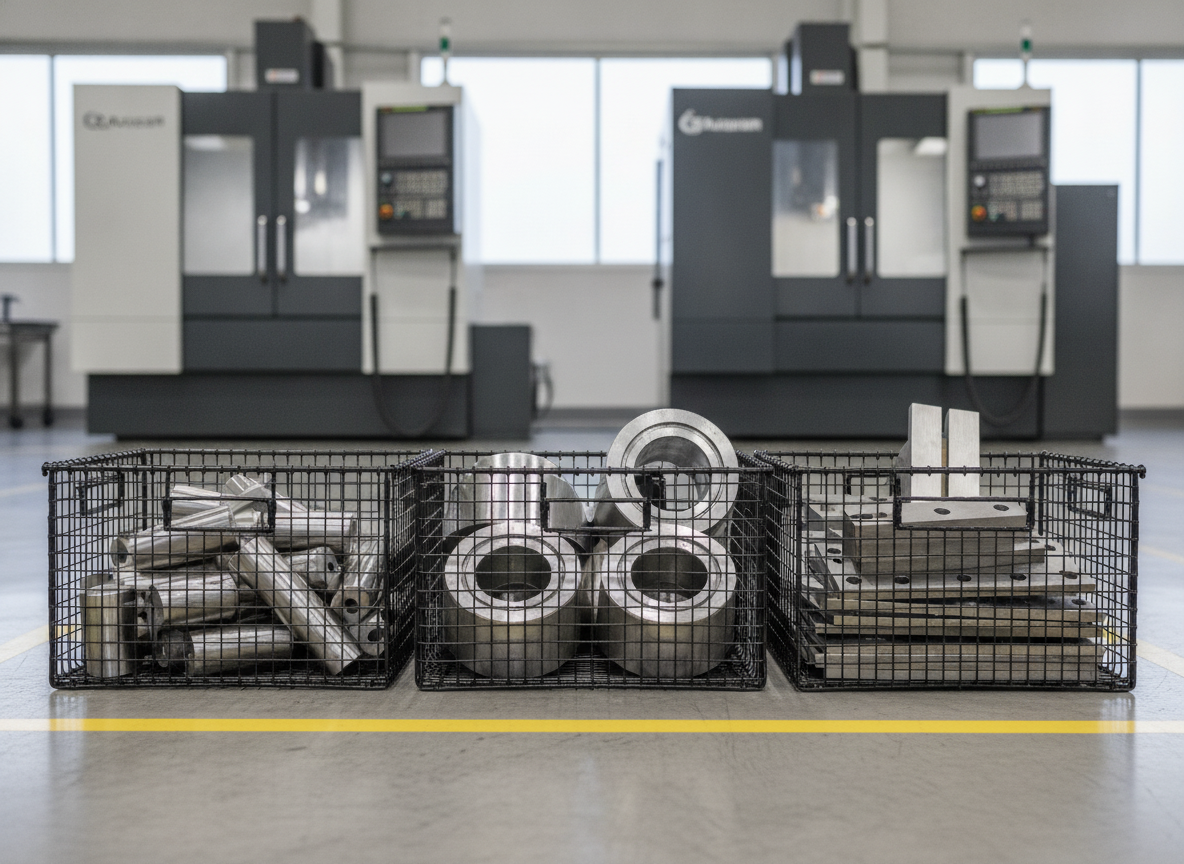
- The 38 mm shaft and the 120 mm housing share one turning axis, so a turning center holds diameter and concentricity in a single chucking. "Lathes are mainly used for shafts, discs, sleeves, and other workpieces with rotational surfaces," according to jlc-cnc.com.
- The 300 × 200 mm plate is the prismatic part. Flatness and the hole pattern both come off one face, so a CNC vertical machining center leads and the first setup locates on that face.
- The shaft with two milled flats is the hybrid. When flat position to the bearing journal is the controlling tolerance, turn first, then mill in a second setup or on a turn-mill.
Count setups, not features. A housing with cross-drilled holes may still start on a turning center when the bore is the critical feature. That single question — how many times does the part leave the fixture? — sorts cnc machining centers and turning centers faster than any comparison table, and it's the test to run before you price either machine. Skip it and the four-part family above quietly turns into four setups per part.
How Do CNC Machining Centers and Turning Centers Split a Mixed Part Family?
Start with what spins. On a turning center the workpiece rotates and a single-point tool travels into it. On a machining center the tool spins and the part stays clamped. That one difference decides most of the split: lathes own shafts, discs and sleeves, anything with rotational surfaces, and the turret's tools pick up the axial holes with drills, reamers and taps.
Setup count is where the money goes. Every extra clamping re-datums the part and stacks tolerance on tolerance, so the split between CNC machining centers and turning centers usually follows whichever category holds the critical feature in one setup.
Five-axis work gets quoted at ±0.005 mm in a single setup, but treat that as a process benchmark: confirm it with a test cut in your own material plus an ISO 230-2 positioning-accuracy report for the specific machine. A trunnion that holds it in aluminum will drift over a long steel run.
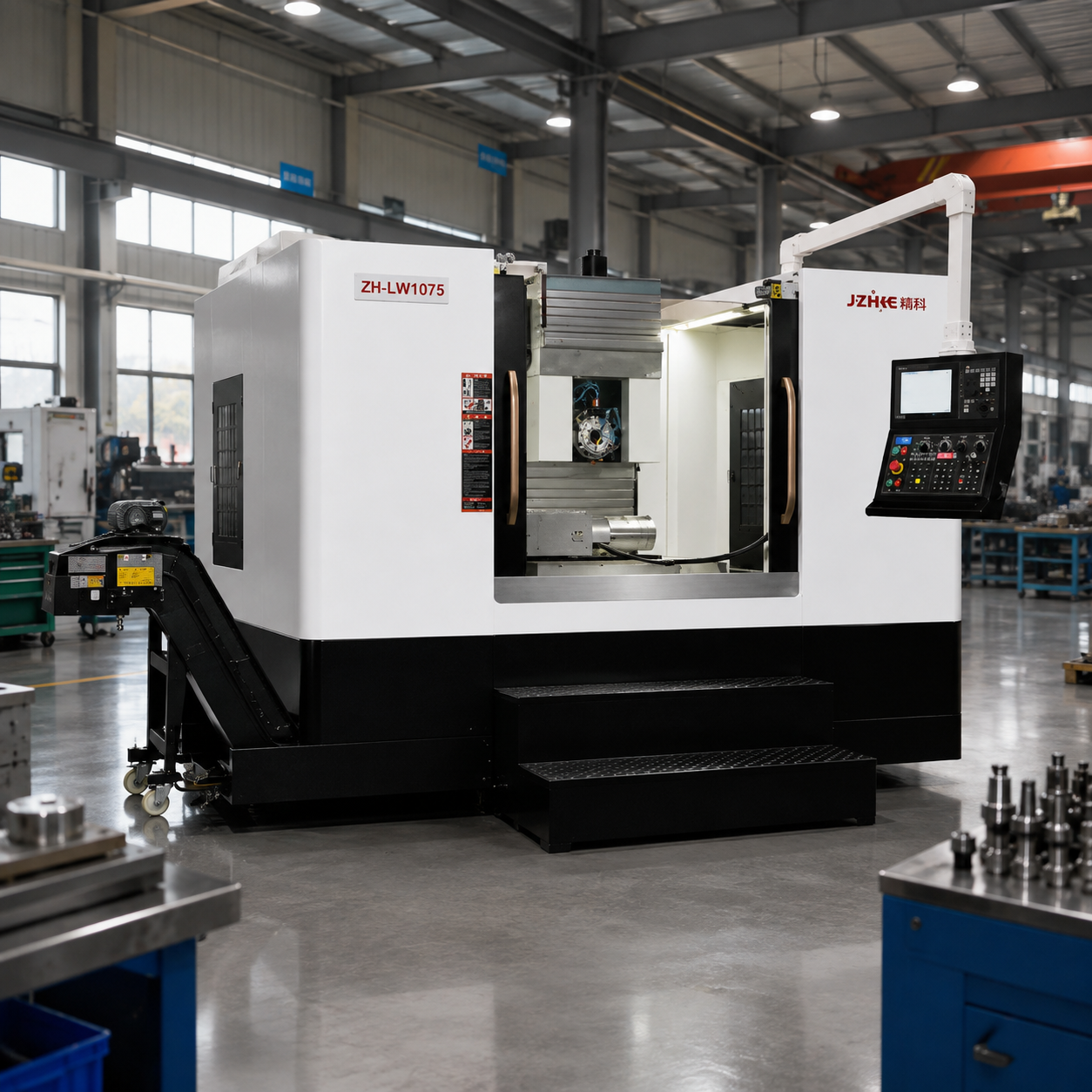
Geometry narrows it further. Plates, blocks, pump housings, multi-face pockets and hole patterns belong on a machining center — a vertical like the ZH-1370V for medium-to-large parts, a horizontal when four faces have to come off in one setup — and changing a part's shape or size is a program edit, which is why small batches and moving drawings end up there.
Know the tooling limits. A 3 mm end mill will cut a 3.2 mm slot at shallow depth; past roughly three times the tool diameter of reach, deflection shows up in the walls. A 2 mm internal fillet at the bottom of a 40 mm deep cavity usually means a larger corner radius or an EDM job.
Finish follows the same logic. Surfaces come off the machine at Ra 1.6–3.2 μm, and a sharp tool with a light finishing pass gets to Ra 0.8–1.6 μm. Below that, Ra 0.2–0.8 μm, you're into grinding or polishing, and the routing should say so before the quote goes out.
Verdict rule: if the controlling tolerance is a turned diameter, the turning center takes the first setup. If it's a face flatness, bore position or a relationship across faces, the machining center does. Where the drawing holds both, split the part at a natural datum and let the harder feature pick the machine.
Should You Buy a CNC Vertical Machining Center for a High-Mix Job Shop?
Most high-mix shops should. A vertical spindle is the cheapest way to cover flat, prismatic parts that change every few weeks. Run the checklist before you sign.
- Part envelope.Your biggest plate needs to sit inside the travels of the CNC vertical machining center you're pricing, fixture on the table, with Z room left over for a drill sticking out of the holder. If you're buying for the family rather than the one hero part, size to the 80th percentile, not the largest drawing in the drawer.
- Workholding count.Five different fixtures across a week means setup eats the margin. Duplicate vises or plates so one set loads while another cuts, and changeover becomes a swap instead of an alignment job.
- CAM flow.High-mix lives and dies on programming speed. CAM reads the CAD file and posts the program, so a shape change turns into an edit in the software instead of a new fixture and a fresh setup sheet — ordinary shop practice, and the reason families with shared features template well while one-off sculpted geometry doesn't. Shared zero points and a common tool library pay you back faster than a hotter spindle.
- Changeover pattern.Batch sizes under fifty? Then setup frequency, not cutting speed, sets your output, and a fixed-column VMC sized to your 80th-percentile part beats a bigger machine you can't re-fixture fast.
- Geometry check.Shafts, discs and sleeves belong on a lathe. If half your family is rotational, a VMC solves the wrong half.
When Does Five-Axis Machining Pay for Itself?
Five-axis earns its keep on multi-face parts where one setup holds tolerance that three refixtures would lose. glcncmachining.com lists ±0.005 mm for five-axis CNC machining in a single setup. Treat that as a process benchmark: prove it on your part with a test cut and ISO 230-2 positioning measurements, not a universal accuracy promise for every five-axis machine.
Plenty of those parts never need simultaneous motion. A 3+2 setup indexes the table to a fixed angle and cuts in three axes. If the faces are flat, square and the angles repeat, 3+2 gets you there for less money. Ask one question: does the angle change while the tool is in the cut? If it doesn't, skip full five-axis.
Geometry kills the case too. A 2 mm internal fillet in a 40 mm deep cavity belongs on an EDM, or gets redesigned with a bigger radius, as glcncmachining.com notes. A 3 mm end mill can cut a 3.2 mm slot at shallow depth; past roughly three times its diameter, the tool deflects. No rotary axis fixes a flexing cutter.
Review the five-axis machining centerwhen contoured faces genuinely share one datum. If they don't, a 3+2 machine or a three-axis VMC with the right fixtures costs less than the extra axes.
Which Accuracy Standard Actually Matters at Acceptance?
ISO 230-2:2014, Test code for machine tools — Part 2: Determination of accuracy and repeatability of positioning of numerically controlled axes, measures how repeatably a ballscrew-driven axis returns to position. That number shows up in hole spacing and step heights between faces. It says almost nothing about surface finish.
For machining centres, the acceptance check is a system test. ISO 10791-7:2020, Test conditions for machining centres — Part 7: Accuracy of finished test pieces, cuts a representative test piece and measures the result. That comes closer to the feature you will actually make than a positioning report alone.
Match the test to the feature. Bore spacing on a housing needs the positioning report. A sealing face needs a test cut. Typical shop practice for as-machined surfaces lands around Ra 1.6–3.2 μm; a sharp tool and a light finishing pass can get Ra 0.8–1.6 μm.
Treat those as starting points for a test cut on your part, not a machine guarantee. Ra 0.2–0.8 μm usually needs a dedicated finishing process or secondary operations such as grinding and polishing. Don't buy a tighter positioning spec to chase finish. Below that range, you're buying grinding.
Tool deflection is the usual reason finish misses. A 3 mm end mill pushed past three times its diameter will chatter whatever the spec sheet says. Read picking the right spindle for the workbefore you add accuracy options.
Machine Types by Part Mix: A Buyer's Comparison Table
Choosing between CNC machining centers and turning centers starts with part geometry. Shafts and discs point to a turning center; prismatic parts, housings, and multi-face work point to a machining center. Match the part mix to the machine that removes the most setups, then accept the compromise.
| Part mix | Machine that wins | Main trade-off |
|---|---|---|
| Small prismatic parts | Vertical machining center, such as the 1370V workhorse for plate work | Fast setups and simple workholding; five-sided parts still need extra operations. |
| Medium-to-large plates | Vertical machining center; gantry machining center when plate size outgrows the table | A gantry covers plates past the vertical machine's table size, and it adds floor space and installation requirements. Confirm the work envelope and site requirements with Zhihe. |
| Large housings | Horizontal machining center, like the horizontal-spindle machine for large housings | One setup for four faces; part handling and fixturing take more planning. |
| Complex multi-face parts | Five-axis machining center | Single-setup access to angles; programming and machine price rise sharply. |
| High-volume drilling/tapping | Drilling and tapping center, a dedicated hole-making machine | Short cycle times on holes; milling capacity is limited, so pair it with a VMC. |
Read your part mix down the first column. If two rows dominate, the machine in the second column that kills the most setups is the one to quote.
RFQ parameter checklist: what to confirm before you quote
| Parameter to confirm | Why it matters | What to send or ask Zhihe |
|---|---|---|
| Largest part envelope | Fixture, tool clearance, and table or pallet size eat into the nominal envelope. A part that fits on paper may not fit with clamps. | Send a dimensioned drawing or 3D model with the largest length, width, and height. Ask Zhihe to confirm the work envelope and maximum workpiece weight for the quoted model. |
| Workholding | Vise, chuck, pallet, tombstone, or rotary table choice sets access, rigidity, and setup count. | Share the fixture concept or a part photo. Ask Zhihe which workholding the machine accepts and whether a fourth axis or pallet changer makes sense. |
| Number of faces | One setup for four faces can move the job from a vertical to a horizontal machining center. Five-axis work adds angular faces but raises programming and machine cost. | Mark every face to be machined on the drawing. Ask Zhihe to confirm the axis configuration and the setup plan for those faces. |
| Controlling tolerance | The tolerance that decides accept or reject matters more than the tightest number on every feature. It drives process, inspection, and machine choice. | List the controlling dimensions and tolerances. Ask Zhihe to confirm the quoted machine and process can hold them. Five-axis work can reach ±0.005 mm in a single setup according to glcncmachining.com; your part still needs its own capability check. |
| Hole depth-to-diameter ratio | Deep holes need peck drilling, through-coolant, and a stable tool. Above roughly three times the tool diameter, deflection and chip evacuation get ugly (glcncmachining.com). | Send the deepest hole’s depth and diameter. Ask Zhihe to confirm the drilling or tapping process, or whether the hole needs a different operation. |
| Finish | As-machined finish is Ra 1.6–3.2 μm. A sharp tool and light cut reach Ra 0.8–1.6 μm. Ra 0.2–0.8 μm needs grinding or polishing (glcncmachining.com). | Put the Ra callout on the drawing. Ask Zhihe whether it is as-machined or needs a secondary process. |
| Annual volume | High volume can justify a drilling/tapping center or automation. Low volume favors a flexible VMC and quick changeover. | Send annual volume, batch size, and forecast. Ask Zhihe to confirm the machine type and automation options. |
Send the part family, critical tolerances, material, annual volume, and destination to Zhihe for an RFQ. A dimensioned drawing or 3D model saves a round of questions.
Where Zhihe Fits a Mixed Part Mix
Match the machine to the part, not to the brochure. Zhihe's line splits along published type: vertical machining centers, horizontal machining centers, drilling and tapping centers, plus five-axis and gantry builds for the shapes that need them. Two verticals cover prismatic and plate work, the ZH-1370V and the ZH-2000V vertical machining center. Which of the two suits your part comes down to the work envelope, so put your largest plate dimensions against the travels listed on each product page before you shortlist.
Multi-face housing work is the horizontals' territory. The ZH-1095 and HMC-1000 are horizontal machining centers, and whether one fixturing reaches four faces of your housing depends on the workholding you and Zhihe settle on. That's a fixture-design conversation, not a spec-sheet one, so bring the housing drawing to it.
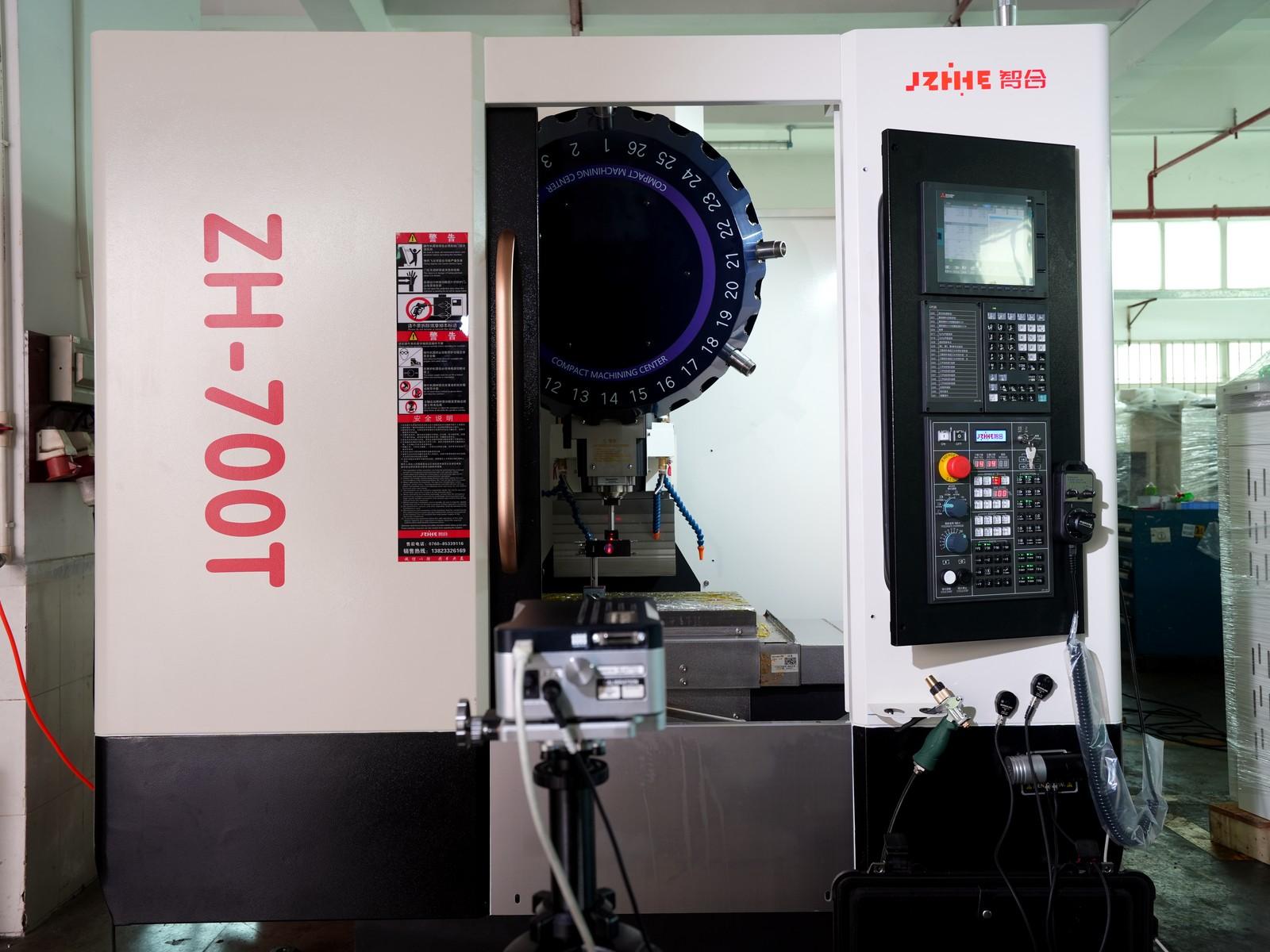
Hole-heavy parts are a third case. The ZH-700T is a drilling and tapping center: drilled, tapped, repeated patterns, with the spindle spending its time going in and out of the part rather than sweeping a cavity. Put a plate with 200 holes on a drilling and tapping center and the cycle makes sense.
Turning sits outside that mapping, and it's the half of the keyword most buyers get wrong. Lathe work means a rotating workpiece and a single-point tool, and it's the natural home for shafts, discs and sleeves (jlc-cnc.com). Complex housings go the other way. Sort your part family by geometry first and the machine category picks itself.
| Model | Published type | Best-fit work |
|---|---|---|
| ZH-1370V | Vertical machining center | Prismatic parts and plates |
| ZH-2000V | Vertical machining center | Prismatic parts and plates |
| ZH-1095 | Horizontal machining center | Multi-face housing work |
| HMC-1000 | Horizontal machining center | Multi-face housing work |
| ZH-700T | Drilling and tapping center | Drilled and tapped hole patterns |
Beyond the catalogue, Zhihe handles OEM CNC machine manufacturing, custom CNC automation, and export from China, and backs the build with installation and training support.
Got drawings? Send them through the contact pageto start an RFQ.
The Cheapest Machine Is Rarely the Lowest Cost
Sticker price buys the iron. Total cost buys the iron, the fixtures, the setups, the scrapped parts and the floor space. Put a job that needs four faces cut on a vertical machining center and you'll re-clamp that part three times. Each re-clamp is a changeover, a new datum, another scrap risk on a workpiece that already carries value.
Tooling spend moves the same way. A machine matched to the wrong cut pushes you into slender tools, light passes and slow cycles.
Setup is where the bill lands. Clamp a part once and you pay for the load, the touch-off and the first-article check. Clamp it four times and you pay four times, and every new datum stacks its own error into the tolerance you're trying to hold.
Changeover is the same bill on a schedule. High-mix work means last month's fixture is wrong for this month's part, so the spindle sits idle while someone swaps jaws, re-probes and re-proves the program. A horizontal machining center attacks that idle time from the side of the part.
The ZH-1095 and HMC-1000 are horizontal machines; how many faces you reach before the part comes off is set by the workholding you build for them, so design the fixture around multi-face access and the re-clamps drop. Turning centers run the same arithmetic from the other direction. The workpiece rotates, so a collet or jaw change plus a touch-off on the tools covers a whole family of shafts and sleeves with far less fixturing than a prismatic job needs.
Scrap is the quiet line item. A re-clamped part can shift, a boring bar can rub where it should cut, and an undersized bore never gets a second chance. On a part that has already been roughed and heat-treated, scrap costs far more than the billet ever did.
So compare cost per good part, and do it across the CNC machining centers and turning centers you're actually choosing between. Price per spindle is the easy number and the least useful one, because fixtures, setup hours, scrap rate, floor space and power all belong in the same column. The lowest quote often finishes last.
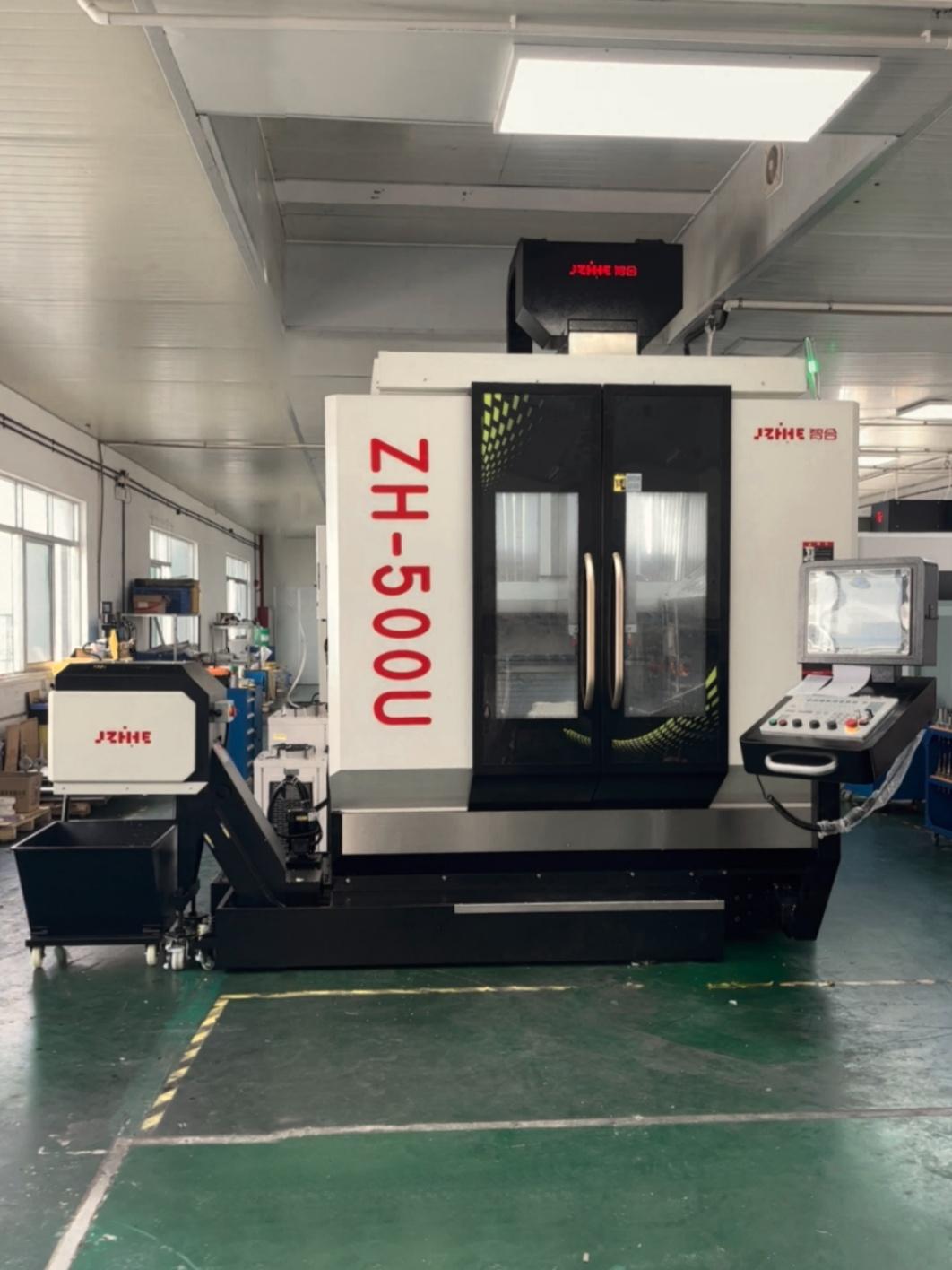
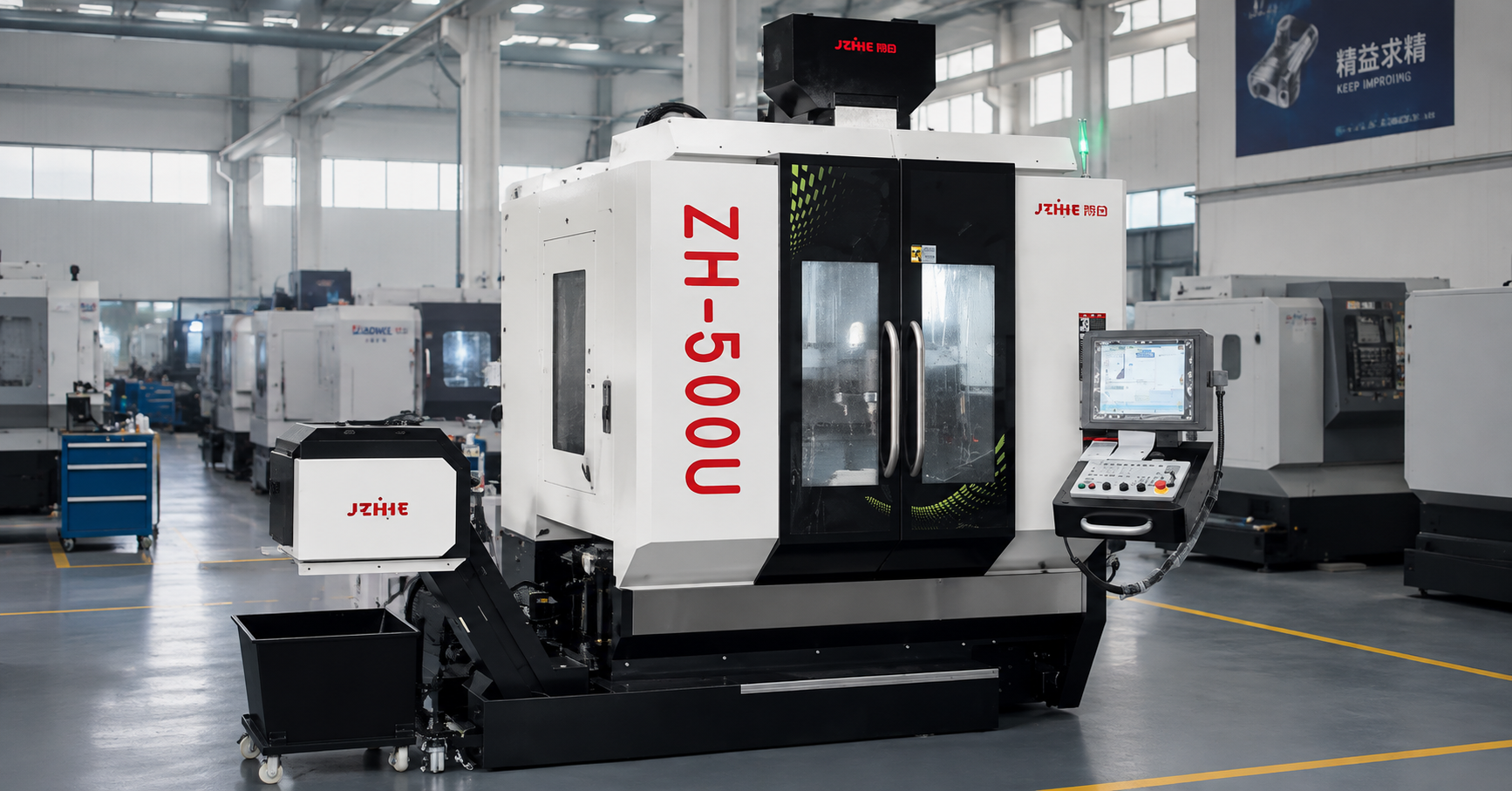
Five-axis work can hold ±0.005 mm in a single setup, according to glcncmachining.com, which is why a trunnion machine such as the ZH-500U trades purchase price for fewer datums and fewer chances to lose a part. Skip five-axis if your parts are prismatic and simple. Pay for it the day a housing needs four faces and a compound angle in one hit.
Key Takeaways
Read the geometry before the brochure. Shafts, discs and sleeves point to turning; blocks, plates and housings point to milling. CNC machining centers and turning centers are different purchases, and confusing them costs setups.
- Count critical faces and features first — that number, not the price, decides how many setups you'll pay for.
- Match the machine to your part mix, not your best-selling job; one odd part shouldn't drag the whole purchase sideways.
- A CNC vertical machining center covers most prismatic work, so it's the sensible first buy.
- Write acceptance against ISO 230-2 and ISO 10791 before the machine ships.
- For prismatic and mixed work, start with Zhihe's machining-center line — ZH-1370V, ZH-1095, gantry and five-axis. For shafts, discs and sleeves, specify a turning center; it's a different machine and a different quote.
Frequently Asked Questions
Turning center or machining center for shaft-type parts that also need milling?
Lathes cut rotational surfaces: shafts, discs, sleeves. Drills, reamers and taps run in the turret or tailstock as well, so plenty of secondary work happens on the same machine. A turning center with live tooling, or a turn-mill, mills flats and cross-holes on the shaft without a second setup. Heavy milling, work spread over several faces, or a tight true position to the turned diameter pushes the job to a machining center. Count the milled features and the tolerance that gates them before you pick the category.
Which part details actually change the machine configuration?
Envelope, weight, number of faces, hole depth-to-diameter ratio, internal fillet radius, and the tolerance that gates the part. A 2 mm internal fillet 40 mm deep is EDM work, or a redesign with a bigger radius. Those details move travel, table size, and spindle taper.
When is a CNC vertical machining center the right first machine?
When most of your work is prismatic, fits the table, and needs three or four faces. The ZH-1370V and the ZH-2000V are both listed as vertical machining centers, so match each work envelope to your largest part and confirm it on the drawings before the order. If large housings dominate your mix, a horizontal machine such as the ZH-1095 will earn more hours per week.
Five-axis or 3+2 indexed?
3+2 gives multi-face access for less money when faces can be machined one at a time and the index time is acceptable. Simultaneous five-axis pays off on contoured surfaces, impellers, and parts where a single setup holds the tolerance. Skip it for deep, small fillets that need a long, thin tool. Single-setup five-axis work usually holds a tighter position than a multi-setup sequence, though the number depends on the machine, the feature, and thermal control. Prove it on a test cut of your part before you sign.
Which accuracy standard matters at acceptance?
ISO 230-2 covers positioning accuracy and repeatability of the axes; ISO 10791 sets test conditions for machining centers. Read the report for your actual machine against your tightest feature, not the brochure. A machine that passes a generous spec can still miss a 0.02 mm bore position when thermal drift is uncontrolled.
Do surface finish and tolerance come from the same purchase?
No. As-machined surfaces typically land around Ra 1.6–3.2 μm; a sharp tool and a light finishing cut get you to roughly Ra 0.8–1.6 μm. Anything below that, say Ra 0.2–0.8 μm, usually needs grinding or polishing. Buy tolerance from the machine and finish from the process.
What documents do we need for customs clearance?
Commercial invoice, packing list, bill of lading, HS code and declared value, certificate of origin, plus the technical file for the model. Insurance certificate and any pre-shipment inspection certificate go on top. Your broker decides which of those he needs, and it changes with the destination and the Incoterm, so request the destination-specific document pack in writing before the container is booked. Check the HS classification against your own tariff line too. A wrong code is cheaper to fix before shipment than after.
What is the MOQ for custom CNC solutions or an OEM-branded machining center?
Project-specific. A custom automation cell and a private-label vertical machine don't share a number. Send the part family, the annual volume, and the target model, then ask for the MOQ in the written quotation. Volume drives price, build schedule, and how much tooling and documentation is reasonable to include.
Does Zhihe hold CE or ISO 9001?
Zhihe's published material doesn't state either, so treat certification as unconfirmed until you see paper. For an EU import, ask for the current certificate pack and check the model scope on the certificate against the machine you're buying; a certificate for one model doesn't cover the range. Your compliance file also needs the declaration of conformity, the electrical documentation, and a risk assessment where the machinery rules apply. Get the copies before you pay the deposit.
How often is the machine calibrated, and what certificate comes with it?
Interval follows use. A shop holding tight position tolerances over two shifts checks more often than one roughing castings. Ask Zhihe to state the recommended interval, the acceptance test, and a sample calibration certificate in the quotation, and confirm which instrument and which standard the certificate references. That answer belongs in the contract, not in a phone call.
Can we have our brand, paint colour, control system, and nameplate on the machine?
Zhihe's published scope covers OEM CNC machine manufacturing, custom CNC automation solutions, and export from China. Branding, colour, control system, and nameplate are configuration items, and each one has to be written into the signed technical agreement with the model, the control brand and version, the colour code, and the nameplate artwork. Don't let any of those four rest on an email.
Does an OEM-branded build add lead time?
Yes. Branding and configuration changes add engineering review and documentation to the standard schedule. How much depends on how far the build departs from a standard ZH-1370V or ZH-1095. Freeze the spec early; late changes cost more than the option did.
How should a quote be structured?
Line items for the machine, options, workholding, tooling package, freight, installation, and training. Ask for control and servo brands, the acceptance test, and the spare-parts list. Add floor space, changeover time, and scrap to the purchase price when you compare.
What about installation, training, and after-sales?
Zhihe provides installation, training, and after-sales service, with support arranged for the destination. Request the commissioning checklist, training agenda, and spare-parts list before shipment. Put the response time in the contract.
Send your part family, the annual volume, and the destination port, and ask for a configured quote with the machine model, the acceptance test, and the document list for that lane. One email with drawings is enough to start.