5-Axis Trunnion Machining Center: What Buyers Should Check Before Investing in Complex Parts Manufacturing
A 5-axis trunnion machining center is rarely an impulse purchase. For most factories, it comes into the discussion after a production problem has already become too expensive to ignore.
Maybe the current process needs three or four clampings. Maybe complex parts keep failing inspection because the datum shifts between setups. Maybe deep cavities collect chips and damage tools. Maybe curved surfaces need too much manual polishing. Or perhaps the shop is trying to win higher-value work in aerospace, medical devices, precision molds, automotive turbo housings, or optical components, but its existing machine platform is holding it back.
From a buyer’s point of view, the question is not simply, “Do we need five axes?”
The more useful question is: will a 5-axis machine reduce enough handling, rework, inspection pressure, and setup risk to justify the investment?
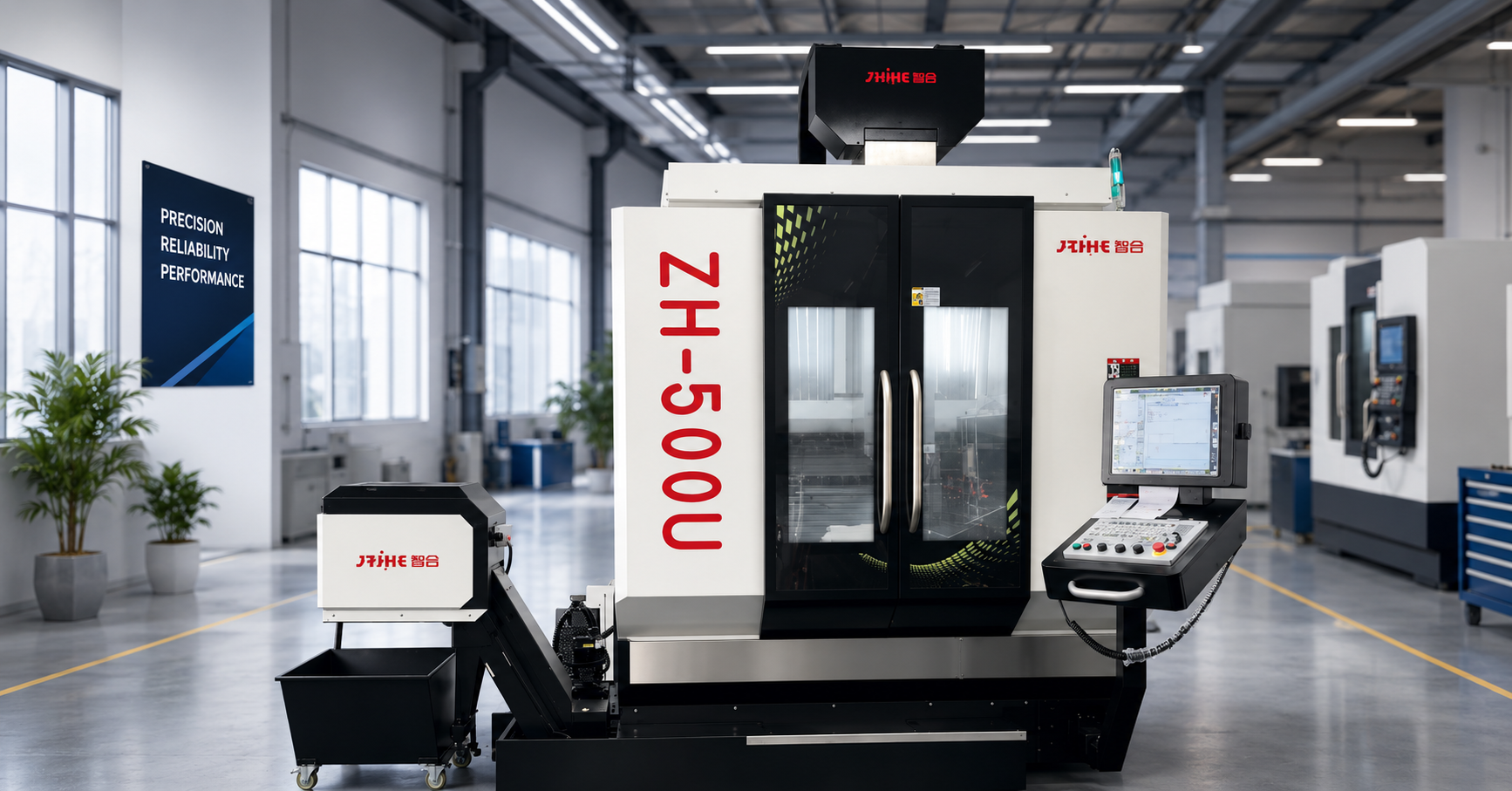
That is where a machine such as the ZH-500U 5-Axis Trunnion Machining Center becomes worth evaluating. According to Zhihe CNC’s product page, the ZH-500U is designed for high-precision, multi-sided machining of complex components. Its key specifications include 750 / 880 / 600 mm X/Y/Z travel, a Ø500 mm trunnion table, 300 kg maximum table load, 20,000 rpm BBT40 electric spindle, 20 kW spindle motor, and LYNUC 5-axis CNC system.
For a buyer, those numbers are not just technical details. They help answer practical questions: will the part fit, can the rotary axes hold the required angle, will the spindle support both speed and rigidity, and can the machine handle the actual material mix?
Why Buyers Move Toward 5-Axis Trunnion Machining
A standard 3-axis machining center can still produce many good parts. It is familiar, easier to program, and often cheaper to buy. But once parts become more complex, the hidden cost of multiple setups starts to appear.
Each re-clamping step introduces risk. The operator must reposition the workpiece. The datum must be re-established. The next operation must align with previous surfaces. Inspection may catch an error later, but by then the part has already consumed machine time, tooling, labor, and material.
A trunnion-style 5-axis machining center helps by allowing the part to tilt and rotate while remaining clamped. The ZH-500U uses an A-axis ±110° DDR direct-drive dual-motor rotary table and C-axis 360° DDR direct-drive rotary table, with A/C axis positioning accuracy of ±6" and repeatability of ±3".
That matters because buyers are not paying for axis movement as a feature. They are paying for fewer setup changes, better multi-face consistency, and more stable machining of complex surfaces.
For parts with angled holes, curved surfaces, multiple datum faces, turbine-like geometry, deep pockets, or tight face-to-face relationships, that difference can decide whether the job is profitable.
What Buyers Should Check First: Part Fit and Table Capacity
Before asking about price, buyers should start with the workpiece.
The ZH-500U product page lists a maximum workpiece capacity of 650 × 500 × 450 mm, a Ø500 mm trunnion table, and 300 kg table load. That gives buyers a practical starting point.
But the workpiece size alone is not enough.
A part may fit on paper and still be difficult to machine after fixtures, tool length, tilt range, and collision clearance are considered. In five-axis machining, clearance becomes more sensitive because the table rotates and tilts. A fixture that works well in a 3-axis setup may block tool access in five-axis work.
Before choosing a 5-axis trunnion machining center, buyers should review:
| Buyer Check Point | Why It Matters |
|---|---|
| Maximum part size | Confirms whether the workpiece fits the travel and rotary envelope |
| Part weight | Must stay within table load capacity |
| Fixture height | Affects tool reach and collision clearance |
| Tool length | Long tools may reduce rigidity or create interference |
| Machining faces | Shows whether five-axis access is actually needed |
| Material | Affects spindle, tool, coolant, and cutting strategy |
| Tolerance target | Helps judge whether rotary accuracy is sufficient |
A 5-axis machine should be matched to the regular part family, not only the largest possible workpiece. This is where some buyers make a costly mistake: they choose a machine around one extreme part, then discover most daily jobs do not use the machine efficiently.
Rotary Accuracy Is Not a Small Detail
For buyers machining complex parts, rotary accuracy is often more important than it first appears.
In multi-face machining, the relationship between surfaces matters. A hole on one face may need to align with a pocket on another. A curved profile may need to transition smoothly across a rotated orientation. If the rotary axes are inconsistent, the part may pass one measurement but fail another.
The ZH-500U uses DDR direct-drive rotary axes and lists A/C axis positioning accuracy ±6" and repeatability ±3". The page also states that an arc-second calibrator is used for A/C axis positioning accuracy and repeatability verification.
From a buyer’s perspective, this is the kind of detail worth discussing during acceptance. Ask how rotary accuracy is tested. Ask whether trial cutting can be performed on a part similar to yours. Ask how the machine will behave after installation, not only during factory demonstration.
The ZH-500U page also lists ±0.005 mm positioning accuracy and ±0.003 mm repeatability, with laser interferometer and ballbar inspection equipment used for verification of X/Y/Z accuracy, repeatability, pitch error, circularity, and servo matching.
That kind of verification gives buyers a better basis for technical discussion than brochure claims alone.
The Spindle: Speed, Power and Real Cutting Needs
The ZH-500U is equipped with a BBT40-Φ150 electric spindle, customized for 20,000 rpm, with 20 kW spindle motor power.
A buyer may first notice the 20,000 rpm speed. That is understandable. High spindle speed helps with aluminum parts, curved surfaces, finishing operations, small tools, and precision contouring. But speed is not the whole story.
Complex parts often require both roughing and finishing. Aerospace and medical parts may require stable contouring. Precision molds may need smooth surface transitions. Automotive turbo housings may need controlled machining around curved flow areas. A spindle must support the actual tool strategy, not only the maximum rpm.
Buyers should ask:
| Spindle Question | Why It Matters |
|---|---|
| Is the spindle suitable for the material? | Aluminum, titanium, stainless steel and superalloys cut differently |
| What tool diameters are expected? | Small tools benefit from speed; larger tools need rigidity |
| How is spindle cooling handled? | Heat affects long-cycle accuracy |
| Is the spindle suitable for finishing only, or also semi-roughing? | Impacts process planning |
| What tool holder standard is used? | BBT40 affects tool system compatibility |
| What maintenance support is available? | Electric spindles require correct care |
The buyer’s goal should be simple: choose a spindle that fits the work, not a spindle that only looks impressive in a headline.
Why Chip Control Can Decide Daily Productivity
Chip control often sounds less important than axis accuracy or spindle speed. In real production, it can be the detail that keeps the process moving.
Complex 5-axis parts often include cavities, narrow pockets, curved surfaces, and hard-to-clean areas. Poor chip evacuation can damage tools, mark surfaces, and force operators to stop the cycle. The ZH-500U standard specification includes a spiral-type chip conveyor with chip cart and a coolant system with two submersible high-pressure water pumps, one dedicated to chip flushing.
The product page’s 5G communication cavity filter case shows why this matters. The customer had poor chip evacuation in deep cavity machining, causing tool chipping and up to 8 tool changes per piece. With the ZH-500U solution, the page reports tool changes reduced to 2 times per piece, tool consumption cost reduced by 60%, and secondary polishing eliminated after surface roughness improved from Ra3.2 to Ra0.8.
For a buyer, this is a useful reminder: chip evacuation is not housekeeping. It affects tool cost, surface quality, cycle time, and yield.
Case Example: 5G Communication Base Station Cavity Filter
One product-page case involves a 6061 aluminum alloy 5G communication base station cavity filter, with workpiece dimensions of Φ480 × 120 mm. The listed customer problems included multi-turnover clamping, cumulative positioning error of ±0.05 mm, poor chip evacuation in deep cavity machining, tool chipping, surface roughness of Ra3.2, and cycle time of about 65 minutes per piece.
The proposed ZH-500U solution used the Φ500 mm trunnion rotary table for 5-axis simultaneous machining in one clamping, the 20,000 rpm BBT40 electric spindle with 20 kW motor, A/C axis repeatability of ±3", and dual high-pressure water pumps for chip evacuation. The results listed on the page include cumulative positioning error controlled within ±0.012 mm, tool changes reduced to 2 times per piece, surface roughness improved to Ra0.8, cycle time reduced to 38 minutes, efficiency increased by 42%, and yield improved from 82% to 96%.
This case is valuable because it reflects what buyers actually care about: fewer clampings, fewer tool failures, less polishing, shorter cycle time, and better yield.
A good machine choice should show up in those numbers, not only in the brochure.
What Buyers Should Ask Before Ordering
A 5-axis trunnion machining center is a serious investment. Before signing a contract, buyers should prepare real production data and ask direct questions.
| Buyer Question | Why It Matters |
|---|---|
| Can my part be finished in one clamping? | Shows whether five-axis machining gives real value |
| What fixture is recommended? | Fixture design affects access, accuracy and collision risk |
| Can trial cutting be arranged? | Verifies machine, tool and process fit |
| How are rotary axes inspected? | Confirms A/C axis accuracy and repeatability |
| What materials has the machine processed before? | Helps judge experience with aluminum, titanium, stainless steel or superalloys |
| What support is included after delivery? | Impacts installation, training and startup time |
| What is the delivery and packaging plan? | Important for overseas buyers |
The ZH-500U page states that buyers may conduct pre-acceptance trial cutting at the supplier’s facility after assembly and commissioning, followed by final acceptance trial cutting after delivery, installation, and commissioning at the buyer’s facility. The warranty period starts after successful final acceptance.
That process matters. It gives both sides a way to confirm machine performance before full production begins.
Commercial Terms Buyers Should Notice
Product performance is only part of the buying decision. Delivery, installation, training, warranty, and spare parts also affect total ownership value.
The ZH-500U product page lists delivery time of approximately 45–60 working days after down payment and signed contract, standard export wooden case packaging with moisture-proof, shock-proof and rust-proof treatment, sea or air freight options, on-site installation and commissioning by supplier engineers, free 2–3 days on-site training, a 12-month warranty from final acceptance, and long-term genuine spare parts supply.
For overseas buyers, those terms should be checked early. A machine that is technically suitable but poorly supported can still create delays.
FAQ
Is a 5-axis trunnion machining center always better than a 3-axis machine?
No. It is better when the part needs multi-face machining, complex contours, angled features, or setup reduction. For simple plates or brackets, a 3-axis machine may be more economical.
Why does the trunnion table matter?
The trunnion table allows the workpiece to tilt and rotate, helping complete more features in one clamping. This can reduce datum errors and improve consistency between faces.
What industries fit the ZH-500U?
The product page lists aerospace, precision molds, automotive turbo housings, medical devices, and optics as target industries.
What should buyers send before requesting a quote?
Send drawings, material, part dimensions, tolerance requirements, surface finish targets, current process problems, fixture requirements, and expected production volume.
Conclusion
A 5-axis trunnion machining center should be evaluated from the buyer’s real production problem, not from machine appearance alone. The value is not simply five-axis movement. The value is fewer setups, better datum control, smoother complex contouring, improved chip evacuation, shorter cycle time, and lower scrap risk.
The ZH-500U offers a practical reference for buyers working with complex aluminum, titanium, stainless steel, superalloy, or engineering plastic parts. Its 750 / 880 / 600 mm travel, Ø500 mm trunnion table, A-axis ±110°, C-axis 360° DDR direct drive, 20,000 rpm BBT40 electric spindle, LYNUC 5-axis control, verified positioning accuracy, and real case results make it suitable for serious evaluation in complex parts manufacturing.
The best next step is not to ask for the lowest price first. It is to send the part drawing and ask whether this machine can improve the process you are actually running.