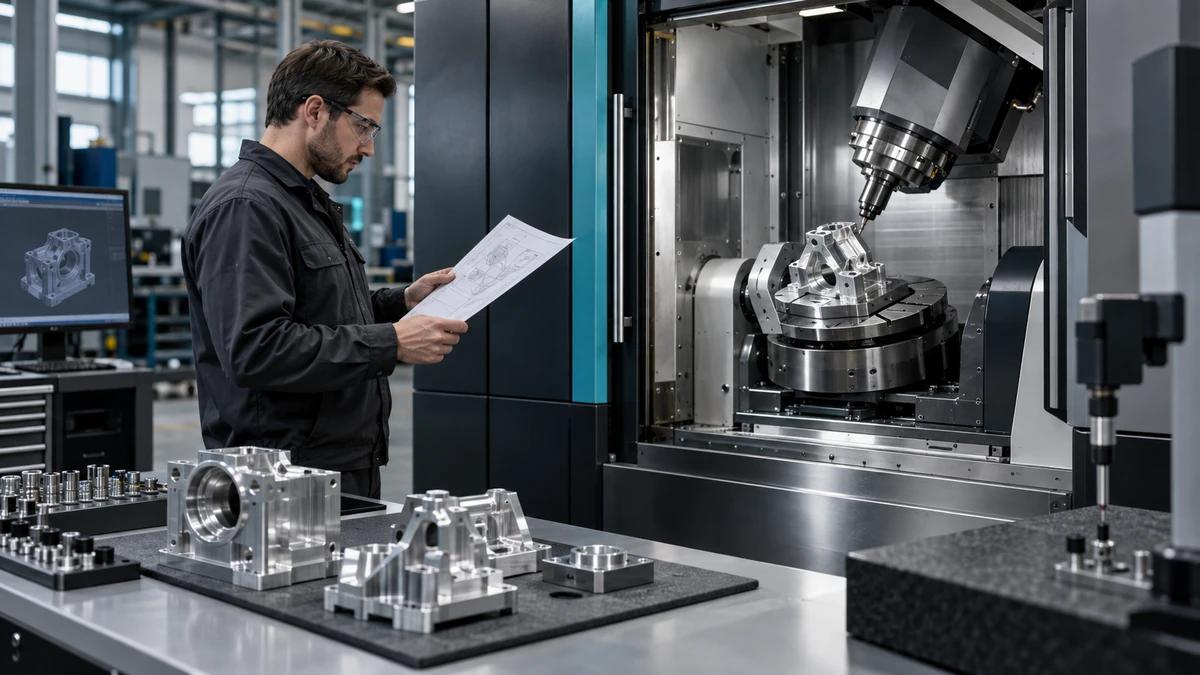
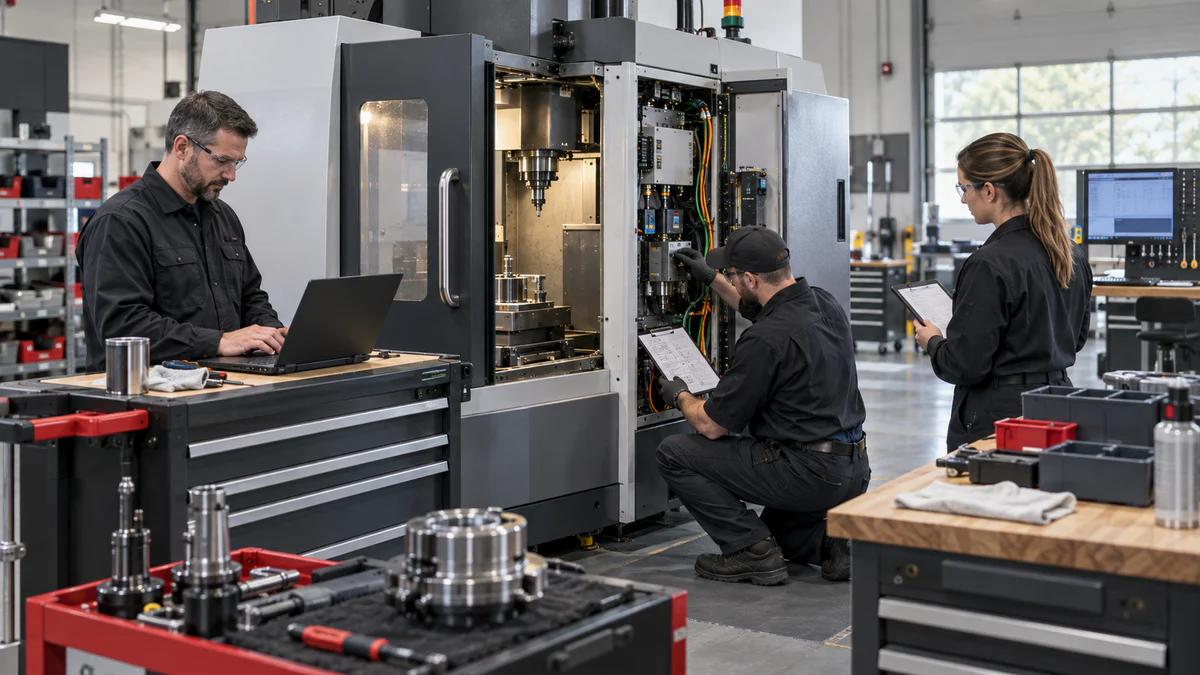
A CNC machine acceptance test should establish whether the delivered machine and agreed production setup meet a written requirement. That sounds straightforward until three different questions get mixed together: does the machine move correctly, can it cut the specified features, and can the proposed process produce acceptable parts repeatedly? Each question needs its own evidence.
For a buyer discussing a new machining center with Zhihe CNC, the useful starting point is a short acceptance specification attached to the quotation. It should name the workpiece, operating conditions, measurements, acceptance limits and unresolved responsibilities. A demonstration becomes much more valuable when both parties know what would count as a failure.
One good part can leave three questions unanswered
Imagine a purchasing team watching a supplier machine an aluminum test piece. The finished bore is within tolerance and the surface looks clean. The team is pleased. Later, somebody asks whether the bore was adjusted after an earlier trial, whether the fixture will be supplied, and whether the reported cycle includes loading and inspection. None of those questions invalidates the part. They do change what it proves.
This is an illustrative buying scenario, not a Zhihe CNC customer case. Its lesson is simple: preserve the conditions surrounding the result. Otherwise, an acceptable component can support a much broader claim than the test actually examined.
A CNC machine acceptance test is particularly useful for buyers introducing a new part family, changing machine architecture or adding automation. It is less useful as an elaborate ritual for a routine purchase if the critical requirements and repeatability evidence are already available. Match the test effort to the uncertainty in the project.
Separate machine motion from the cutting process
What a machine measurement tells you
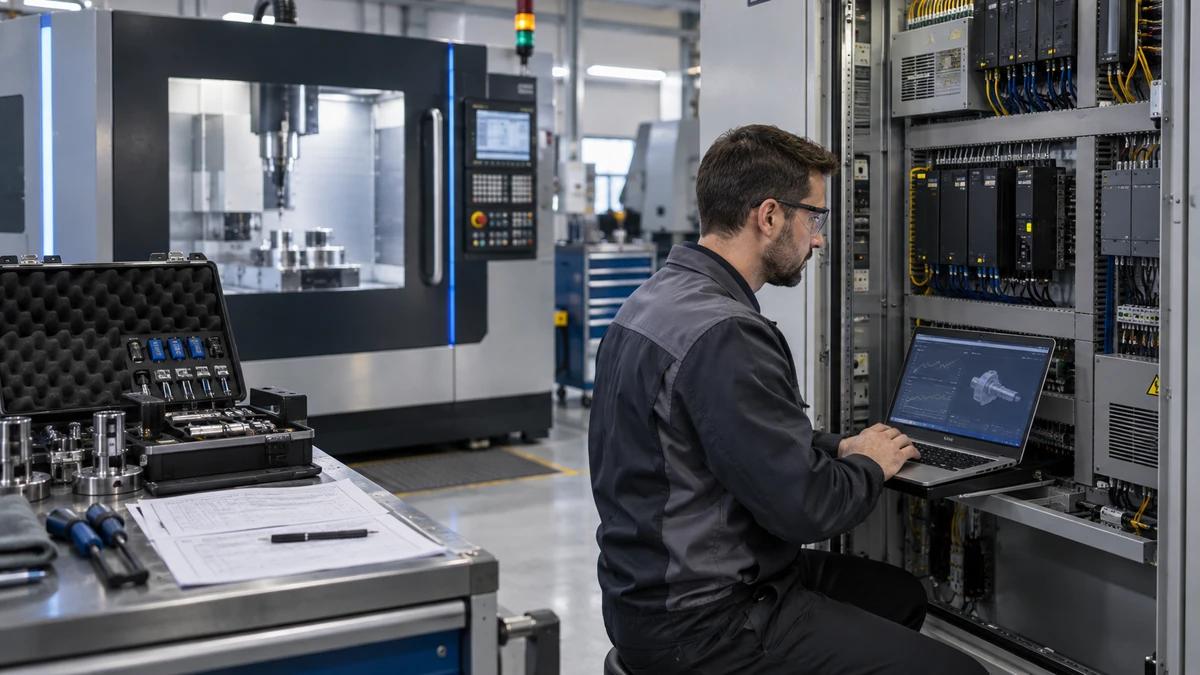
Renishaw describes laser and ballbar systems as tools for assessing the static and dynamic performance of precision motion systems. Its machine calibration overview distinguishes several measurement approaches rather than presenting one universal accuracy number. A buyer should take the same approach when reading a machine report.
Ask which axes, positions, directions and operating conditions were tested. Identify the measuring instrument and the applicable procedure. A positioning result is not automatically a surface-finish result, and a machine-motion measurement is not a production capability study. The report should make that distinction easy to see.
What a trial cut adds
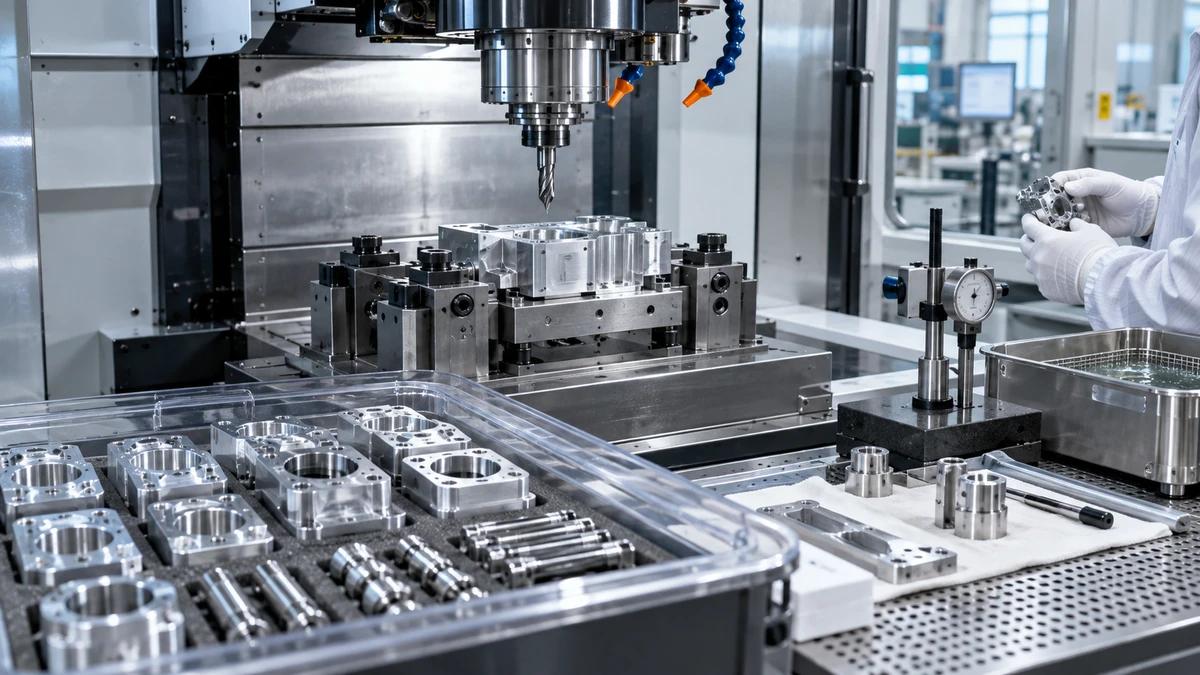
A trial cut introduces the material, tool assembly, workholding, program and measurement of the finished part. That is valuable because the proposed production process depends on all of them. It also means that a poor feature may require investigation beyond the machine itself.
Use stock representative of the intended material and condition. Record the cutter, holder, tool length, workholding arrangement, coolant arrangement and program revision. If the supplier changes a tool or adjusts an offset during the trial, keep the change in the record. An explained correction teaches the buyer more than a result with its history removed.
What repeated production adds
A repeat run asks whether the result survives ordinary production events. These might include unloading and reloading, a planned tool replacement, or a change between two part variants. Agree the trial quantity and the reasons for it; there is no universal sample size that fits every purchase.
Renishaw's machine-builder support page discusses benchmarking at the factory and again at the customer site. For procurement, this supports a useful distinction between evidence collected before shipment and evidence collected after installation. It does not prescribe the contractual acceptance terms for a Zhihe machine.
Write the CNC machine acceptance test specification first
The following table is a requirements template, not a specification sheet for a particular model. Replace each item with the requirement agreed for the proposed configuration.
| Required item | What the buyer should provide | What the supplier should return |
|---|---|---|
| Workpiece and material | Drawing revision, stock condition and representative blank | Proposed test piece and any departure from production stock |
| Work envelope | Part, fixture and tool-access requirements | Configuration-specific travel and clearance confirmation |
| Critical features | Dimensions, datum relationships and surface requirements | Measurement method, acceptance limits and reporting format |
| Machine motion | Which motion characteristics need evidence | Test procedure, instrument and operating conditions |
| Tooling and workholding | Existing tooling constraints and fixture ownership | Supplied tools, holders, fixtures and exclusions |
| Production expectation | Batch mix, planned hours and quality conditions | Trial duration, quantity and time-accounting boundary |
Do not insert a general brochure accuracy figure into every line. A feature tolerance belongs to a drawing. A motion specification belongs to a defined machine test. Keeping those statements separate makes the CNC machine acceptance test easier to interpret and prevents an accidental promise about every future part.
Compare acceptance approaches, not just machine prices
Different configurations deserve different evidence. The table below compares purchasing approaches without inventing a model's capacity, price or guaranteed performance.
| Proposed arrangement | Evidence that deserves attention | What could remain outside the trial |
|---|---|---|
| Standalone vertical machining center | Loading, workholding access, feature measurement and chip removal | Work transferred to a second setup or another machine |
| Horizontal machine with pallets | Pallet identification, repeated location, indexing and part access | Offline fixture preparation and later assembly |
| Five-axis configuration | Actual tool and holder access, rotary references and postprocessor readiness | Unspecified geometries and programs not included in the test |
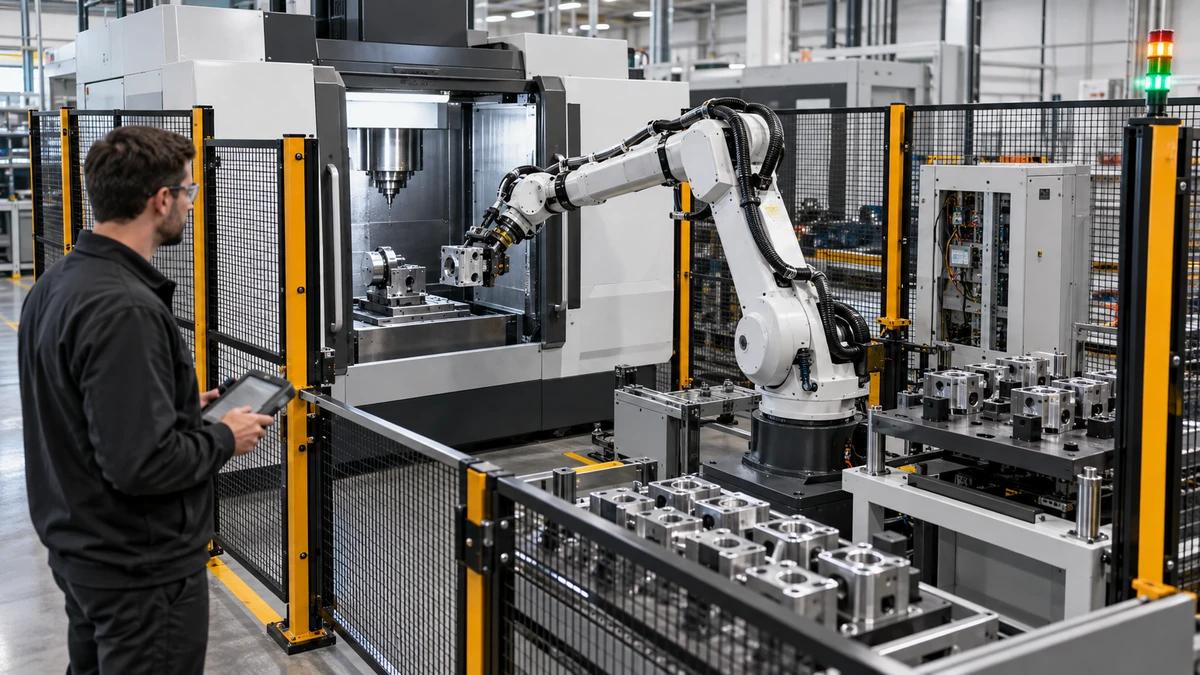
| Machine with automated handling | Part presentation, agreed interruption recovery and traceable output | Upstream processes, downstream inspection and unrelated automation |
This comparison helps answer a practical question: what extra uncertainty does the proposed option introduce? A larger or more complex machine does not remove the need to define the workpiece and process. Conversely, an uncomplicated part may not justify a complicated acceptance program.
The commercial discussion belongs in the test plan
Who pays for material, tools and a repeat trial?
List trial stock, consumable tools, special gauges and fixture costs separately from the machine. State whether the fixture and programs become deliverables. If a buyer supplies a unique blank, decide how many blanks are available and what happens if one is damaged during development.
Also agree how an unsuccessful result is handled. A documented correction, a revised test and a clear decision owner are more useful than an informal promise to make the next sample better. Commercial terms require agreement between the parties; this article is a planning guide, not a substitute for that agreement.
What happens when the buyer requests a change?
A new material, controller option, fixture interface or automation requirement can affect the test scope and schedule. Ask Zhihe CNC to identify the changed configuration, the evidence that needs repeating and the revised delivery assumptions. Do not carry an old acceptance result across a materially changed setup without review.
Zhihe CNC's company profile describes machining-center manufacturing, custom machine solutions and project-based delivery scheduling. Those capabilities make configuration-specific discussion appropriate. They do not establish a standard lead time or a certificate for an individual order.
What should accompany the machine?
Request the agreed reports, relevant manuals, configuration list, final program versions, training scope and service contacts. Ask separately for any certificates required for the destination and intended use. A trial-cut record, a calibration record and a regulatory or quality certificate serve different purposes. None should silently replace another.
A short agenda for the acceptance meeting
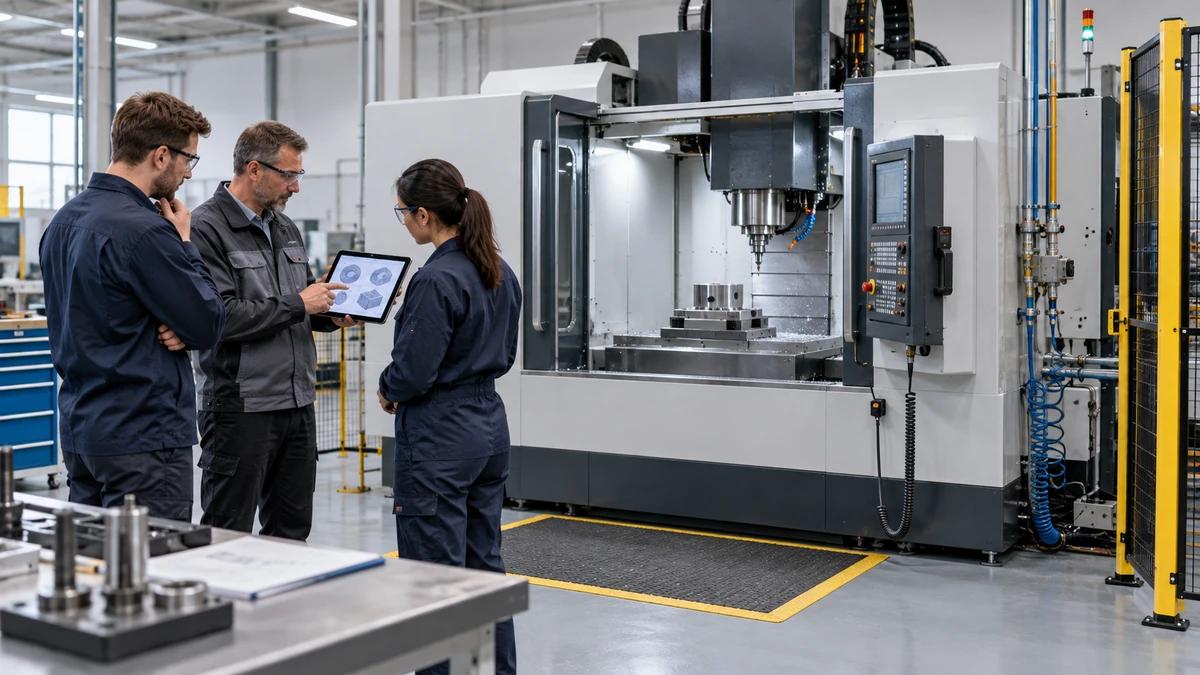
Use the CNC machine acceptance test meeting to resolve decisions, not to read every document aloud. Start with the configuration actually present. Review the critical feature results and any adjustments. Then address exceptions, shipment conditions and the site checks that remain.
Finish by identifying the person who can release the machine and the person responsible for each unresolved item. Record whether an open item prevents shipment, prevents production use, or is a later improvement request. That distinction helps both teams plan the next step without pretending that every exception has the same consequence.
Ten questions buyers commonly ask
Is a standard piece enough for a CNC machine acceptance test?
It can establish an agreed baseline, but it may not expose your difficult feature or fixture problem. Ask what the standard piece represents and whether a representative production feature needs an additional trial.
Should the exact production material be used?
Prefer representative material and stock condition when cutting performance is part of the decision. If another blank is used, record the difference and limit the conclusion accordingly. Do not assume a convenient trial material proves a harder application.
Does a good positioning report guarantee good parts?
No. The finished result also depends on tooling, workholding, programming, material and measurement. Use the motion report for the characteristic it measures, then evaluate the cutting process separately.
How many parts should be measured?
Agree the quantity around the feature risk, expected variation and production events you need to observe. A small demonstration and a formal capability study answer different questions; label the work accurately.
Can acceptance take place remotely?
Some reviews can be supported by video, live observation and shared records. Agree camera views, part identification, access to raw results and the limits of remote observation before relying on it.
Should inspection time count in cycle time?
State the boundary explicitly. Cutting time, machine-cycle time and elapsed time per accepted component can differ. Report the number that answers the buyer's production question and list excluded activities.
What if a feature fails once?
Preserve the result, investigate the cause and follow the agreed correction and retest process. Quietly discarding the part makes it harder to judge whether the change solved the actual problem.
Is a factory trial also site acceptance?
Not necessarily. Transport, installation and site conditions introduce a separate context. Agree which checks must be repeated at the destination and who supplies the required resources.
Can a customized machine use the same checklist?
The basic questions remain useful, but custom interfaces and functions need their own evidence. Add them to the configuration and test scope instead of relying on a checklist written for a standard machine.
What should I send Zhihe CNC first?
Send the drawing, material, critical features, expected batch mix and the decision you need the trial to support. Identify any fixture, controller, inspection or destination requirements that constrain the proposal.
Turn the open questions into an inquiry
Before arranging a CNC machine acceptance test, write down the three results that would make you confident in the purchase and the three uncertainties that still worry you. Attach those notes to your drawing and ask for a configuration-specific proposal through Zhihe CNC's contact page.
You can also review the machining-center product range to identify the architectures worth discussing. The next useful deliverable is a scoped test and a comparable quotation—not an unsupported assurance that every future component will pass.