What buyers really need from a CNC machining center manufacturer
When engineers and sourcing teams search for a CNC machining center manufacturer, they are usually not just looking for a machine on a floor. They are trying to reduce risk. That might mean tighter repeatability, cleaner surface finish, faster turnaround on custom parts, or a shop that can handle inspection without turning every job into a back-and-forth of revisions. In practice, the right partner is often the one that can machine metal parts consistently and prove it with a disciplined quality workflow.
That matters because a machining quote rarely tells the full story. A part may look simple on paper, then reveal deep pockets, thin walls, bolt-hole patterns, and reference faces that are easy to distort if the setup is weak. For buyers in aerospace, automotive, robotics, industrial equipment, fixtures, tooling, and general custom fabrication, the real decision is not just who can cut metal. It is who can deliver the geometry, finish, and inspection routine that keep downstream assembly from slowing down.
What the shop-floor image suggests about capability
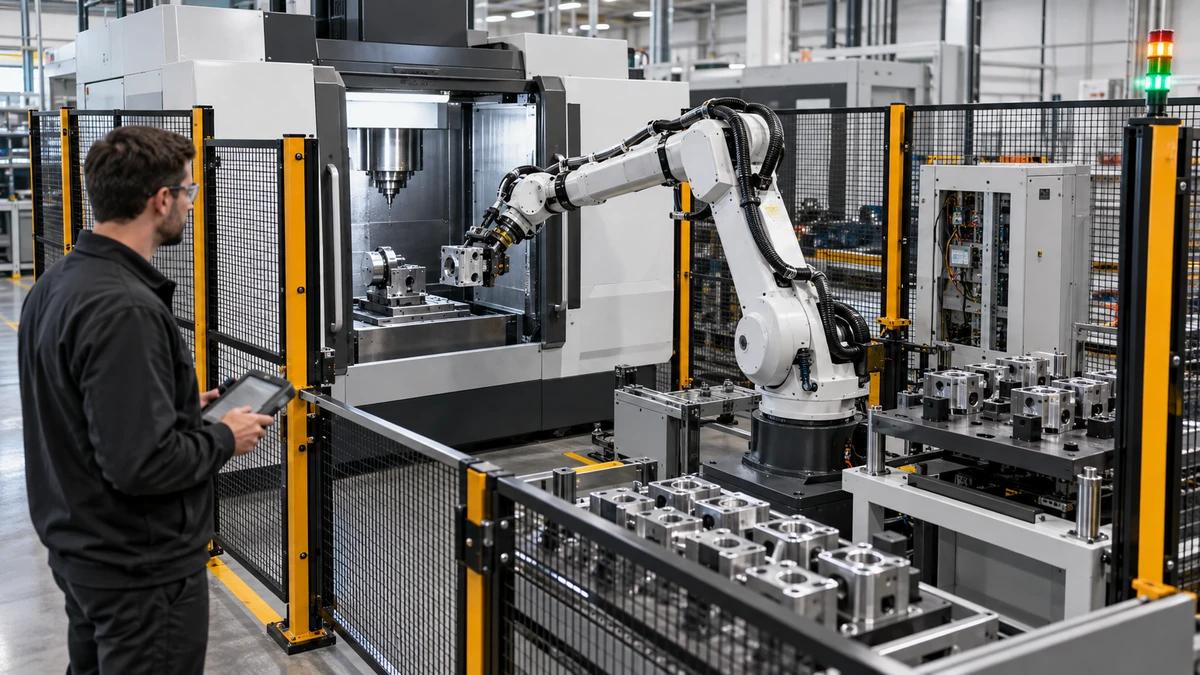
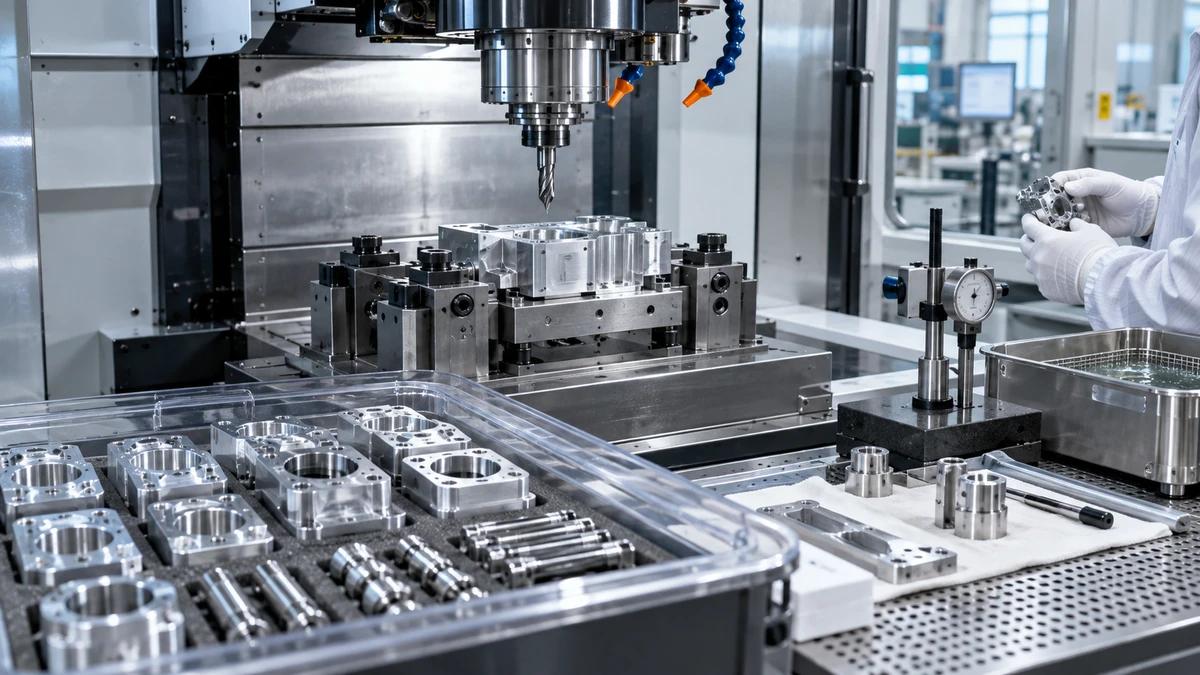
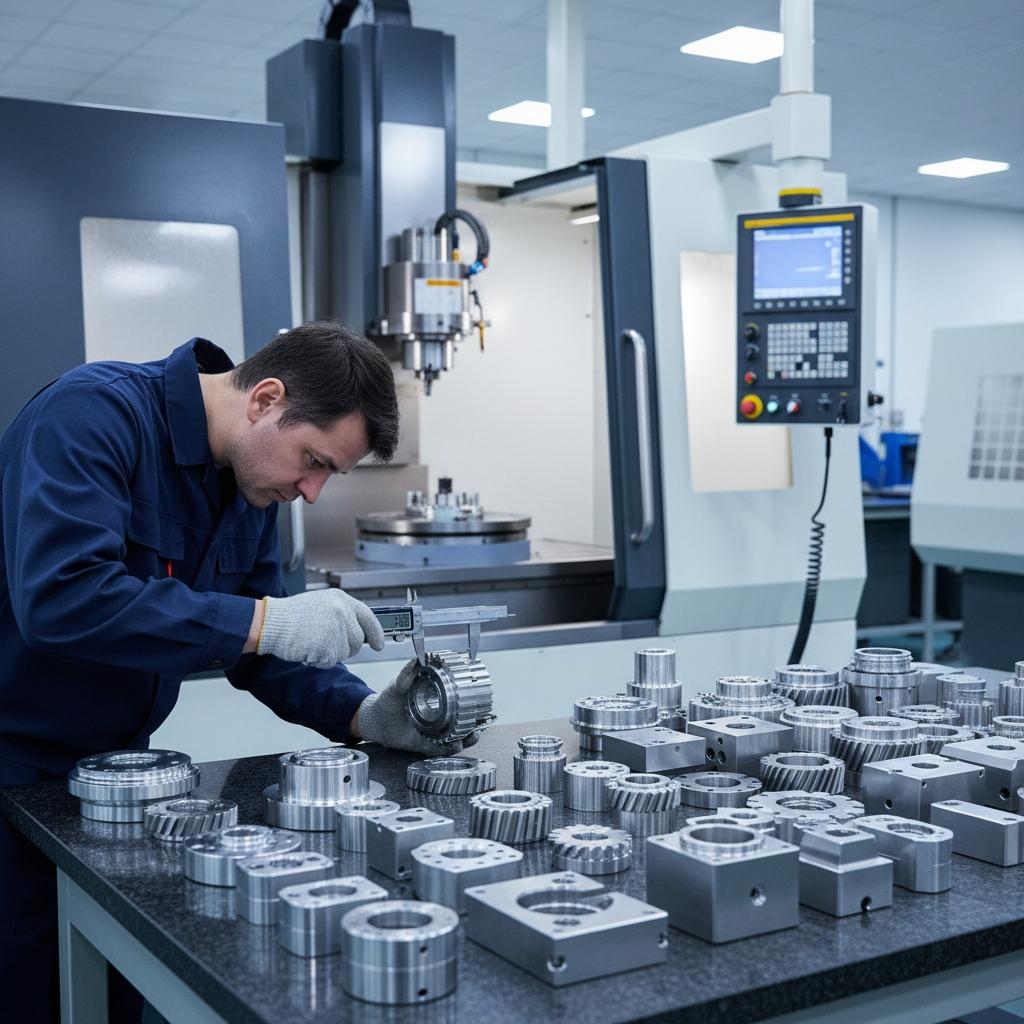
The product setup described here points to a CNC milling and machining workstation with an operator inspecting finished parts. That combination is worth noticing. It suggests a workflow built around both cutting and checking, which is still the basic language of good machining.
The parts shown appear to be machined from metal, likely aluminum or steel, with bright silver or ground surfaces. There are flanges, housings, blocks, shafts, circular rings, and other multi-face components. Those shapes usually demand more than simple drilling. They often require controlled pocketing, face milling, hole placement, and careful repositioning so that flat reference surfaces and internal cavities stay aligned.
A buyer should read that as a useful sign: the work is not limited to rough stock removal. It looks closer to precision machining for custom parts, prototypes, or production runs where repeatable dimensions and usable surface finish are part of the brief.
Quick comparison: machine capacity versus manufacturing discipline
Many sourcing conversations focus too heavily on machine count or axis count. That can be misleading. A capable CNC machining center supplier is not defined only by the machine enclosure or spindle size. The more useful question is whether the factory has a stable process.
Look for these practical signals
A machining center factory with inspection tools nearby is usually easier to trust than one that measures only after a problem appears. Visual signs such as calipers, reference surfaces, and finished parts arranged for checking can indicate a more controlled workflow. It is not proof of quality by itself, of course, but it is better than a shop that treats inspection as an afterthought.
Also consider part variety. If a manufacturer can handle prismatic components, cylindrical features, internal cavities, and bolt-hole patterns without making every drawing a special case, that usually says more about process maturity than a glossy machine brochure does.
Material and geometry considerations that affect sourcing
Metal machining is rarely difficult in the abstract. The difficulty appears in the details. Aluminum often rewards speed and good surface handling, while steel can demand more attention to tool wear and stability. The photo description does not identify the exact material grade, so buyers should not assume one. Still, the visible finishes and cut surfaces suggest a shop used to working with machined metal components that need clean edges and accurate faces.
Geometry is the other pressure point. Deep pockets, intersecting holes, and thin flanges can all create risk during clamping and secondary operations. If your parts have multiple faces or need datum control across several setups, ask how the shop manages reference surfaces and part location. That question is often more revealing than asking for a general capability list.
Selection criteria that save time later
If you are qualifying a CNC machining center manufacturer, keep the conversation grounded in the job itself.
Ask how they handle inspection of finished parts.
Ask whether they are set up for prototypes, small batches, or longer production runs.
Ask what kinds of custom precision parts they are most comfortable with: housings, blocks, shafts, fixtures, or mixed-feature assemblies.
Ask how they manage surface finish requirements when the part must look good as well as function well.
Those questions help you separate a true machining partner from a shop that only looks busy.
Common mistakes buyers make
The most common mistake is assuming that a CNC machining center manufacturer and a CNC machining center supplier are interchangeable search terms. They are not always. One may build or operate production capability; the other may mainly resell or coordinate supply. If you need repeat work, the difference matters.
Another mistake is sending a drawing package without stating which dimensions are critical. A good shop can machine accurately, but it cannot guess what your assembly actually cares about. If a hole pattern controls fit, say so. If a flat face is a sealing surface, identify that too. Buyers sometimes learn this the hard way after the first article is already on the bench.
FAQ for sourcing teams
Can one shop handle both prototyping and production?
Often yes, but only if its setup discipline scales. Prototype work may allow more handholding; production work usually needs steadier inspection and repeatable fixturing.
Why does post-machining inspection matter so much?
Because cutting a part is only half the job. If the finished component is off by a small amount, assembly, alignment, and wear performance can all suffer.
Should I choose based on the machine itself?
Not alone. The machine matters, but the workflow around it matters just as much: setup, tool control, inspection, and communication.
A practical next step
If you are shortlisting a CNC machining center manufacturer for custom metal parts, start with the part drawing, not the sales pitch. Share the critical dimensions, the material if it is known, the finish expectations, and the expected lot size. Then ask how the shop would inspect the work and where it sees the main risks.
That kind of conversation usually tells you more in ten minutes than a page of capability claims. And for buyers who have been burned by vague machining quotes before, that is often the clearest path to a reliable source.