Why High Rigidity Matters When Choosing a Vertical Machining Center
A high rigidity vertical machining center may not sound as exciting as a faster spindle or a larger machine size. Yet in real production, rigidity often decides whether a part is machined smoothly or becomes a source of chatter, tool wear, rework, and unstable quality.
This is especially true for medium-sized parts. Boxes, housings, discs, molds, automotive components, and general machinery parts are not always extremely large, but they can still place serious demands on the machine. They may require heavy roughing, accurate hole positions, flat mounting surfaces, and stable finishing results.
If the machine is not rigid enough, problems appear quietly. The tool begins to vibrate. The surface becomes uneven. Dimensions drift after rough cutting. Operators reduce cutting parameters to avoid chatter, and the machine that looked productive on paper becomes slower in practice.
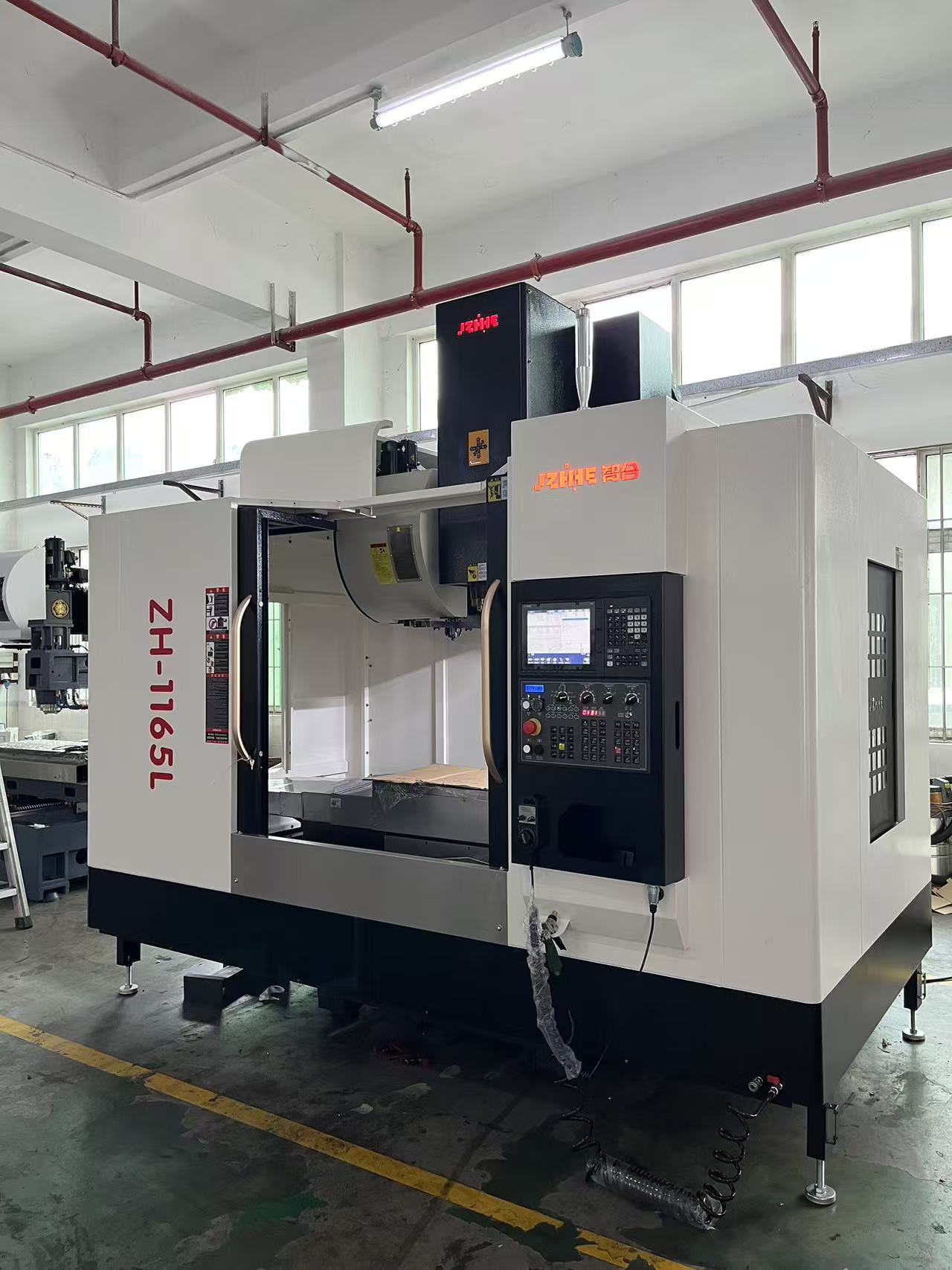
That is why buyers should look carefully at models such as the ZH-1165L Vertical Machining Center. It is designed for heavy cutting and high-precision machining, with a structure intended to combine linear guide speed with hard rail rigidity and vibration absorption. For manufacturers machining medium-sized industrial parts, that combination can make a real difference.
What Does Rigidity Mean in CNC Machining?
Rigidity is the machine’s ability to resist deformation under cutting force. During machining, the tool pushes against the workpiece. The workpiece pushes back. The machine structure must absorb this force while keeping the tool path stable.
If the machine bends, vibrates, or loses stability, the part quality suffers.
A high rigidity vertical machining center helps maintain the relationship between the spindle, tool, fixture, and workpiece. This is important during heavy cuts, interrupted cuts, long tool overhangs, and machining of harder materials.
For B2B buyers, rigidity is not an abstract technical term. It connects directly to cost. Better rigidity can support more stable cutting, fewer tool marks, less rework, and more predictable production.
Why Rigidity Is Critical for Heavy Cutting
Heavy cutting creates larger forces than light finishing. When machining steel, cast iron, mold materials, or thick aluminum components, the machine must remain stable while removing material efficiently.
A light-duty machine may still complete the job, but it may need slower parameters. That means longer cycle times. In some cases, it may also produce vibration that damages tools or affects surface finish.
The ZH-1165L is positioned as a vertical machining center for heavy cutting. Its application range includes medium-sized boxes, housings, discs, molds, general machinery, automotive parts, and mold manufacturing. Its 1100 / 650 / 600 mm X/Y/Z travel provides enough working range for many medium-sized workpieces, while its structure is intended for stronger cutting conditions.
In daily production, this matters. Buyers are not only paying for the machine to move. They are paying for the machine to cut with control.
Rigidity and Surface Finish Are Closely Linked
Surface finish is often discussed as a tooling or programming issue. That is only partly true. Machine rigidity also plays a major role.
When vibration occurs, the tool may leave visible marks on the workpiece. These marks can require secondary finishing, polishing, or even re-machining. In mold manufacturing, this can delay delivery. In automotive or general machinery parts, it can affect assembly quality or sealing performance.
A high rigidity vertical machining center can help reduce chatter and support more stable finishing. This does not mean the machine alone solves every surface problem. Cutting tools, coolant, material, clamping, and programming still matter. But without a stable machine structure, even good tools may not perform as expected.
Think of it like writing on a shaking table. The pen may be excellent, but the result will still suffer if the base is unstable.
How Rigidity Affects Tool Life
Tool life is another hidden cost. When a machine vibrates during cutting, the tool edge experiences irregular load. This can accelerate wear, cause chipping, or force the operator to replace tools earlier than planned.
For shops that run repeated batches, this adds up quickly. A few extra tools per week may not seem dramatic, but over months of production, the cost becomes visible. More importantly, unstable tool wear can affect consistency between parts.
A rigid machine allows the tool to cut under more predictable conditions. That helps the process engineer choose parameters with more confidence. It also reduces the need for constant manual adjustment.
For procurement teams, this is worth remembering: the purchase price of a machine is only one part of the total cost. Tool consumption, rework, downtime, and operator intervention also matter.
Why Medium-Sized Housings and Box Parts Need Stability
A CNC machining center for medium-sized housings must handle more than simple flat milling. Housing parts may include pockets, holes, sealing faces, bearing seats, mounting surfaces, and side features. Many of these features must maintain alignment.
If the machine lacks rigidity, roughing may release stress or create vibration that affects later operations. If the fixture is also weak, the problem becomes worse. By the time the part reaches inspection, the issue may already be built into the geometry.
The ZH-1165L’s travel range and heavy-duty positioning make it suitable for many medium-sized housings and box-type parts. Its 10,000 rpm belt-drive BT40 spindle also gives buyers a practical configuration for milling, drilling, and tapping operations across general industrial materials.
The point is not that rigidity replaces process planning. It supports it. A stable machine gives the process engineer a better foundation.
What Buyers Should Check When Evaluating Rigidity
Rigidity is not always easy to compare from a product photo. Buyers should ask practical questions:
| What to Check | Why It Matters |
|---|---|
| Machine structure | Affects resistance to cutting force and long-term stability |
| Guideway design | Influences speed, load support, and vibration absorption |
| Spindle configuration | Affects cutting force, tool compatibility, and finish quality |
| Table capacity | Determines whether heavier workpieces can be supported safely |
| Fixture space | Helps avoid unstable clamping during machining |
| Trial cutting | Shows real performance on actual or similar workpieces |
| Accuracy testing | Confirms whether the machine meets acceptance requirements |
For acceptance discussions, buyers can refer to recognized machine-tool test standards. ISO 230-2 covers testing and evaluation of positioning accuracy and repeatability of numerically controlled machine-tool axes, and ISO 10791-7 covers the accuracy of finished test pieces for machining centres. These references are useful when buyers want testing to be more objective and traceable.
High Rigidity Does Not Mean Ignoring Speed
Some buyers worry that a rigid machine must be slow. That is not always true. The better question is whether the machine provides the right balance between speed and stability.
The ZH-1165L is described as combining the high speed of linear guide machines with the rigidity and vibration absorption of hard rail machines. This matters because most production parts need both fast movement and strong cutting support.
For example, a part may require rough milling, hole drilling, tapping, contour milling, and final finishing. Fast rapid traverse helps reduce non-cutting time. Rigidity helps during actual material removal. A good machine should not force the buyer to choose only one side.
Common Mistakes Buyers Should Avoid
One mistake is assuming that all vertical machining centers are similar. They are not. Two machines may have similar travel, but behave very differently under load.
Another mistake is choosing by price alone. A cheaper machine may cost more later if it requires slower cutting, more tool changes, more rework, or frequent service.
Some buyers also overlook part mix. If the shop mainly machines light aluminum parts, a heavy-duty platform may not be necessary. But if the work includes steel housings, molds, discs, and automotive components, a stronger machine structure becomes more important.
A final mistake is skipping trial cutting. A trial piece can reveal vibration, surface quality, tool behavior, and process stability before the machine is accepted.
FAQ
What is a high rigidity vertical machining center?
A high rigidity vertical machining center is a CNC machine designed to resist deformation and vibration during cutting. It is especially useful for heavy cutting, steel parts, molds, housings, and medium-sized industrial components.
Why is rigidity more important than spindle speed in some applications?
Spindle speed helps with cutting efficiency, but rigidity helps maintain stability under load. For heavy cutting and mold machining, a fast spindle cannot compensate for a weak machine structure.
Is the ZH-1165L suitable for automotive parts?
Yes. Based on the provided product information, the ZH-1165L is suitable for automotive parts, general machinery, mold manufacturing, boxes, housings, discs, and medium-sized components.
Can rigidity improve tool life?
Yes. A more stable cutting process can reduce vibration and irregular tool load, which may help improve tool life and reduce unexpected tool damage.
What should buyers send before asking for a machine recommendation?
Buyers should send drawings, material information, workpiece size, tolerance requirements, cutting operations, fixture details, and expected production volume.
Conclusion
A high rigidity vertical machining center matters because machining is not only about movement. It is about controlled cutting. Rigidity affects vibration, accuracy, surface finish, tool life, and production consistency.
For manufacturers working with medium-sized housings, molds, discs, automotive parts, and general machinery components, the ZH-1165L Vertical Machining Center offers a practical heavy-duty platform. Its travel range, BT40 spindle, Mitsubishi controller, and rigid design make it suitable for buyers who need stable machining rather than light-duty capacity.
The best purchasing decision starts with the actual workpiece. Check the material, cutting force, fixture plan, surface requirements, and batch volume. Once those details are clear, the value of machine rigidity becomes much easier to see.