Vertical Machining Center for Mold Manufacturing: What Buyers Should Check
Choosing a vertical machining center for mold manufacturing is not the same as buying a general milling machine. Mold work is less forgiving. A mold base, cavity, insert, or die component may look like a block of steel at first, but once machining begins, the job quickly becomes a test of rigidity, vibration control, tool stability, and finishing accuracy.
For B2B buyers, the real question is not simply, “Can this machine cut mold steel?” Many machines can. The better question is: can it remove material efficiently, keep accuracy stable after roughing, and still deliver a clean finishing surface without creating extra polishing or rework?
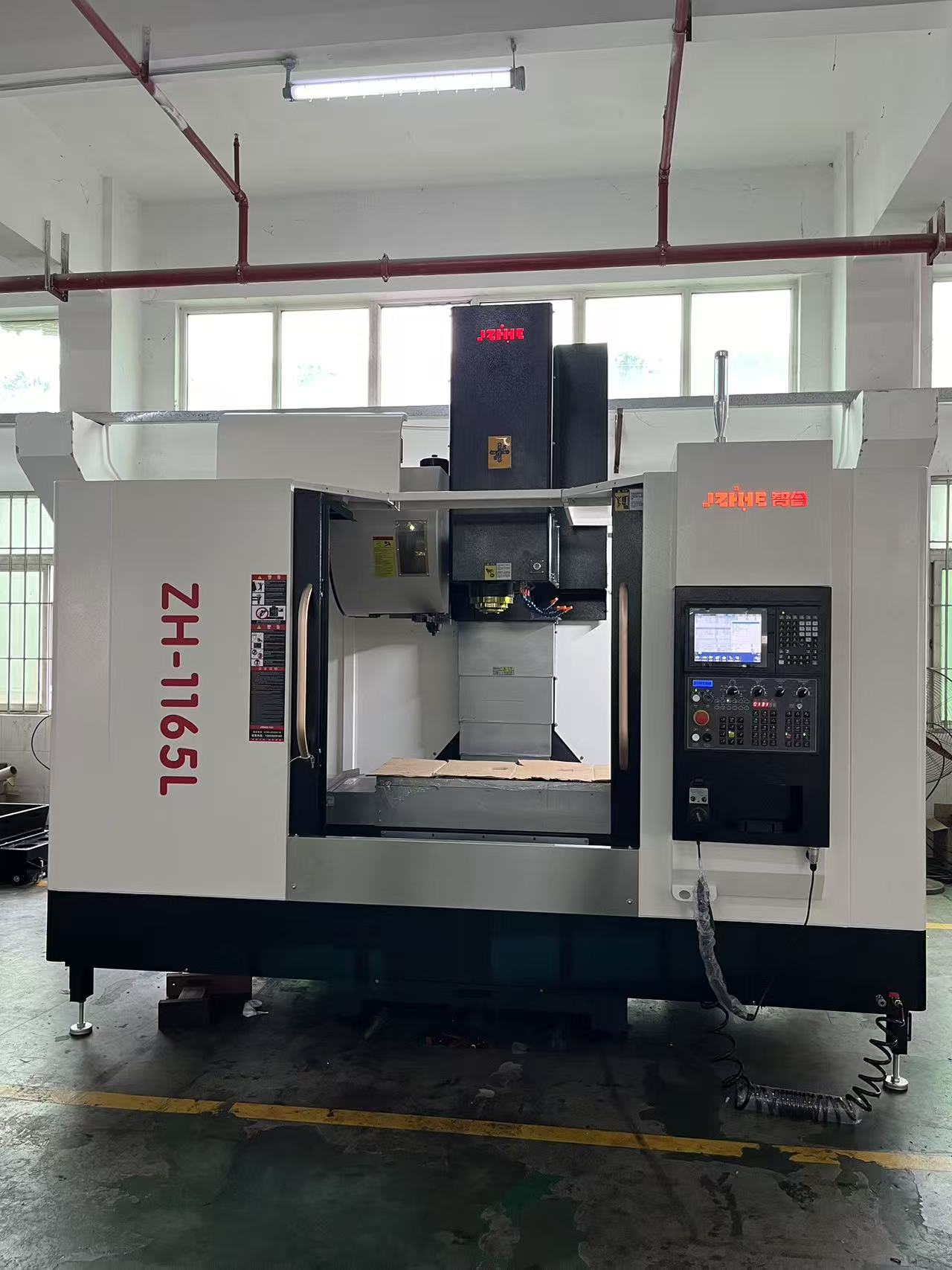
That is where a model such as the ZH-1165L Vertical Machining Center becomes relevant. Based on the product information, it is designed for heavy cutting and high-precision machining of medium-sized boxes, housings, discs, and molds. With 1100 / 650 / 600 mm X/Y/Z travel, a 10,000 rpm belt-drive BT40 spindle, 20 / 20 / 12 m/min rapid traverse, and MITSUBISHI M80VB CNC controller, it fits the type of mold shop that needs more than light-duty milling.
Why Mold Manufacturing Needs a Stronger Machining Platform
Mold machining often involves two very different stages. Rough machining removes a large amount of material. Finishing then asks the same machine to produce accurate surfaces, smooth contours, and consistent details. That switch is not easy.
If the machine lacks rigidity during roughing, vibration can appear. If vibration is not controlled, the tool may wear faster, the surface may become unstable, and dimensional accuracy may drift. Later, the finishing operation has to repair what the roughing stage disturbed. That means more time, more tool consumption, and sometimes more manual polishing.
A vertical machining center for mold manufacturing should support the whole process: roughing, semi-finishing, drilling, tapping, boring, and final finishing. It should not only perform well in one step and struggle in the next.
For mold buyers, that balance matters more than a single impressive specification.
Check Machine Rigidity Before Checking Speed
Many buyers naturally look at spindle speed first. Speed is important, but for mold manufacturing, rigidity usually deserves earlier attention.
Mold bases and cavity blocks are often made from steel or alloy materials. These materials create higher cutting force than aluminum. During heavy milling, the machine frame, spindle system, guideway structure, and table support must resist vibration and deformation.
The ZH-1165L is positioned as a machine that combines the high speed of linear guide machines with the high rigidity and vibration absorption of hard rail machines. This matters because mold shops need both. Fast movement saves time during positioning and lighter cutting. Strong vibration absorption supports heavier cutting and more stable machining.
A machine that is only fast may feel attractive in a demo. On a mold shop floor, however, unstable cutting can become expensive very quickly.
Travel Size and Workpiece Fit Should Be Checked Carefully
A mold part does not only need to fit inside the machine travel. It needs room for fixtures, tool holders, safe clearance, and chip movement.
The ZH-1165L provides 1100 mm X-axis travel, 650 mm Y-axis travel, and 600 mm Z-axis travel. For many medium-sized mold bases, housings, plates, and die components, this travel range gives buyers practical room for setup.
Still, buyers should not judge only by the part’s outer dimensions. A mold block may fit on the table, but if the fixture is too high, tool reach becomes a problem. If the cutting tool is long, Z-axis clearance becomes more sensitive. If side access is needed, the setup may require additional planning.
Before choosing a CNC machining center for molds, buyers should prepare the largest regular workpiece, the heaviest workpiece, fixture drawings if available, and the expected tool length. These details tell more than the product name.
Spindle Configuration: Why BT40 Can Be Practical for Mold Shops
A BT40 vertical machining center is widely used for medium-sized parts and mold-related machining. The ZH-1165L uses a 10,000 rpm belt-drive BT40 spindle, which gives a practical balance for general mold roughing and finishing work.
For buyers, the key is to match spindle performance to material and cutting strategy. If the shop mostly machines small aluminum parts, a high-speed light-duty machine may be enough. If the shop works with steel molds, larger cutters, and heavier roughing passes, spindle torque, rigidity, and vibration control become more important.
The spindle should support the real tool list: face mills, end mills, drills, taps, boring tools, and finishing cutters. It should also match the shop’s expected surface finish and cycle time targets. A spindle that looks fine on paper may still be wrong if the tool strategy is not considered.
What Buyers Should Check Before Ordering
A practical mold manufacturing buyer should review the machine from several angles:
| Check Point | Why It Matters for Mold Manufacturing |
|---|---|
| Machine rigidity | Reduces vibration during roughing and helps protect finishing accuracy |
| Worktable and travel | Confirms whether mold blocks, fixtures, and tools can fit safely |
| Spindle type | Affects cutting force, tool compatibility, and surface finish |
| Guideway structure | Influences vibration absorption and stability under load |
| CNC controller | Affects programming workflow, operator familiarity, and service support |
| Chip removal | Heavy cutting produces chips that must be managed efficiently |
| Supplier support | Installation, training, and maintenance affect long-term production |
Buyers should also ask how machine accuracy is verified. ISO 230-2 specifies methods for testing the accuracy and repeatability of positioning of numerically controlled machine-tool axes, while ISO 10791-7 covers accuracy of finished test pieces for machining centres. These standards can help buyers frame acceptance testing more professionally instead of relying only on catalog claims.
Common Mistakes in Mold Machine Selection
One common mistake is choosing a machine only because it has a larger travel. A larger machine is not automatically better. If the structure is not rigid enough, it may still produce chatter during heavy cutting.
Another mistake is buying for maximum spindle speed while ignoring cutting load. Mold machining is not only about fast rotation. It is also about stable material removal.
Some buyers also forget fixture planning. A mold part may require strong clamping, accurate datum control, and enough clearance for deep cavity machining. A poorly planned fixture can reduce the benefit of a good machine.
The most expensive mistake is choosing a machine without trial cutting or technical discussion. A mold shop should share drawings, material grade, tolerance requirements, surface finish expectations, and current machining problems before confirming a model.
FAQ
Is a vertical machining center suitable for mold manufacturing?
Yes. A vertical machining center is suitable for mold bases, cavities, inserts, die parts, plates, and other mold components, especially when the machine has enough rigidity, travel, spindle strength, and stable control.
Why does rigidity matter in mold machining?
Rigidity helps reduce vibration, tool chatter, surface marks, and dimensional drift. This is important because mold work often includes heavy roughing followed by precision finishing.
Is the ZH-1165L suitable for medium-sized molds?
Based on its 1100 / 650 / 600 mm travel and heavy-cutting design, the ZH-1165L is suitable for many medium-sized molds, housings, discs, and box-type parts.
What should buyers provide before requesting a recommendation?
Buyers should provide drawings, material, part size, tolerance requirements, surface finish needs, tooling plan, fixture requirements, and expected batch volume.
Conclusion
A vertical machining center for mold manufacturing should be selected by looking at the full machining process, not one specification. Mold parts need stable roughing, reliable semi-finishing, accurate drilling and tapping, and clean final surfaces.
The ZH-1165L Vertical Machining Center is a practical option for mold shops that need heavy cutting and high-precision machining of medium-sized parts. Its travel range, BT40 spindle configuration, rigid structure, and Mitsubishi control system make it suitable for buyers who want a stronger platform for mold bases, cavities, dies, and related industrial parts.
For the best result, start with the mold drawing. The right machine is the one that fits the part, the material, the fixture, and the production rhythm—not just the one with the longest specification list.