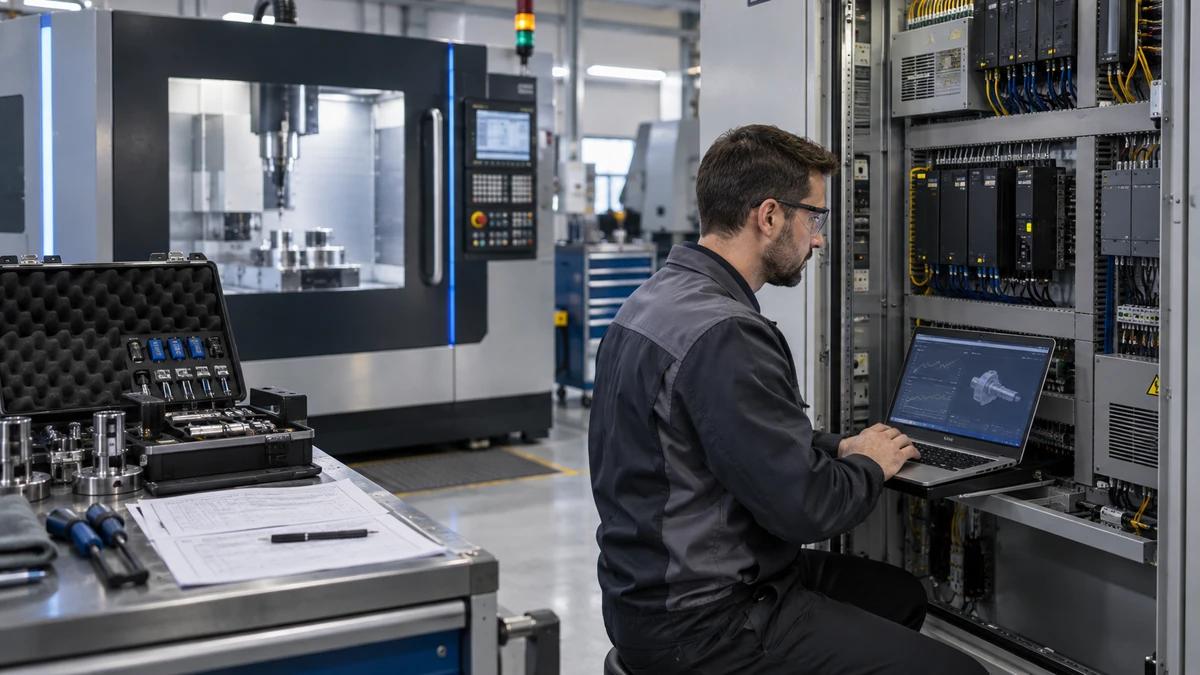
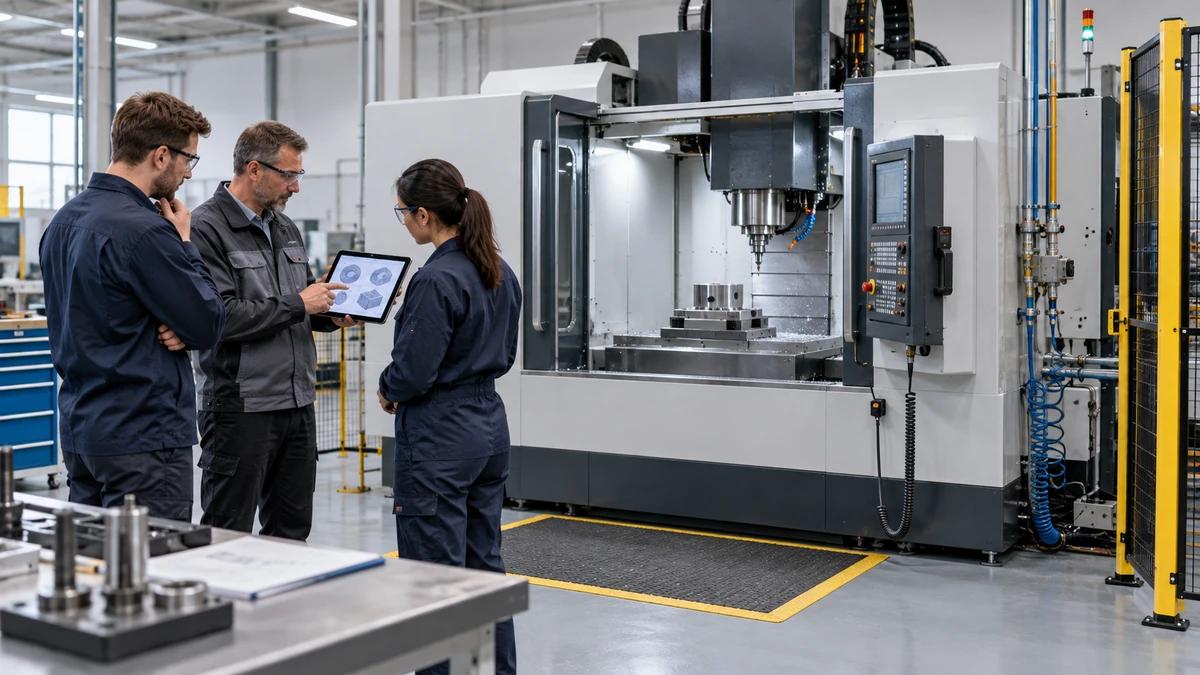
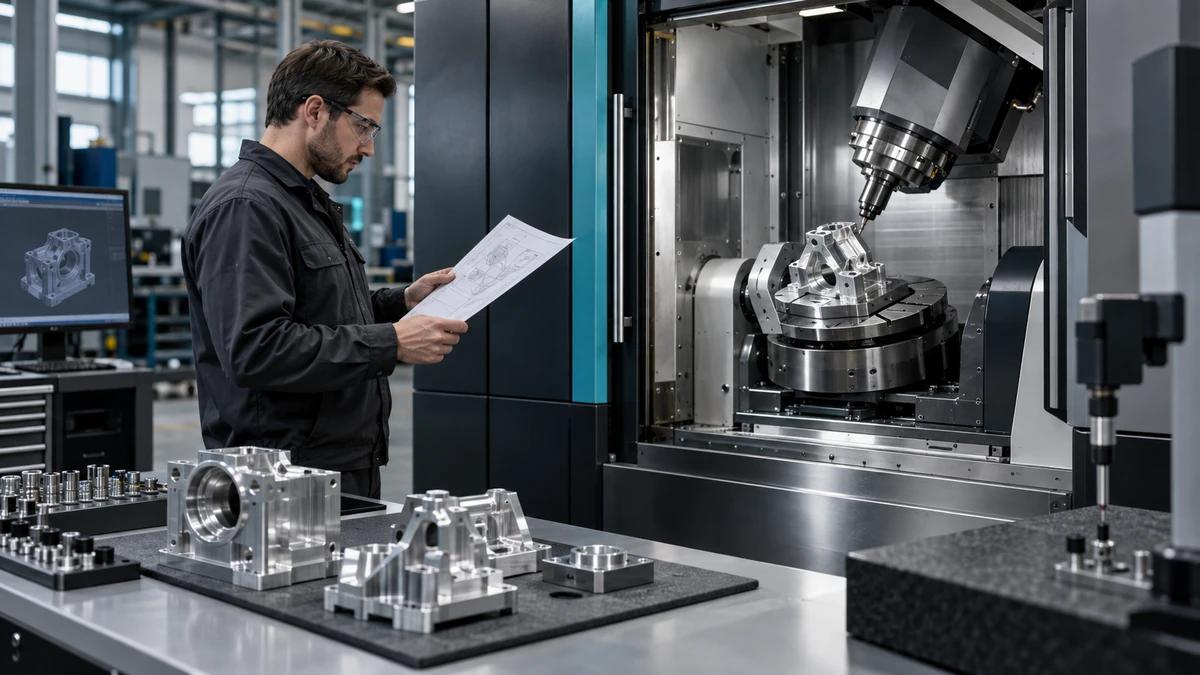
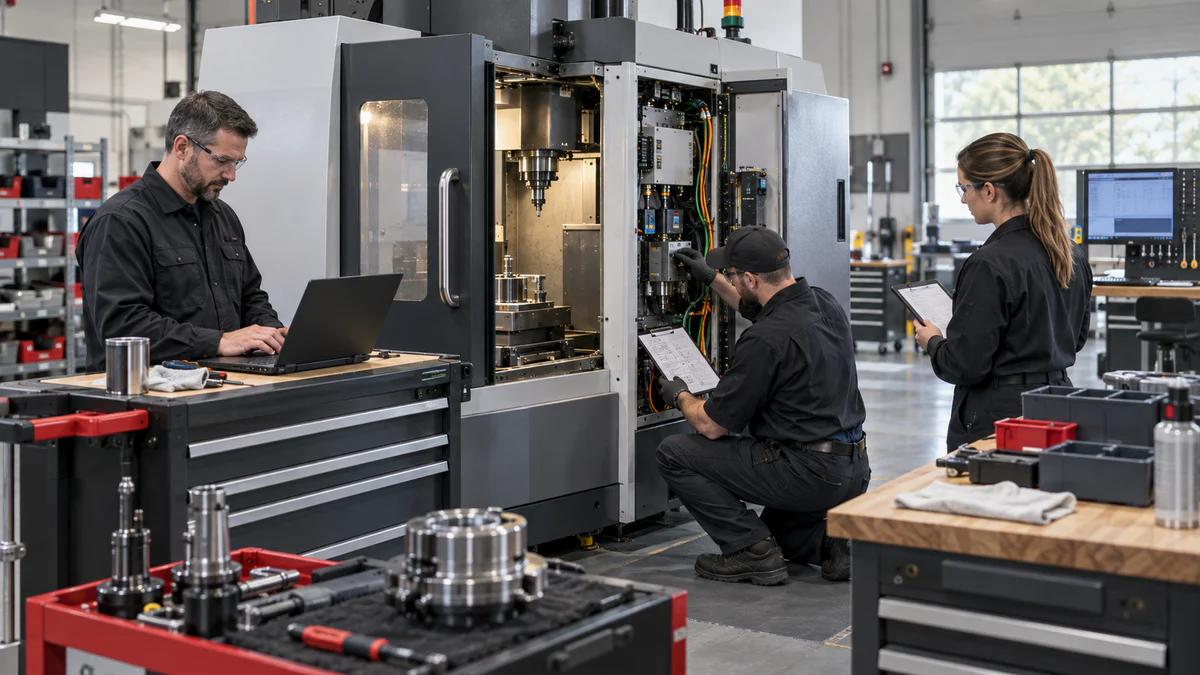
A VMC machine manufacturer visit should follow the life of one machine from buyer requirement to recoverable production, not wander through a showroom. Zhihe CNC organizes the audit as a working day with timed stops, evidence receipts, and contradiction checks.
The route helps sourcing, engineering, quality, maintenance, and management use limited factory time well. It also separates what can be observed today from what needs serial-specific records, a controlled test, or later site verification.
08:30 — Open With the Buyer Workload
Begin with controlled drawings, CAD, material, stock, datums, tolerances, surfaces, batch size, annual volume, target cycle, inspection, automation, site, utilities, skills, and growth scenarios. Ask the host team to explain how these inputs change the proposed model and options.
Zhihe CNC records unresolved points before the tour. A missing tool projection or fixture height can invalidate later claims about work envelope, magazine fit, spindle duty, and cycle.
09:15 — Trace One Requirement Into Configuration
| Buyer condition | Configuration response | Proof to collect |
|---|---|---|
| Tall fixture | Usable Z envelope | Clearance model |
| Heavy cut | Spindle and structure | Duty and trial plan |
| Fine bore | Thermal and inspection | Conditioned evidence |
| High mix | Magazine and changeover | Combined tool map |
| Automation | Access and signals | Interface definition |
The purpose is not to approve every option; it is to see whether each option has a stated reason.
10:00 — Read the Incoming and Assembly Controls
Sample material certificates, receiving inspection, key-component identification, storage, assembly instructions, torque or fit records, cleanliness, lubrication, wiring, piping, spindle handling, alignment, software loading, and nonconformance control. Connect each record to a serial number and revision.
A VMC machine manufacturer should be able to explain how a detected deviation is contained, corrected, retested, and released.
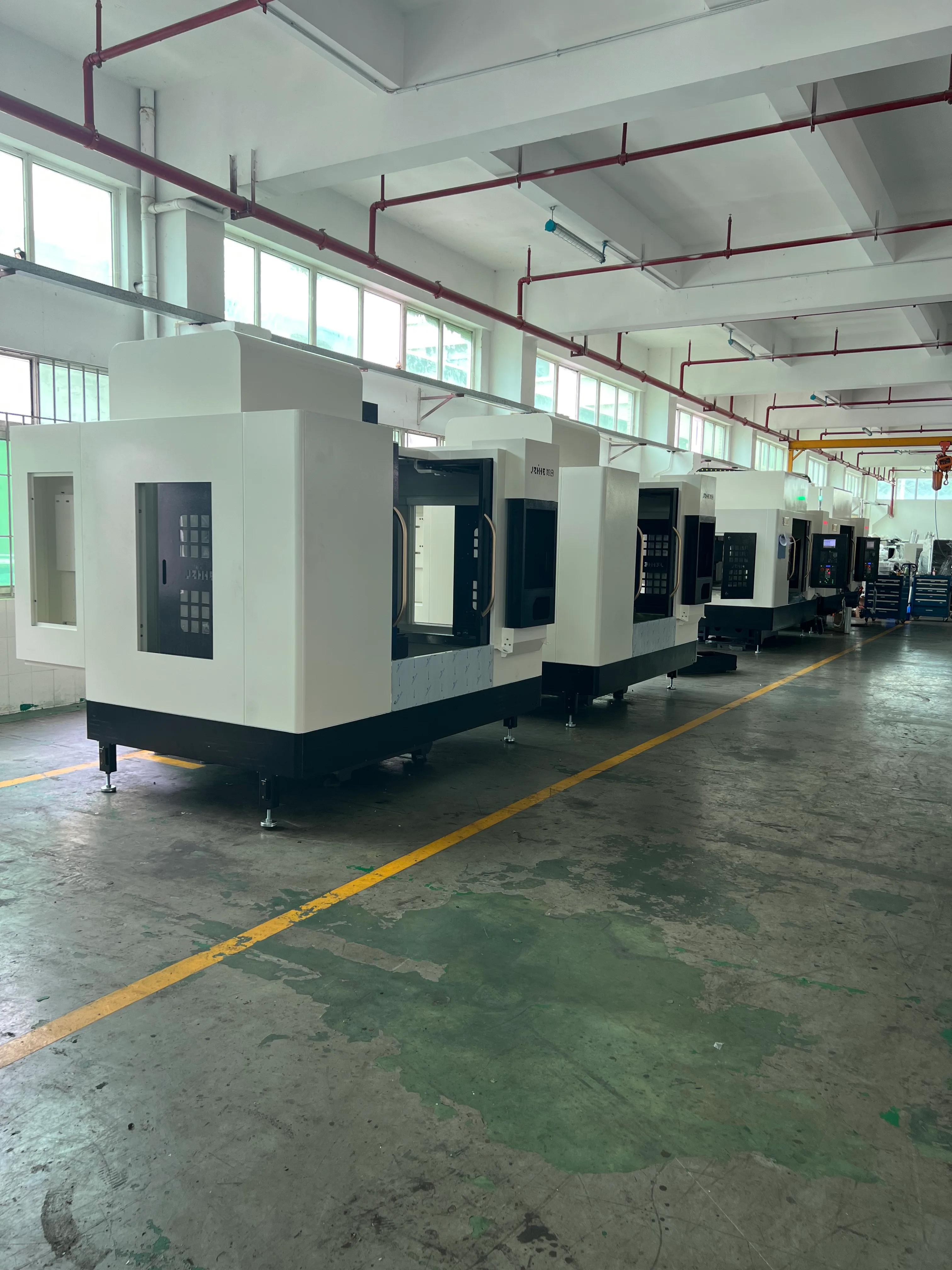
11:00 — Observe Geometry Without Losing Conditions
Record setup, foundation, level, temperature, warm-up, measurement equipment, calibration status, axis positions, feed direction, compensation state, repeat method, acceptance limit, and report identity. The ISO 230-2 search reference provides positioning-test context, but a result only answers the conditions actually measured.
Ask which checks are performed before and after transport and how the receiving site can reproduce them.
12:00 — Hold a Contradiction Check
Before lunch, compare model names, travels, loads, spindle data, tool limits, controller functions, options, software, voltage, test conditions, documentation, and dates across quotation, specification, drawings, records, and the physical machine. Mark differences rather than accepting verbal reconciliation.
Zhihe CNC uses this checkpoint early enough that the afternoon trial can test the correct baseline.
13:30 — Watch a Trial That Represents Production
Freeze material, blank, fixture, tools, holders, runout, program, postprocessor, offsets, thermal state, coolant, inspection, limits, sample, and exceptions. Include a difficult reach, tool change, chip-prone feature, interruption, and restart when these are relevant.
Do not let one favorable surface replace the complete quality route. A trial should show how output is identified, measured, approved, and linked back to machine and process conditions.
Use an Evidence Receipt List
| Audit stop | Receipt | Decision supported |
|---|---|---|
| Application | Controlled requirement matrix | Machine fit |
| Assembly | Serial traveler sample | Traceability |
| Geometry | Conditioned report | Measurement meaning |
| Cutting | Trial pack and inspection | Process evidence |
| Delivery | Interface and packing files | Site readiness |
| Support | Backup and escalation file | Recovery |
Receipts can be reviewed later; memories of a busy tour cannot.
15:00 — Test Tool, Chip, and Coolant Reality
Inspect real holder lengths, neighboring-pocket restrictions, sister tools, tool-life logic, replacement readiness, chip evacuation from cavities and fixtures, washdown, conveyor, filtration, coolant stability, cleaning, and maintenance access. Ask how mixed materials or fine chips change the routine.
The VMC machine manufacturer should connect auxiliary systems to the buyer workload, not present them as independent brochure features.
15:45 — Review Change and Software Control
Identify the approved controller, PLC, NC, parameters, compensation, macros, cycles, licenses, options, postprocessor assumptions, program-transfer method, backups, and restoration test. Review how changes are requested, assessed, verified, approved, issued, and archived.
Zhihe CNC recommends sampling one software correction from problem report through retest and release.
16:30 — Walk From Packing Back to Installation
Match packing list to the signed scope. Map preservation, lifting points, transport restraints, route, rigging, foundation, utilities, leveling, geometry restoration, functions, tooling, trial material, inspection, training, acceptance, and production release. The ISO 10791 series reference offers test context, while the project plan must assign site-specific owners and evidence.
17:15 — Close With Service Recovery
Review alarm intake, remote-support boundary, language and time-zone coverage, diagnostic data, response classification, escalation, field service, spare strategy, maintenance, backups, and part-quality verification after repair. Ask who owns open items after the visit and which evidence closes each one.
A VMC machine manufacturer creates confidence when the service file connects the serial machine, approved baseline, failure evidence, corrective action, retest, and restored output.
Convert the Day Into a Decision Within 24 Hours
Issue a short decision file while observations remain fresh. Separate verified facts, representative demonstrations, documents promised, contradictions, risks, open questions, actions, owners, and due dates. Do not turn every observation into an equal score; identify the few conditions that can stop the project.
Rate evidence for relevance, identity, condition, recency, and reproducibility. A report with a good number but no serial, configuration, method, or limit remains weak. A transparent failed test with controlled correction and retest may show more process maturity than a perfect but untraceable sample.
Zhihe CNC recommends one end-to-end trace from buyer feature to machine choice, factory control, trial, delivery, and recovery. This confirms that separate departments work from the same production problem.
Schedule remote closure for documents that could not be collected and a receiving-site check for facts that a factory tour cannot prove, such as local utilities, operator practice, transport effects, and sustained production under the buyer's material flow.
Give the VMC Machine Manufacturer a 30-Day Evidence Deadline
The factory visit ends with open evidence, not with a handshake. Group every item into application, configuration, assembly, geometry, software, trial, delivery, training, service, or commercial scope. Assign the person who supplies it, the person who reviews it, the required format, and the date. Define what happens to the shortlist if a mandatory item is late or inconsistent.
During the first week, ask the VMC machine manufacturer to close simple document gaps and correct contradictions across quotations, drawings, option lists, tests, and packing scope. Review revisions as a complete package. A corrected spreadsheet should not silently leave an old drawing, screenshot, or test plan in circulation.
Use the second week for evidence that requires preparation: a serial-specific record, combined tool map, clearance model, conditioned measurement report, software inventory, or site-interface sheet. Zhihe CNC recommends checking whether each new file answers the original question rather than rewarding volume.
Use the third week for witnessed or recorded demonstrations that could not fit the audit day. Freeze the configuration and test conditions, identify the machine and work, and agree how questions or failures will be logged. The VMC machine manufacturer should preserve both the result and the response to exceptions.
In the fourth week, hold a closure meeting around decisions, not presentations. Green items need traceable approval. Amber items need a controlled plan that does not affect purchase release. Red items stop the affected commitment. Recalculate technical and commercial comparisons only after scope and evidence are aligned.
Keep the 30-day file through delivery and installation. It becomes a practical baseline for receiving checks, training, acceptance, spares, and service. If a promised condition changes, the record shows which earlier decisions and tests must be revisited instead of relying on staff memory.
Know the Boundary of a One-Day Factory Audit
One day cannot prove long-term uptime, tool life, yield, service response, or performance across every part and shift. The audit samples a management and evidence system. New configurations, sites, software, materials, fixtures, operators, or production extremes require targeted verification rather than confidence borrowed from the visit.
FAQ
Who should attend a VMC factory audit?
Include sourcing, process, quality, maintenance, safety, logistics, and site-interface owners as relevant.
Should the tour start in the showroom?
No. Start with the controlled buyer workload so every later observation has a reason.
Why check records by serial number?
Serial identity connects the offered machine to actual assembly, inspection, correction, testing, and release.
What conditions belong on a geometry report?
Record setup, level, temperature, warm-up, equipment, calibration, positions, direction, compensation, repeat method, and limits.
What makes a trial part useful?
It represents defined risks and preserves material, tools, program, thermal, inspection, and acceptance conditions.
Why inspect a corrected record?
It shows whether the factory can control deviations and verify that the correction worked.
What should the packing review prove?
It should match delivered items, preservation, interfaces, documents, options, and installation responsibilities to the signed scope.
How is service readiness tested?
Trace a realistic incident from intake through diagnosis, escalation, parts, repair, quality verification, and closure.
Can the audit prove future uptime?
No. It can assess controls and evidence, while sustained results still depend on site and production conditions.
What should visitors send Zhihe CNC first?
Send the workload dossier, proposed configuration, audit questions, acceptance needs, and site boundary.
Plan the One-Day VMC Audit With Zhihe CNC
To audit a VMC machine manufacturer, send Zhihe CNC your part family, materials, stock, features, tolerances, volumes, process risks, tooling, inspection, site, and support expectations. Review the vertical machining center range, the Zhihe CNC profile, and the visit-planning route before setting the audit clock.