5-Axis CNC Machining Center for High-Mix Low-Volume Production: A Buyer’s Guide to Cost, Flexibility and Acceptance
A 5-axis CNC machining center is often discussed in terms of advanced capability. But from a buyer’s point of view, the real question is usually more practical: can the machine handle changing orders without turning every new part into a setup project?
This is especially true in high-mix, low-volume production.
A shop may process an aerospace part this week, a medical component next week, then a precision mold insert, optical part or automotive turbo housing after that. Batch sizes may be small, but the parts are often valuable and geometrically difficult. In that environment, a machine has to do more than cut accurately once. It must support flexible part families, fast setup thinking, stable 5-axis motion, and reliable acceptance.
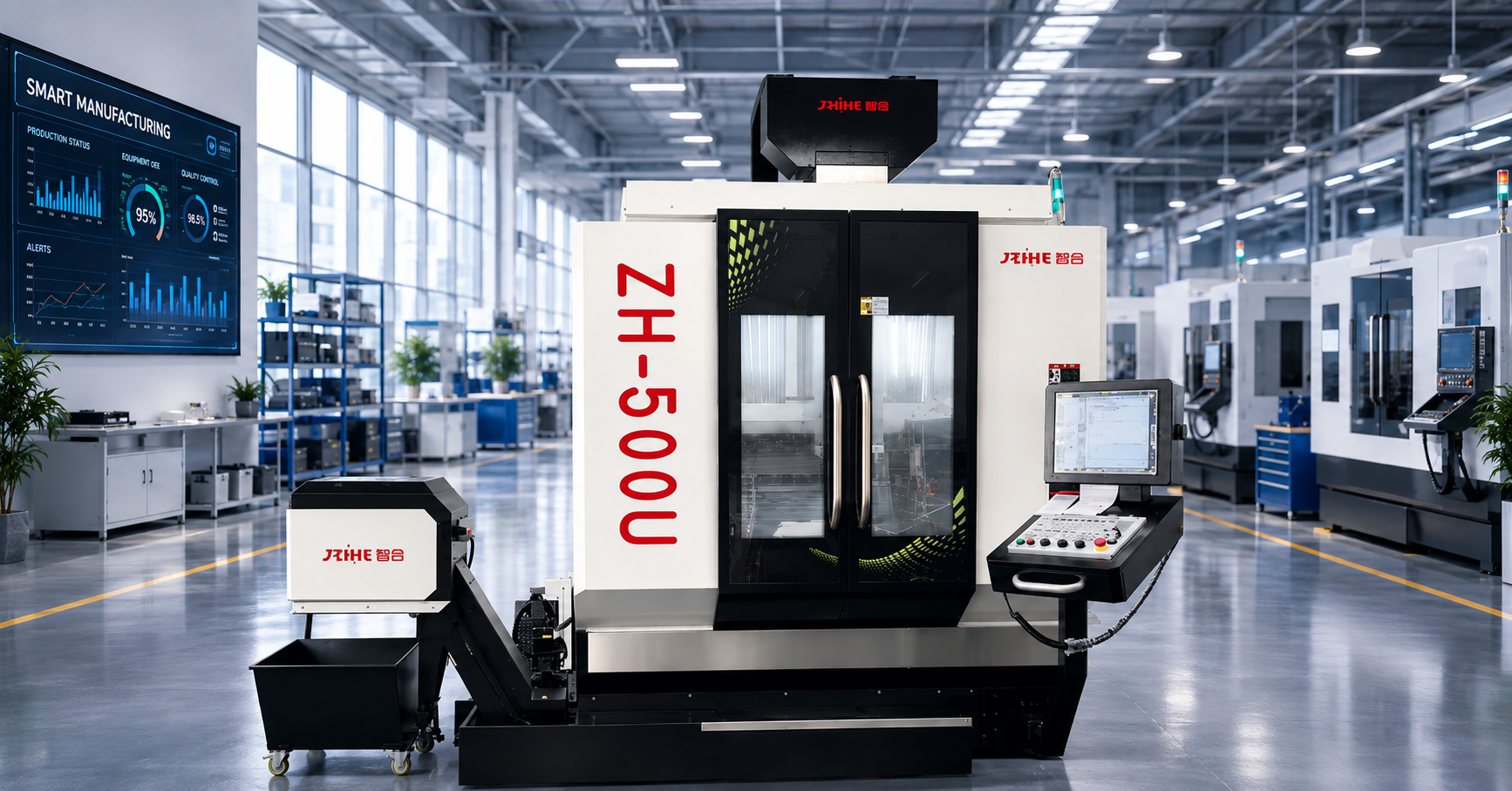
The ZH-500U product page describes the machine as ideal for high-mix, low-volume production demanding complex contour accuracy and single-setup efficiency. It also lists applicable materials including aluminum alloys, titanium alloys, stainless steel, superalloys and engineering plastics.
That positioning makes the machine relevant for buyers who need flexibility, not just capacity.
Why High-Mix Low-Volume Production Changes the Buying Logic
In mass production, the buyer may optimize around one part, one fixture, one tool list and one stable cycle. In high-mix low-volume work, the situation is different.
Parts change. Materials change. Surface requirements change. Setup time becomes more visible. Programming quality matters. Fixturing must be adaptable. Operators need to move from one job to another without losing control of accuracy.
A general machine may handle some of this work, but repeated repositioning can become expensive. Every time a part is unclamped and moved, the risk increases. For complex parts, that risk may be greater than the cost of machine time.
A 5-axis CNC machining center helps when it allows more surfaces to be completed in one clamping. The ZH-500U uses a trunnion table with A-axis ±110° and C-axis 360°, which supports multi-angle access and 5-side machining.
For buyers, this means the machine may reduce the number of setups across many different part types. That is often where the real value appears.
Matching Materials to Machine Capability
The ZH-500U product page lists applicable materials as aluminum alloys, titanium alloys, stainless steel, superalloys and engineering plastics. That range matters because high-mix shops often do not work with only one material.
Each material creates different priorities:
| Material | Buyer Concern | Machine Requirement |
|---|---|---|
| Aluminum alloys | Fast cutting, chip evacuation, surface finish | High spindle speed and chip flushing |
| Titanium alloys | Heat, deformation, tool wear | Stable motion, rigidity and correct cutting strategy |
| Stainless steel | Work hardening and tool load | Rigidity and coolant planning |
| Superalloys | Difficult cutting and tool life | Process discipline and machine stability |
| Engineering plastics | Burrs, heat and surface quality | Clean cutting and suitable parameters |
The buyer should not assume one process fits all materials. A capable 5-axis machining center gives flexibility, but process planning still needs to be specific.
What Makes the ZH-500U Useful for Mixed Complex Components
The ZH-500U includes several configuration points that matter in flexible production:
| ZH-500U Feature | Buyer Benefit |
|---|---|
| 750 / 880 / 600 mm travel | Fits many medium-size complex parts |
| Ø500 mm trunnion table | Supports 5-side access for suitable workpieces |
| 300 kg table load | Allows a useful range of high-value components |
| 20,000 rpm BBT40 electric spindle | Supports finishing, contouring and precision machining |
| 20 kW spindle motor | Helps balance speed and cutting rigidity |
| 32-tool arm-type magazine | Supports multi-operation machining without constant tool changes |
| NSK C3-grade ball screw and Rexroth 45 mm ball linear guideways | Supports precision motion and stability |
| Spiral chip conveyor and chip cart | Helps manage chips in continuous work |
| Dual high-pressure water pumps | Supports chip flushing, especially in deep cavities |
These specifications are listed on the ZH-500U product page.
From the buyer’s side, the 32-tool magazine is especially important in high-mix work. A complex part may require roughing tools, finishing tools, drills, chamfer tools, ball end mills, and special cutters. If the tool magazine is too limited, the operator may interrupt jobs more often.
Cost Is Not Only Machine Price
A 5-axis machine usually costs more than a simple vertical machining center. Buyers know this. The harder part is judging whether the machine reduces enough hidden cost to make sense.
Hidden costs in complex parts production include:
- Multiple setup labor
- Re-clamping error
- Extra inspection
- Tool breakage
- Secondary polishing
- Scrap from datum mismatch
- Slow cycle time
- Operator waiting time
- Fixture redesign
- Lost high-value orders
A 5-axis CNC machining center can help reduce some of these costs, but only when the part mix actually benefits from 5-axis access.
The ZH-500U’s 5G cavity filter case shows this clearly. The reported result was cycle time reduced from about 65 minutes to 38 minutes, efficiency increased by 42%, yield improved from 82% to 96%, tool consumption cost reduced by 60%, and secondary polishing eliminated after surface roughness improved to Ra0.8.
Its aerospace impeller case also shows cost impact: cycle time reduced from about 120 minutes to 78 minutes, yield improved from 75% to 94%, and per-piece processing cost reduced by 28%.
For buyers, these examples show how a machine investment should be evaluated: not only purchase price, but production improvement.
Acceptance Matters More in Flexible Production
When a machine will process different parts and materials, acceptance should not be vague.
The ZH-500U page lists inspection equipment including laser interferometer, ballbar and arc-second calibrator. It also outlines a trial cutting protocol with pre-acceptance trial cutting at the supplier’s facility and final acceptance trial cutting after delivery, installation and commissioning at the buyer’s facility.
This is important because high-mix buyers need confidence before the machine enters production. Trial cutting can help verify:
| Verification Area | Why It Matters |
|---|---|
| Workpiece fit | Confirms clearance and fixture practicality |
| Rotary accuracy | Checks real angular machining behavior |
| Surface finish | Shows whether finishing meets expectations |
| Chip evacuation | Reveals deep cavity or pocket problems |
| Tool list | Confirms whether magazine capacity is enough |
| Cycle time | Helps calculate production value |
| Operator workflow | Shows loading, unloading and setup issues |
A buyer should not accept only a static machine inspection if the real production challenge is process-based. The trial part should represent the actual job as closely as possible.
Supplier Support: What Buyers Should Confirm
High-mix low-volume production often requires more technical communication than repeat mass production. Buyers may need help with model selection, setup advice, trial cutting, installation, training, maintenance and spare parts.
The ZH-500U page lists on-site installation and commissioning by supplier engineers, free on-site training for 2–3 days, a 12-month warranty from final acceptance, a standard tool kit, and long-term genuine spare parts supply.
For buyers, that support should be discussed in practical terms:
- Who installs the machine?
- What foundation and lifting assistance must the buyer prepare?
- What training is included?
- What parts are included in the standard tool kit?
- How fast can spare parts be supplied?
- What is excluded from warranty?
- What happens if trial cutting fails acceptance requirements?
- What documentation is provided?
These questions may feel less exciting than discussing spindle speed, but they affect the real ownership experience.
When a 5-Axis Machine Is Worth It
A 5-axis CNC machining center is not always the right answer. Buyers should be honest.
It becomes worth considering when the shop has several of these conditions:
| Condition | Why 5-Axis May Help |
|---|---|
| Multiple setup operations | Reduces clamping and datum error |
| Complex curved surfaces | Improves tool access |
| Angled holes or side features | Reduces manual repositioning |
| High-value materials | Lowers scrap risk |
| Tight surface relationships | Protects geometry |
| Small batches with complex parts | Reduces setup burden |
| Frequent part changes | Supports flexible production |
| Need for higher-value orders | Expands capability |
If the shop mostly runs simple plates, low-tolerance brackets or basic one-side drilling, a 5-axis machine may be unnecessary.
But if the buyer is trying to move into complex components, precision molds, aerospace work, medical devices or high-value contract machining, the investment may be easier to justify.
Common Mistakes Buyers Should Avoid
One mistake is buying five axes without a part strategy. The machine should support a real part family, not only a future idea.
Another mistake is underestimating programming and fixture preparation. Five-axis work depends on CAM planning, collision checking and smart clamping.
A third mistake is ignoring tool magazine capacity. High-mix jobs may require a broader tool list than expected.
Some buyers also compare only purchase price. That misses the bigger picture. The real question is whether the machine reduces rework, setup time, scrap and inspection burden enough to improve total cost.
Finally, do not skip acceptance planning. A 5-axis machine should be accepted through measured accuracy and trial cutting, not only visual inspection.
FAQ
What does high-mix low-volume production mean?
It means the shop produces many different part types in smaller batches. Flexibility, setup efficiency and process stability become especially important.
Why is the ZH-500U relevant for this type of production?
The product page states that it is ideal for high-mix, low-volume production requiring complex contour accuracy and single-setup efficiency.
What materials can the machine process?
The product page lists aluminum alloys, titanium alloys, stainless steel, superalloys and engineering plastics as applicable materials.
What should buyers check before ordering?
Check part fit, rotary axis accuracy, spindle suitability, tool capacity, fixture method, chip evacuation, trial cutting protocol, installation support, warranty and spare parts availability.
Is trial cutting necessary?
For complex parts, yes. Trial cutting helps confirm whether the machine can produce the buyer’s actual workpiece with acceptable accuracy, surface finish, chip control and cycle time.
Conclusion
A 5-axis CNC machining center for high-mix low-volume production should be evaluated through the buyer’s real workflow. The machine must handle different materials, changing parts, complex contours, reduced setups, trial cutting, and production support.
The ZH-500U provides a strong reference for this type of purchasing decision. Its trunnion table, A-axis ±110°, C-axis 360°, 20,000 rpm BBT40 electric spindle, 32-tool magazine, precision drive components, chip management system, inspection process, trial cutting protocol, and commercial support terms are all relevant to buyers who need flexible complex-part machining.
For sourcing teams, the smartest next step is to prepare real part data. Send drawings, material, tolerances, surface requirements, current process problems and expected output. A serious machine recommendation should be built around that information, not around a generic machine category.